
News
-
The Media Change & Innovation Division team has recently published new peer-reviewed journal articles on the Transhumanist Anthropocene, content creators’ belief systems and enchanted sensemaking, and causal evidence of the chilling effects of dataveillance.
You can access the publications here:
- Schütze, Paul / Latzer, Michael (2026): The Transhumanist Anthropocene: From the climate crisis to upgrading humanity. The Anthropocene Review. Advance online publication. https://doi.org/10.1177/20530196261453840 [pdf]
- Jaramillo-Dent, Daniela / Latzer, Michael (2026): Exploring content creators' belief systems within their social media ecosystems. Dialogues on Digital Society. Advance online publication. https://doi.org/10.1177/29768640261439170
- Jaramillo-Dent, Daniela / Latzer, Michael (2026): Enchanted sensemaking among content creators. Information, Communication & Society. Advance online publication. https://doi.org/10.1080/1369118X.2026.2670731 [pdf]
- Festic, Noemi / Büchi, Moritz / Latzer, Michael / Odermatt, Céline (2026): Dataveillance inhibits legitimate communication: causal evidence for chilling effects. Journal of Communication, 1-13. https://doi.org/10.1093/joc/jqag004 [pdf]
-
New publications on techno-religion, human augmentation technologies, internet use in Switzerland
18th February 26The Media Change & Innovation Division team has recently published new peer-reviewed journal articles on techno-religion and human augmentation technologies, as well as the English versions of the four research reports from the World Internet Project – Switzerland 2025.
You can access the full publications here:
Latzer, M. (2026). Digitalization, AI and the rise of techno-religion: Transhumanist promises and the challenge to Enlightenment. Telecommunications Policy, 50(2), 103115. https://doi.org/10.1016/j.telpol.2025.103115 [pdf]
Frascaria, G., Jaramillo-Dent, D., & Latzer, M. (2026). Adoption of Human Augmentation Technologies for Non-Medical Applications: A Systematic Review of Empirical Literature. International Journal of Human–Computer Interaction, 1–33. https://doi.org/10.1080/10447318.2026.2625258 [pdf]
Frascaria, G., Festic, N., & Latzer, M. (2026). Evolving User Profiles and Adoption of Cyborg Technologies: Evidence from a Repeated Cross-Sectional Study in Switzerland. In Proceedings of the 2026 CHI Conference on Human Factors in Computing Systems, CHI ’26 (pp. 1-13). https://doi.org/10.1145/3772318.3790952 [pdf]
World Internet Project – Switzerland 2025 (English research reports):
- Internet Diffusion and Digital Divides in Switzerland 2025
- Use of the Internet and Generative AI in Switzerland 2025
- Trust and Concerns When Using the Internet in Switzerland 2025
- The Transforming Relationship Between Humans and Technology: Convergent Technologies and Digital Everyday Religion in Switzerland 2025
-

Our team member Daniela Jaramillo-Dent was honored last Friday with the Best Seminar Award by the Department of Communication and Media Research (IKMZ) at the University of Zurich.
Daniela received the award for her spring-semester seminar “Content creators and social media ecosystems,” in recognition of her outstanding and dedicated approach to teaching. The award was presented during the IKMZ’s annual graduation ceremony.
This is not the first time Daniela’s teaching excellence has been praised; she also received the Best Lecture Award in 2023 for her spring lecture course “Digital Inequalities and Platforms.”
We congratulate her on this well-deserved achievement!
-
Generative AI is Taking Over Everyday Life in Switzerland: From Experimentation to Regular Use
6th November 25Switzerland is more digital than ever and artificial intelligence is increasingly becoming part of everyday life. However, not everyone benefits equally: while younger people spend more time online than they would like, older people, those with low digital literacy and non-users of AI are falling behind. Most people in Switzerland are concerned about AI and the next generation of technology – but those who use AI regularly are more optimistic. These are the latest findings from the World Internet Project (WIP-CH) – Switzerland 2025, a representative long-term study by the University of Zurich. The WIP-CH has been examining internet use in Switzerland since 2011 and is now presenting the data for 2025.
Switzerland is online like never before: in 2025, people aged 20 to 29 spend an average of 8.4 hours per day online. The Swiss online population spends an average of 5.7 hours online each day – three times as much as in 2011 (1.8 hours) and two hours more than before the Covid pandemic in 2019 (3.6 hours). This generally increases the importance of digital life: “In 2025, for the first time, the internet is more important than personal contacts for 20- to 29-year-olds – both for information and for entertainment,” says study director Michael Latzer. Especially social media platforms such as TikTok and Instagram play a central role in the daily lives of young people (used by 95% of 20- to 29-year-olds), and their use is also increasing among older generations (58% among those aged 70+). The digitalization of everyday life is progressing rapidly: two out of three transactions (65%) are cashless, 39% of products are purchased online, and a third of work that can be done remotely is carried out from home (33%).
Almost half of Switzerland uses generative AI regularly: an unprecedented spread
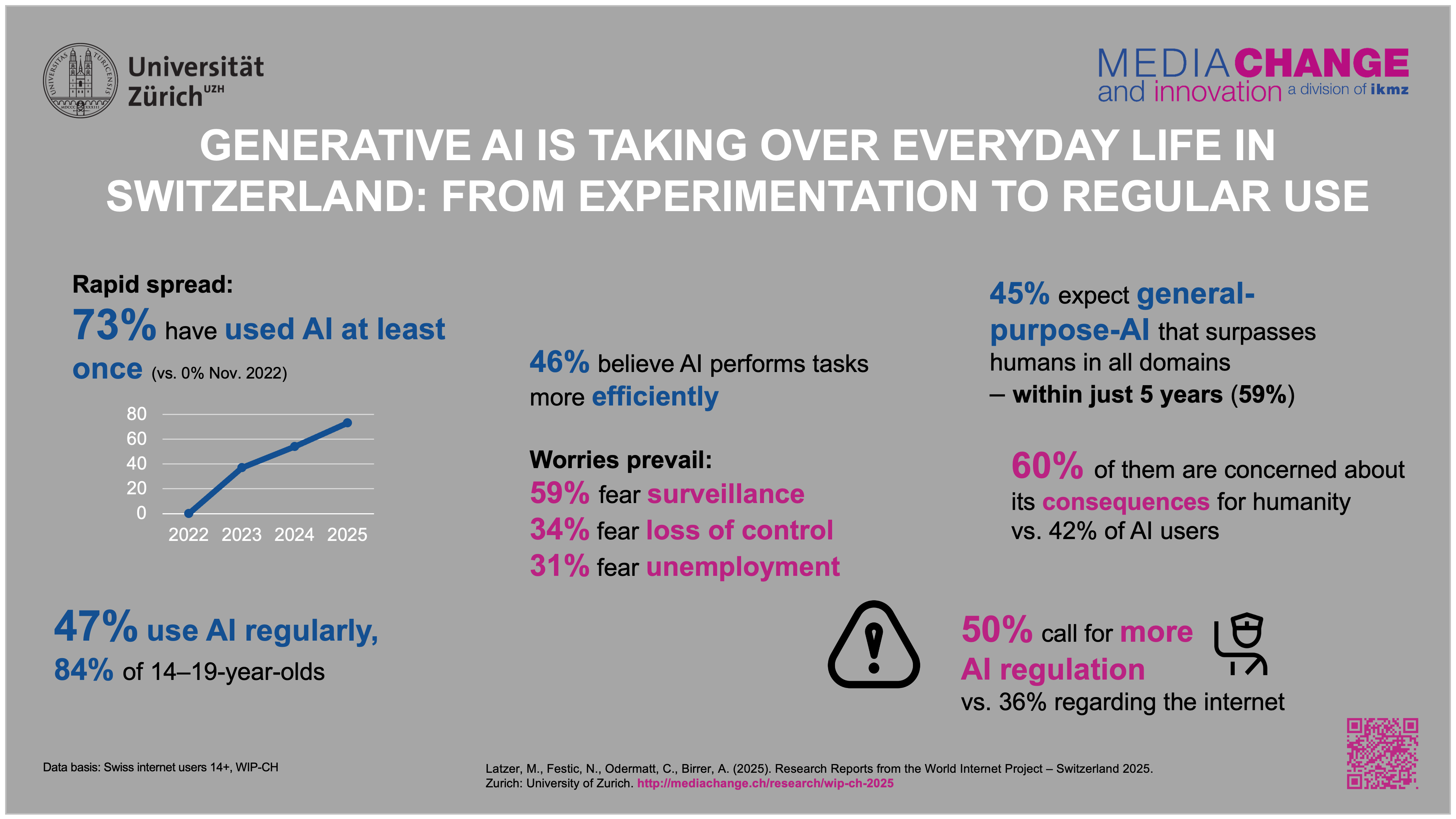
Since the launch of ChatGPT in November 2022, the share of the population that has used generative AI has risen sharply. The share of the population that has already used such applications rose at record speed from 37% in 2023 to 54% in 2024 and 73% in 2025. What began as one-time experimentation has turned into regular use: nearly half of the population (47%) uses generative AI at least once a month (weekly: 21%, daily: 17%), and among 14- to 19-year-olds, the figure is as high as 84%. “Actual AI use is considerably higher, as AI is increasingly integrated into everyday services such as search engines and chatbots, often without being noticed”, explains Michael Latzer.
Generative AI is most commonly used in education and work (53%), with two-thirds of 20- to 29-year-olds doing so (64%). Three in ten (34%) 14- to 19-year-olds say they use AI to create content they were actually supposed to produce themselves. For many regular AI users, AI has also already become an important advisor for everyday decisions, for example regarding finances and career choices (21% each, compared to 3–4% among non-users). Among 14- to 19-year-olds, AI plays an important role in financial (29%) and health-related decisions (28%). However, compared to traditional sources, the overall importance of generative AI and influencers remains low: when it comes to political decisions, only 7% consider AI-generated information important, compared to 27% who rely on classic internet sources. Despite widespread use, skepticism remains: although a large majority of regular users are convinced that AI helps them complete tasks more efficiently (71%), only one-third (35%) believes that AI will improve life overall.
Surveillance, loss of control, and job fears – Switzerland calls for AI regulation
The Swiss population is concerned about the potential risks of AI: six in ten people in Switzerland (59%) fear increased surveillance, and one in three worries that generative AI could spiral out of control and spell the end of humanity (34%) or lead to mass unemployment (31%). Younger internet users tend to see the opportunities offered by generative AI, while older users tend to see the risks: for those under 30, the focus is on completing tasks more efficiently (58%), while for those aged 30 and above, the main concern is that generative AI could be used to monitor private life (58–66%). Accordingly, the demand for regulation is strong: one in two (50%) calls for stricter rules on generative AI – significantly more than for the internet in general (36%). Regular AI users are less likely to demand this (42%).
Half of Switzerland believes in “Artificial General Intelligence” and is worried about it
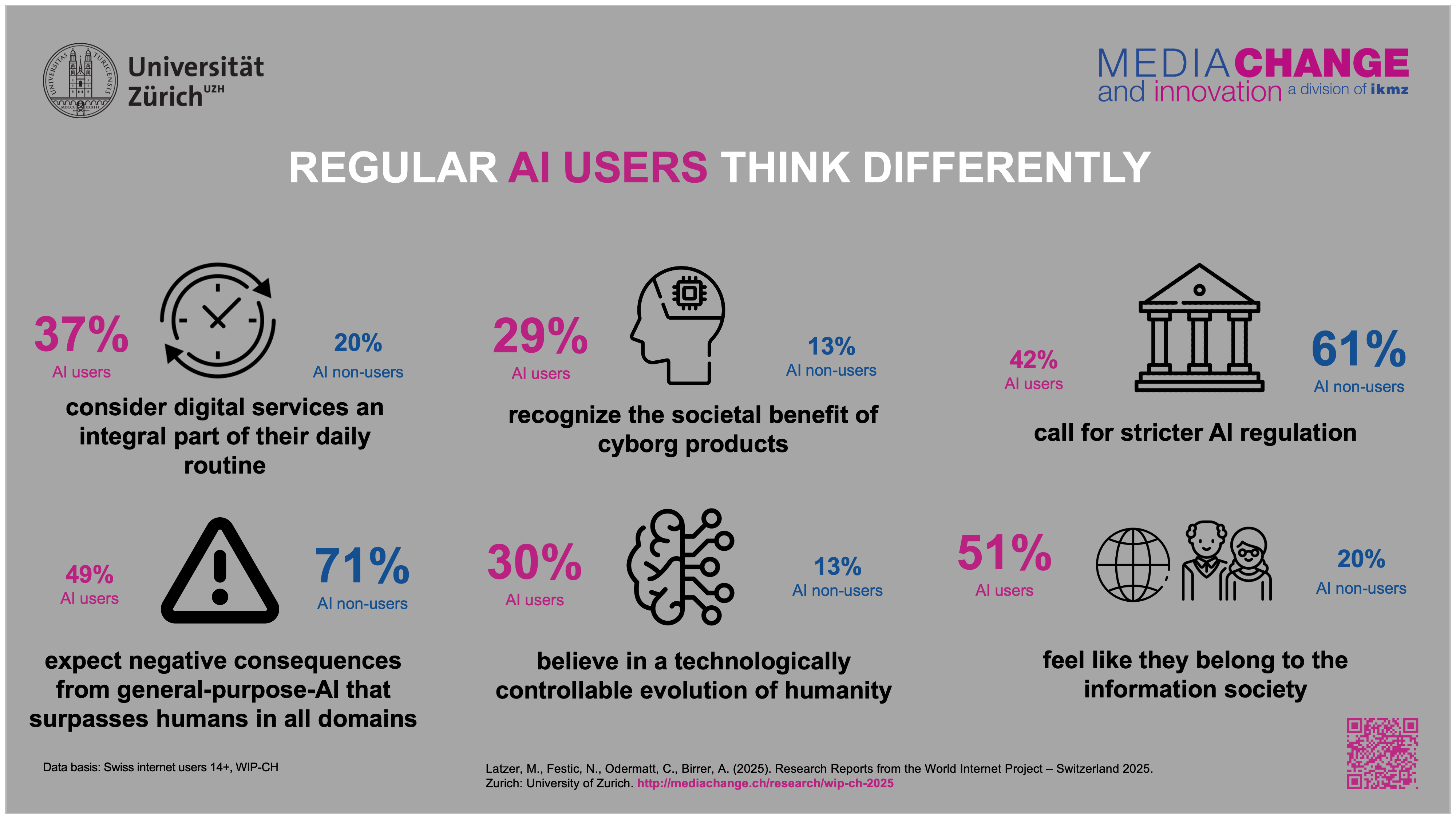
Almost half of Swiss internet users (45%) believe that generative AI will soon evolve into “Artificial General Intelligence” – a general-purpose application that surpasses humans in nearly all areas of life. More than half of them expect this to happen already within the next five years (59%). Those who use AI regularly are more likely to believe in the emergence of such “Artificial General Intelligence” (55%). However, this belief is accompanied by growing concerns about consequences: 60% of the population and 49% of AI users expect “Artificial General Intelligence” to have mostly negative effects on humanity. In contrast, attitudes toward the internet remain far more positive: 60% believe it is good for society.
Skepticism toward next generation of technology – risks of cyborg-products prevail
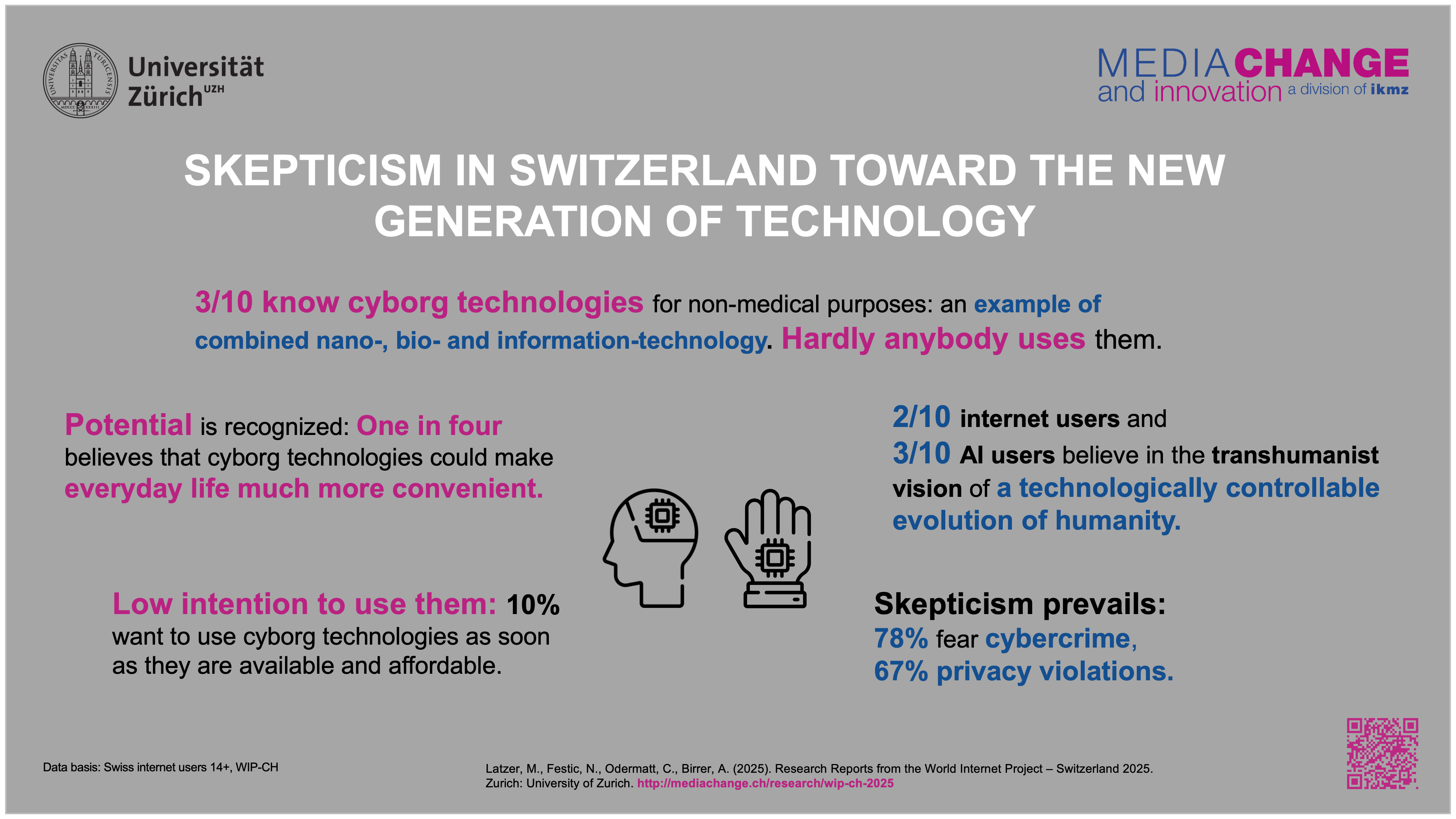
The next generation of technology combines internet-, bio-, and nanotechnologies with the aim of enhancing human abilities and overcoming biological limits – for example, through so-called cyborg products. While Silicon Valley has high hopes for such future technologies, the Swiss population remains skeptical: only one-fifth (21%) believes in this potential, rising to 30% among AI users. The majority, however, sees mainly risks, such as new forms of cybercrime (78%), privacy violations (67%), and social inequality (64%).
AI fuels digital divides: some lose time, others fall behind
Social divides in digitalization follow age and internet skills, reinforced by the use of AI. While 91% of 20- to 29-year-olds in Switzerland rate their internet skills as good to excellent, this applies to only 59% of those aged 70 and above. The difference is even more pronounced when it comes to generative AI: almost half of 14- to 19-year-olds (45%) feel comfortable using it, but only 20% of those aged 70 or older do. These differences are reflected in the sense of belonging to the information society. Only 34% of the population feel part of it, 25 percentage points less than in 2015. The sense of inclusion is particularly low among older people (19% among those 70+) and those with lower internet skills (14%), while 20- to 29-year-olds and people with high internet skills feel significantly more integrated (54% each). Those who use AI regularly feel more included (51% vs. 20% among non-users).
Digitalization also has its downsides: while older people and those who do not use AI risk being left behind, younger people and AI users struggle with digital overuse. More and more people now spend more time online than they would like (38% vs. 24% in 2019). Among 14- to 19-year-olds, 82% want to reduce their internet use time, as do 58% of AI users.

- News Release WIP-CH 2025 (in English)
- News Release WIP-CH 2025 (in German)
- News Release WIP-CH 2025 (in French)
- News Release WIP-CH 2025 (in Italian)
The full results can be accessed below in four research reports, 10 infographics, and 12 selected graphs.Research Reports 2025 in German (Themenberichte)

- Internetverbreitung und digitale Bruchlinien in der Schweiz 2025
- Nutzung von Internet und generativer KI in der Schweiz 2025
- Vertrauen und Sorgen bei der Internetnutzung in der Schweiz 2025
- Mensch-Technik-Beziehung im Wandel: Konvergierende Technologien und digitale Alltagsreligion in der Schweiz 2025
Research Reports in English
- Internet Diffusion and Digital Divides in Switzerland 2025
- Use of the Internet and Generative AI in Switzerland 2025
- Trust and Concerns When Using the Internet in Switzerland 2025
- The Transforming Relationship Between Humans and Technology: Convergent Technologies and Digital Everyday Religion in Switzerland in 2025
Infographics


- The digitalization of everyday life is overburdening young people (English / German)
- Generative AI is taking over everyday life in Switzerland: from experimentation to regular use (English / German)
- Increasing use of digital services in everyday life in Switzerland (English / German)
- Digitalization level before, during and after the Covid pandemic (English / German)
- Digitalization push raises concerns in Switzerland (English / German)
- The young and the old differ regarding generative AI (English / German)
- Regular AI users think differently (English / German)
- Skepticism in Switzerland toward the new generation of technology (English / German)
- Increasing self-censorship in Switzerland due to perceived online surveillance (English / German)
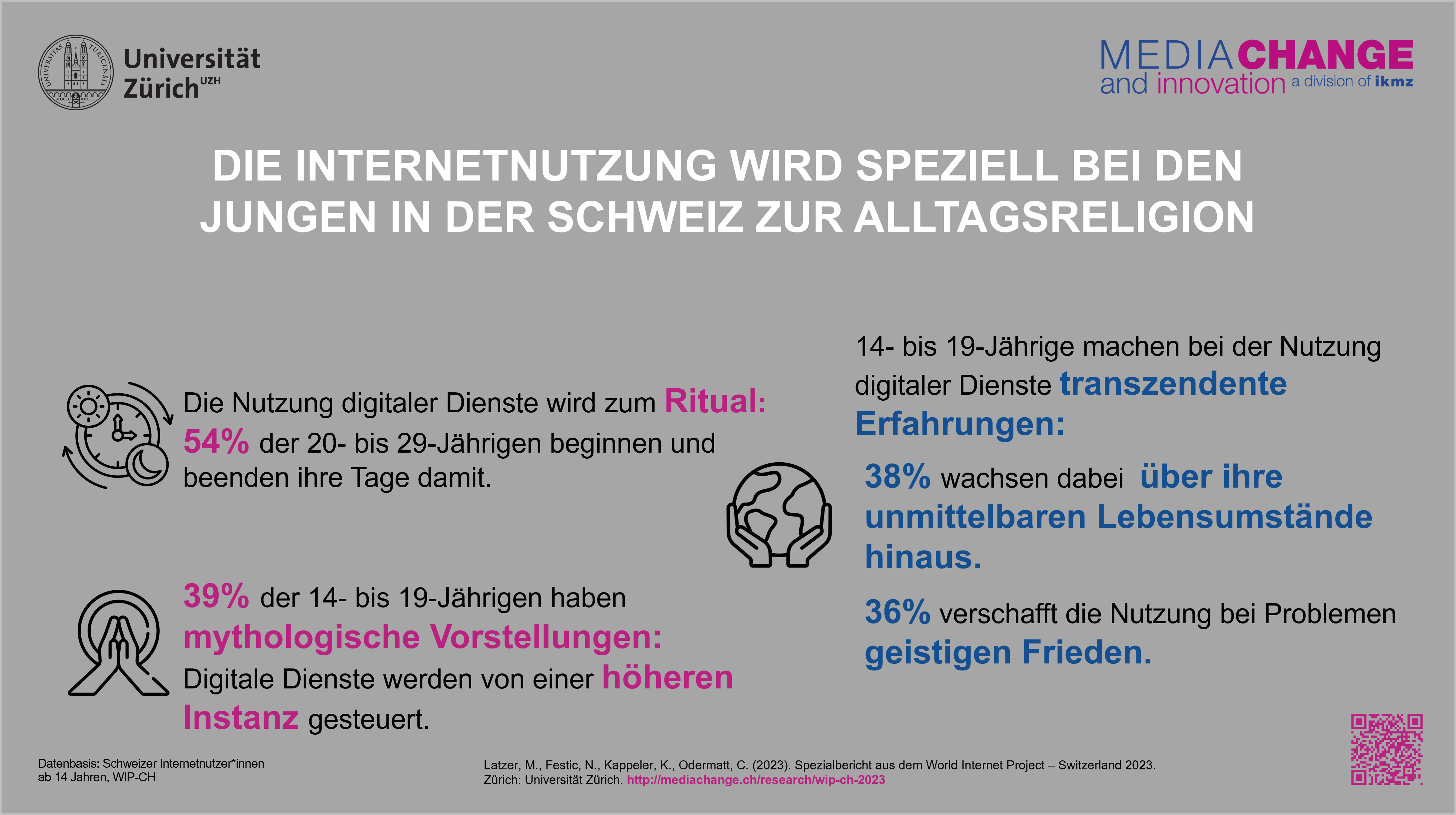
- Internet use is becoming an everyday religion especially among young people in Switzerland (English / German)
Selected Graphs
- Knowledge and Use of Generative AI Over Time, 2022–2025 (English / German)
- Knowledge and Regular Use of Generative AI by Age, 2025 (English / German)
- Use Purposes of Generative AI, 2025 (English / German)
- Assessment of Risks and Opportunities of Generative AI, 2025 (English / German)
- Assessment of Selected Risks und Opportunities of Generative AI by Age, 2025 (English / German)
- Assessment of Risks and Opportunities of Generative AI by Use, 2025 (English / German)
- Belief in the Emergence of General Artificial Intelligence, 2025 (English / German)
- Average Daily Internet Use Time over Time 2011–2025 (English / German)
- Desire to Reduce Internet Use Time by Age, 2025 (English / German)
- Sense of Belonging to the Information Society by Internet Skills Over Time 2015–2025 (English / German)
- Perceived Benefits of the Internet and Converging Technologies Over Time 2023–2025 (English / German)
- Indicators of Transhumanist Belief, 2025 (English / German)
Icons made by Freepik, Ehtisham Abid, monkik and juicy_fish from www.flaticon.com
-
Vortragsreihe: Wie Digitalisierung und Künstliche Intelligenz unsere Gesellschaft verändern
8th September 25Wir freuen uns, die öffentliche Vortragsreihe „Wie Digitalisierung und Künstliche Intelligenz unsere Gesellschaft verändern“ anzukündigen und Sie herzlich dazu einzuladen. Diesen Herbst begrüssen wir jeden Dienstag um 14:15 Uhr Gastreferentinnen und -referenten.*
Die Vortragsreihe beleuchtet die enge Verbindung zwischen Medienwandel und gesellschaftlichem Wandel, mit besonderem Fokus auf die fortschreitende Digitalisierung der Gesellschaft und auf Künstliche Intelligenz (KI).
Jede Woche teilen internationale Expertinnen und Experten sowie Referierende der Abteilung Media Change & Innovation (IKMZ) Erkenntnisse aus ihrer Forschung und diskutieren aktuelle Fragen. Die Themen reichen von religionsähnlichen, transhumanistischen Verheissungen und Praktiken der Digitalisierung und KI, über Sinnkonstruktion bei Influencerinnen und Influencern, die Transformation des Menschseins durch Cyborgisierung, die abschreckenden Effekte von Dataveillance (Datenüberwachung), bis hin zu Auswirkungen auf Anthropozentrismus und das Anthropozän und noch vieles mehr.
Die öffentliche Vortragsreihe wird von der Abteilung Media Change & Innovation am Institut für Kommunikations- und Medienforschung (IKMZ) gemeinsam mit dem Center for Information Technology, Society, and Law (ITSL) organisiert und ist in die wöchentliche BA-Vorlesung von Prof. Dr. Michael Latzer integriert. Die Veranstaltung steht allen Interessierten offen.
Ort: Affolternstrasse 56, 8050, Zürich
Raum: AFL-F-121
Zeit: Jeden Dienstag um 14:15 - 15:45 Uhr
Vollständiges Programm
* Presentations will be held in German or English, according to the title.
-
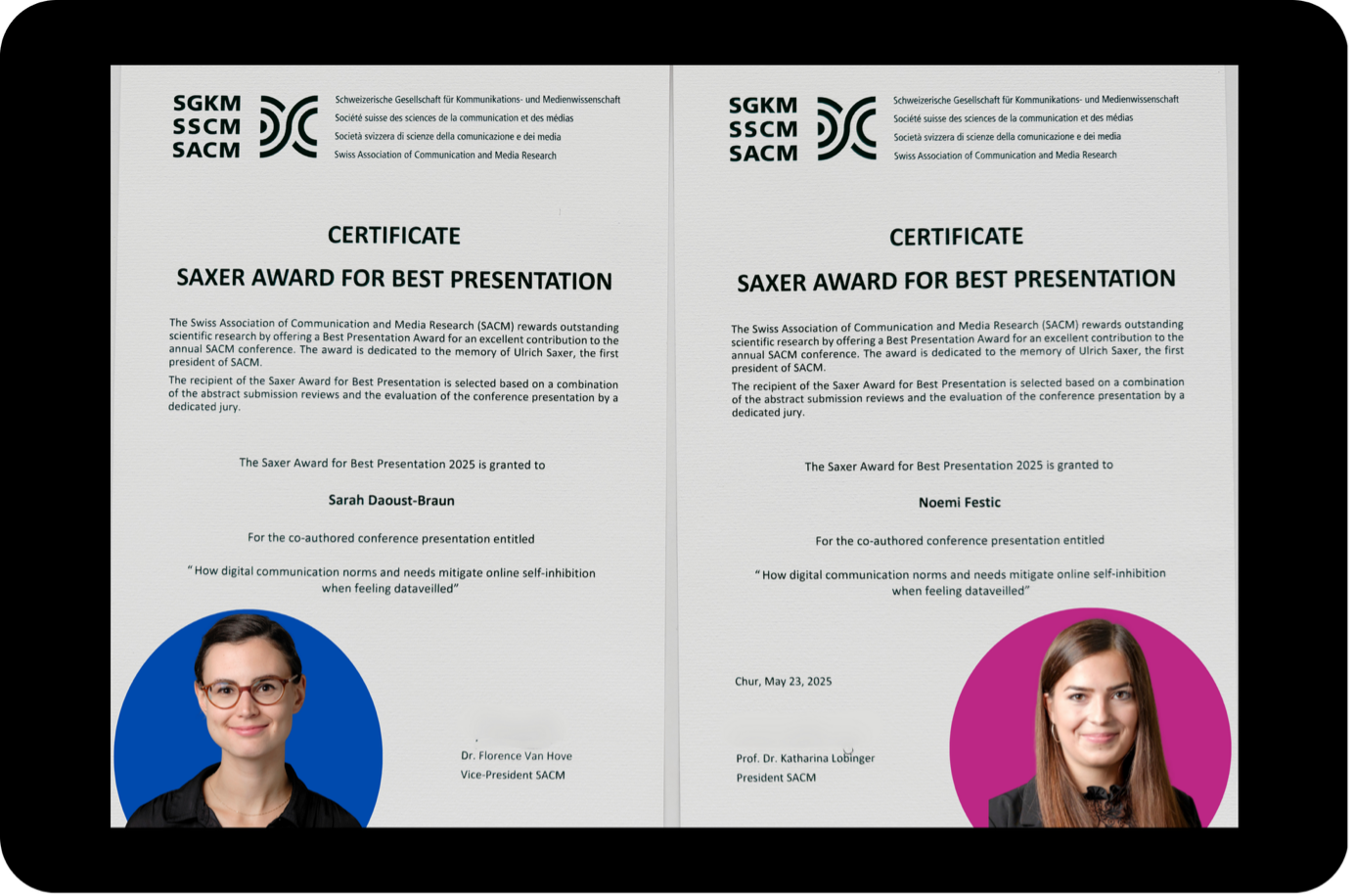
We are proud to celebrate two special recognitions awarded at the 2025 Swiss Association of Communication and Media Research (SACM) Annual Conference last week in Chur.
Our team members Sarah Daoust-Braun and Noemi Festic received the Saxer Award for Best Presentation for their work on how motives for digital communication mitigate the chilling effects of dataveillance. This research is part of the Media Change & Innovation Division’s project The Chilling Effects of Dataveillance: Conceptual Advances and Empirical Evidence for Switzerland, funded by the Swiss National Science Foundation.
Our former team member Kiran Kappeler, now a postdoctoral researcher at the Center for Tracking and Society at the University of Copenhagen, was also honored with the Dissertation Award for her outstanding cumulative dissertation entitled “Negotiating Digital Technology Use in the Highly Digitized Swiss Society – A Mixed-Method Analysis of the Digital Practices of Individuals.”
Kiran’s doctoral work is based on her collaboration in three Media Change & Innovation Division’s projects: The Chilling Effects of Dataveillance: Conceptual Advances and Empirical Evidence for Switzerland and The Significance of Algorithmic Selection for Everyday Life: The Case of Switzerland, both funded by the Swiss National Science Foundation, as well as the World Internet Project - Switzerland.
We warmly congratulate them for their well-deserved achievements! -
“Artificial Intelligence” in Switzerland 2024: Rapid Diffusion and Increasing Digital Inequality
21st November 24This report examines how the current technological developments in “Artificial Intelligence,” specifically generative AI based on large language models (e.g., tools like ChatGPT), have been integrated into the daily lives of the Swiss and what they think about them.
Rapid diffusion: Within a year and a half of launch, AI tools are known across Switzerland, with half the population and nearly all of the young using them
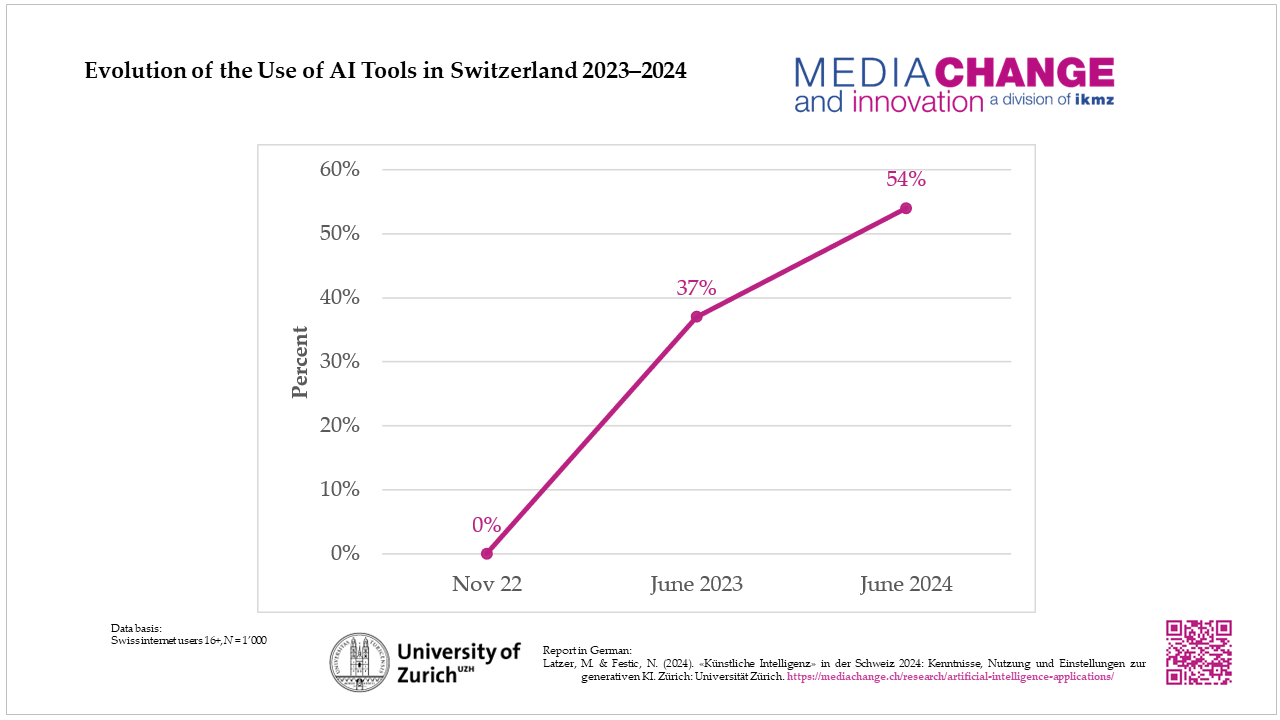
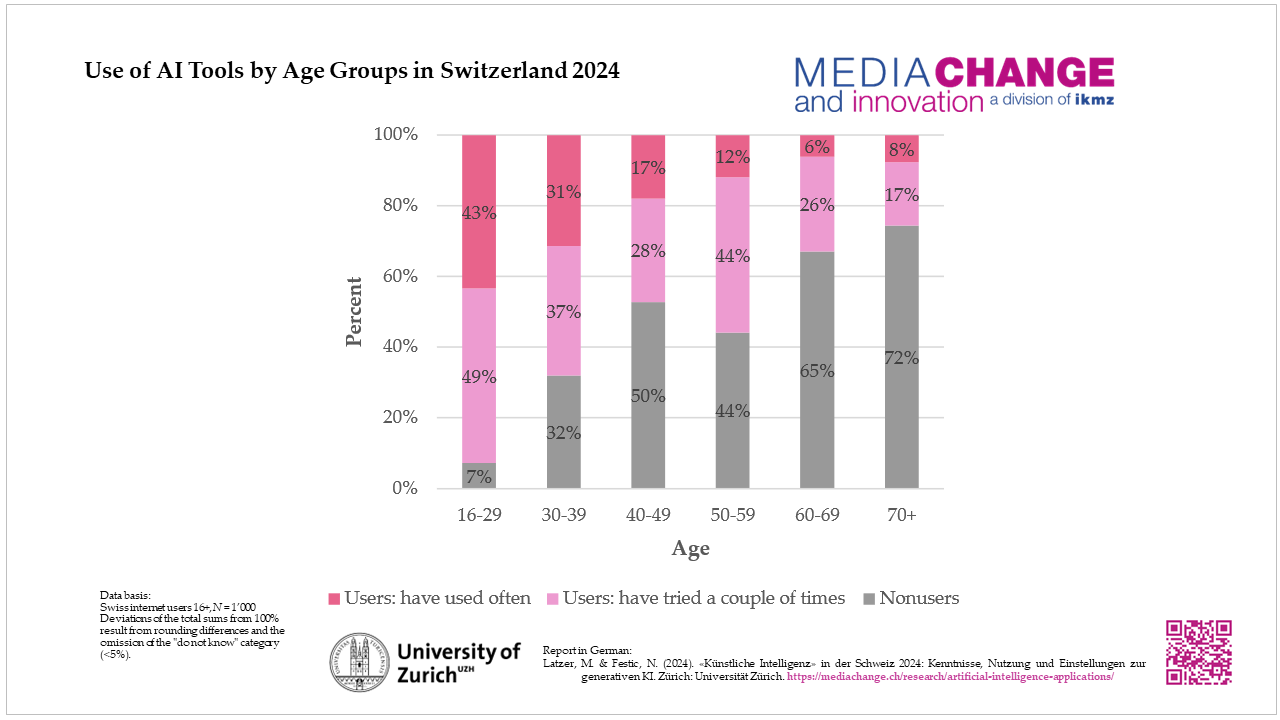
Nearly all Swiss internet users (98%) have heard of AI tools, a figure that has increased since 2023 (79%). Half of Swiss internet users (54%) have already used AI tools. Among the youngest age group, nearly everyone (93%) has tried AI tools, with 43% using them frequently. In contrast, in the oldest age group, only 8% use them frequently, while almost three-quarters (72%) have never used them. The use of AI tools has risen by 17 percentage points since mid-2023 (2024: 54%, 2023: 37%).
Digital inequalities in the Swiss society by age and education are amplified by Artificial Intelligence
Knowledge of AI tools is significantly higher among younger age groups (61% among the youngest vs. 7% among the oldest). Younger individuals are also much more likely to be AI users (ages 16–29: 93%, ages 70+: 24%). Additionally, the proportion of users rises sharply with increasing levels of educational attainment (low: 37%, medium: 42%, high: 70%).
Early signs of saturation; Incorrect information from AI tools is the main reason for non-use
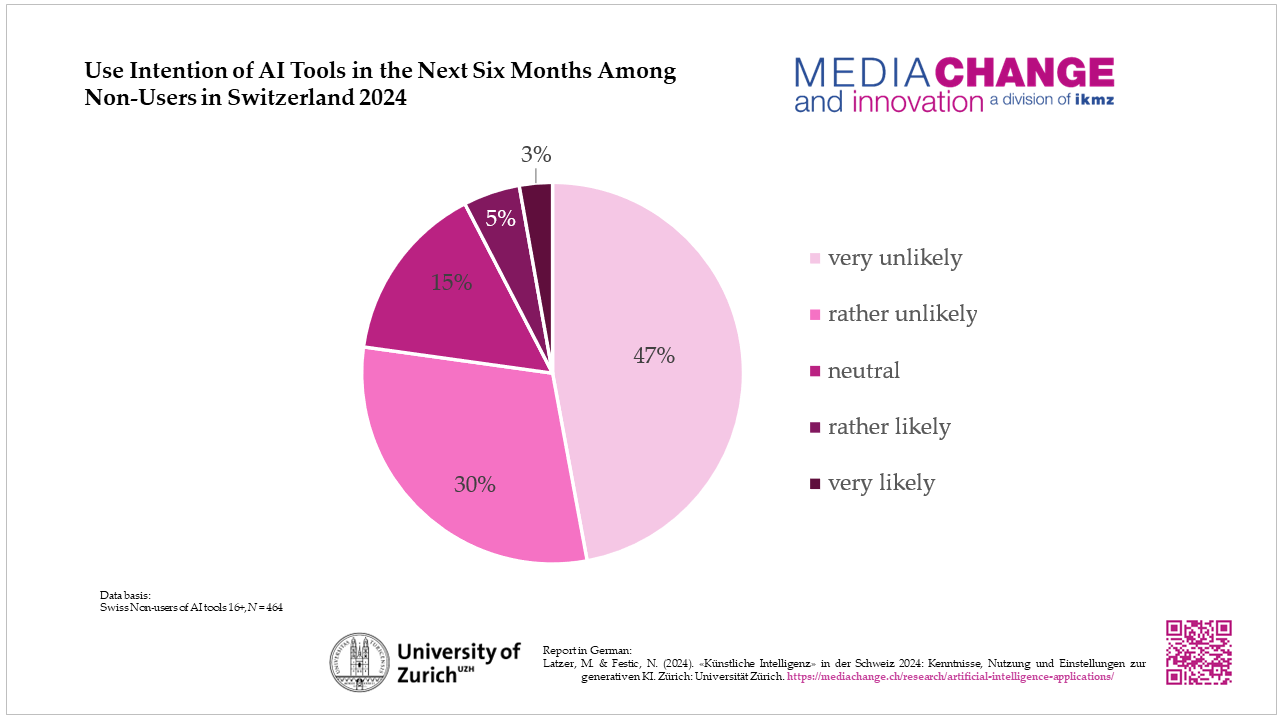
There appears to be a certain level of saturation in the adoption of AI tools: 77% of current non-users consider it (very) unlikely that they will use AI tools in the next six months. The most common reason for non-use is that "generative AI often produces incorrect information" (mean = 4.01). An almost equally important reason is that AI tools have little relevance to the daily lives of respondents (mean = 3.93).
Half of Swiss internet users are skeptical about children using AI tools; AI users, younger people, and men view it more positively
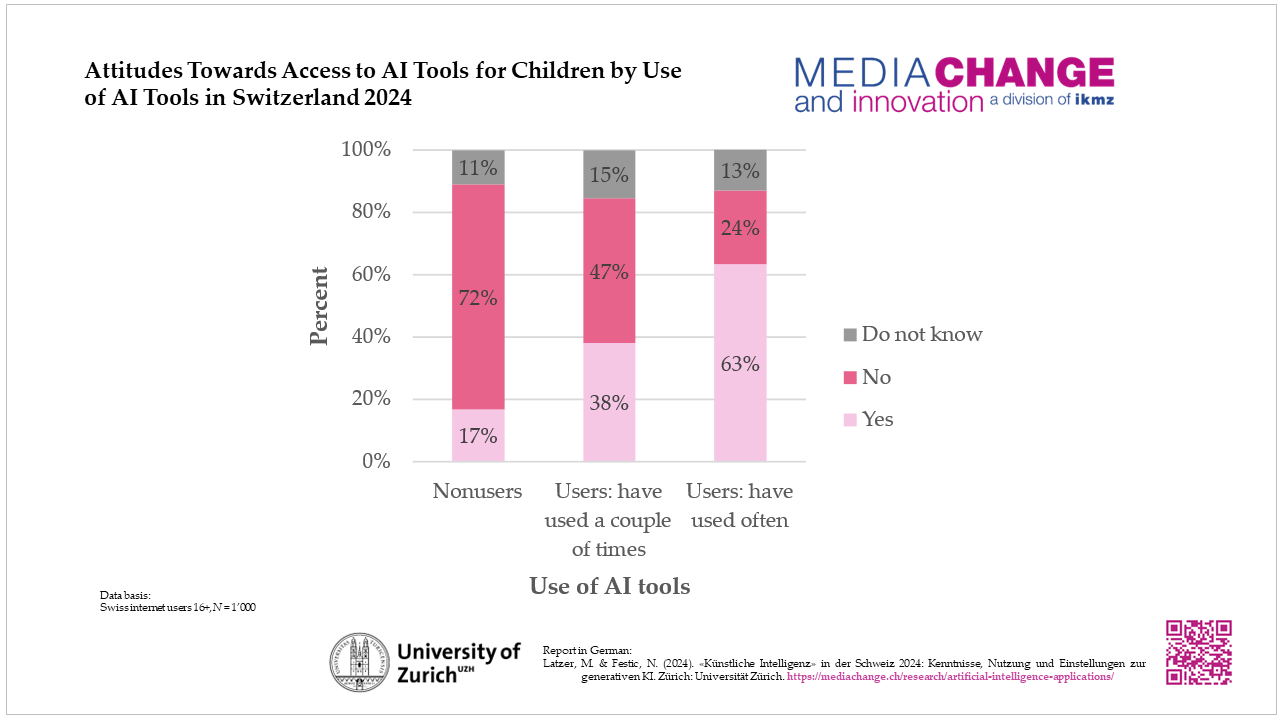
Half (54%) of Swiss internet users aged 16 and older believe that children should not have access to AI tools. A third (33%) support access, and 13% are undecided. Younger individuals, men, and AI users are more likely to support children using AI tools.
As part of the World Internet Project – Switzerland, we collaborated with the Swiss public broadcasting association (SRG) to collect nationally representative data on the use and implications of these AI tools. As part of their repeated “Wie geht’s, Schweiz?” survey that is concerned with the well-being of the Swiss population in various areas of life (politics, personal finances, work, relationships, etc.), the data was collected in May and June 2024.
The results are available in the report and the news release in German and English. The English version of the report will be published soon.
- «Künstliche Intelligenz» in der Schweiz 2024: Kenntnisse, Nutzung und Einstellungen zur generativen KI
- News Release “Artificial Intelligence” in Switzerland 2024 (in German)
- News Release “Artificial Intelligence” in Switzerland 2024 (in English)
Infographics
- Evolution of the Use of AI Tools in Switzerland 2023-2024 (English/German)
- Use of Al Tools by Age Groups in Switzerland 2024 (English/German)
- Use Intention of Al Tools in the Next Six Months Among Non-Users in Switzerland 2024 (English/German)
- Attitudes Towards Access to AI Tools for Children by Use of Al Tools in Switzerland 2024 (English/German)
-
Our team member Kiran Kappeler successfully defended her cumulative dissertation on July 10th. We warmly congratulate her on this significant accomplishment.
Her outstanding dissertation includes four peer-reviewed articles and is entitled “Negotiating Digital Technology Use in the Highly Digitized Swiss Society—A Mixed-Method Analysis of the Digital Practices of Individuals.”
Kiran has been working in the Media Change & Innovation Division as a Research and Teaching Associate since September 2019. She will continue her work as a Senior Research and Teaching Associate over the following months. We wish her great success in her next career steps.
-
Internet Use as Everyday Religion on the Rise, Cyborgization Still in its Early Stages
16th November 23
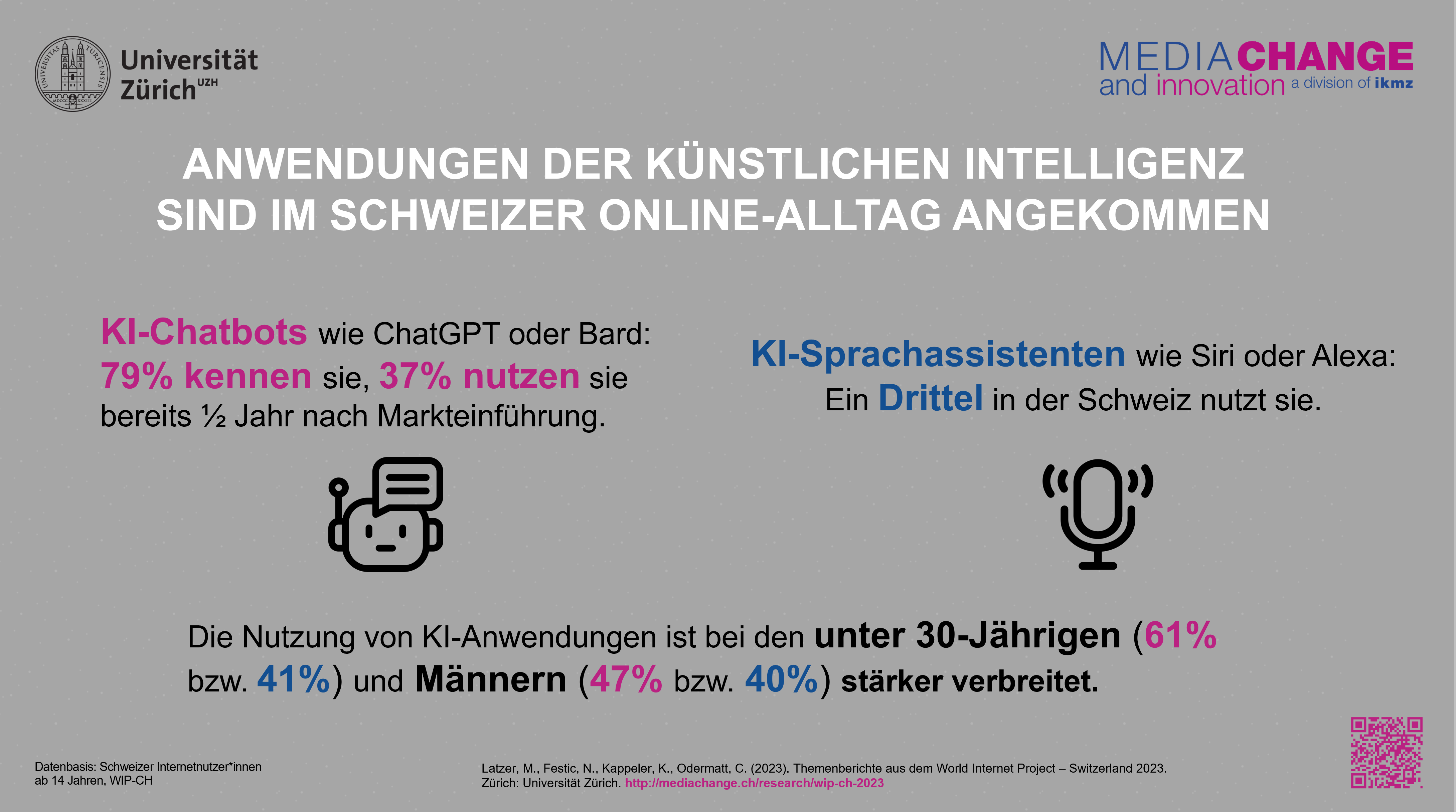
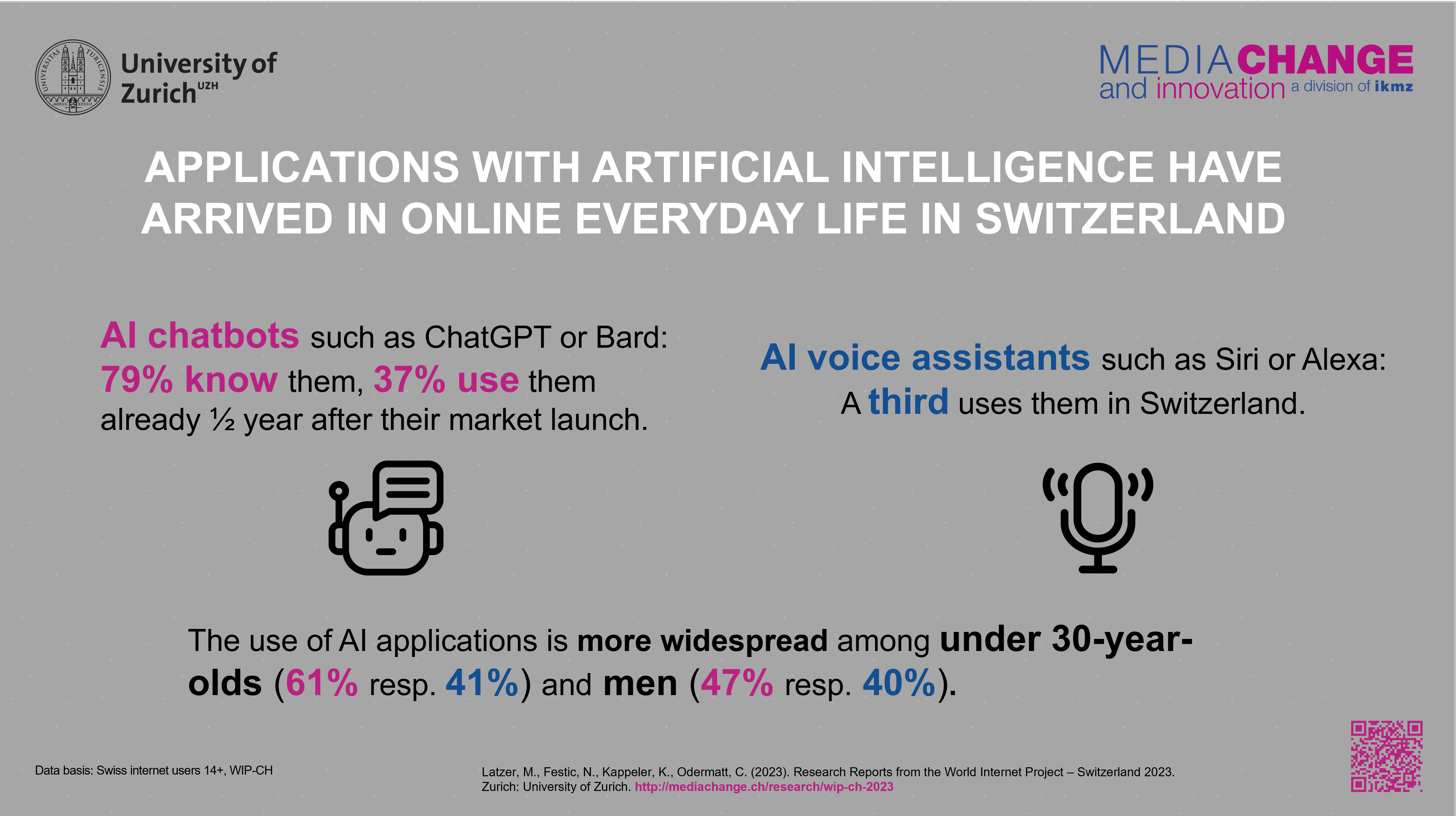
The next generation of digital technology is spreading in Switzerland: Artificial intelligence has already arrived, cyborg technologies for self-optimization have not yet. Especially among younger people, internet use is becoming an everyday digital religion. These are results of the World Internet Project – Switzerland 2023.Chatbots with artificial intelligence (AI) such as ChatGPT or Bard are already widespread in Switzerland: 8 in 10 internet users (79%) have already heard of them and half of those (37%) have already either tried (18%) or used them multiple times (19%). Younger and more highly educated people know of and use these services particularly often. “The high level of awareness and use of ChatGPT and similar AI applications is surprising, especially since they have only been available since the end of 2022,” emphasizes Michael Latzer, professor of Media Change and Innovation at the University of Zurich.
Clear indications of a religion-like digitalization
Digitalization is giving rise to a new social form of religion – an everyday digital religion. The everyday use of digital services fulfills similar social functions as traditional religions, e.g., reducing complexity, creating meaning or social cohesion. Just under a third of the population (30%) think that suggested content in social networks or health and well-being apps is controlled by an inexplicable, higher instance. For a quarter of the population (27%), internet use has become a kind of ritual: they start and end their day with it. Between 10% and 19% of internet users report transcendental experiences that exceed the usual boundaries of everyday life.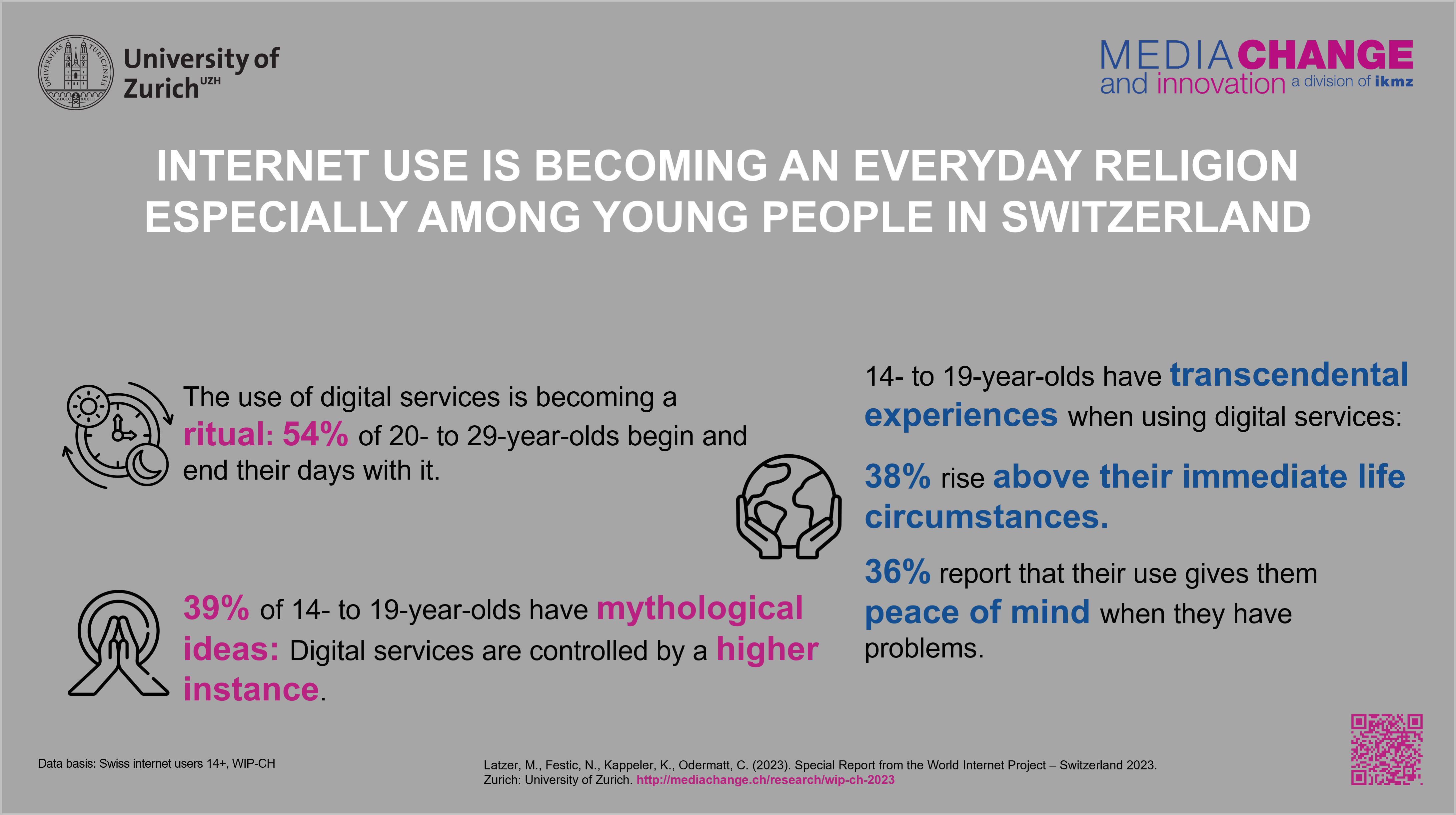
Cyborgization is still in its infancy
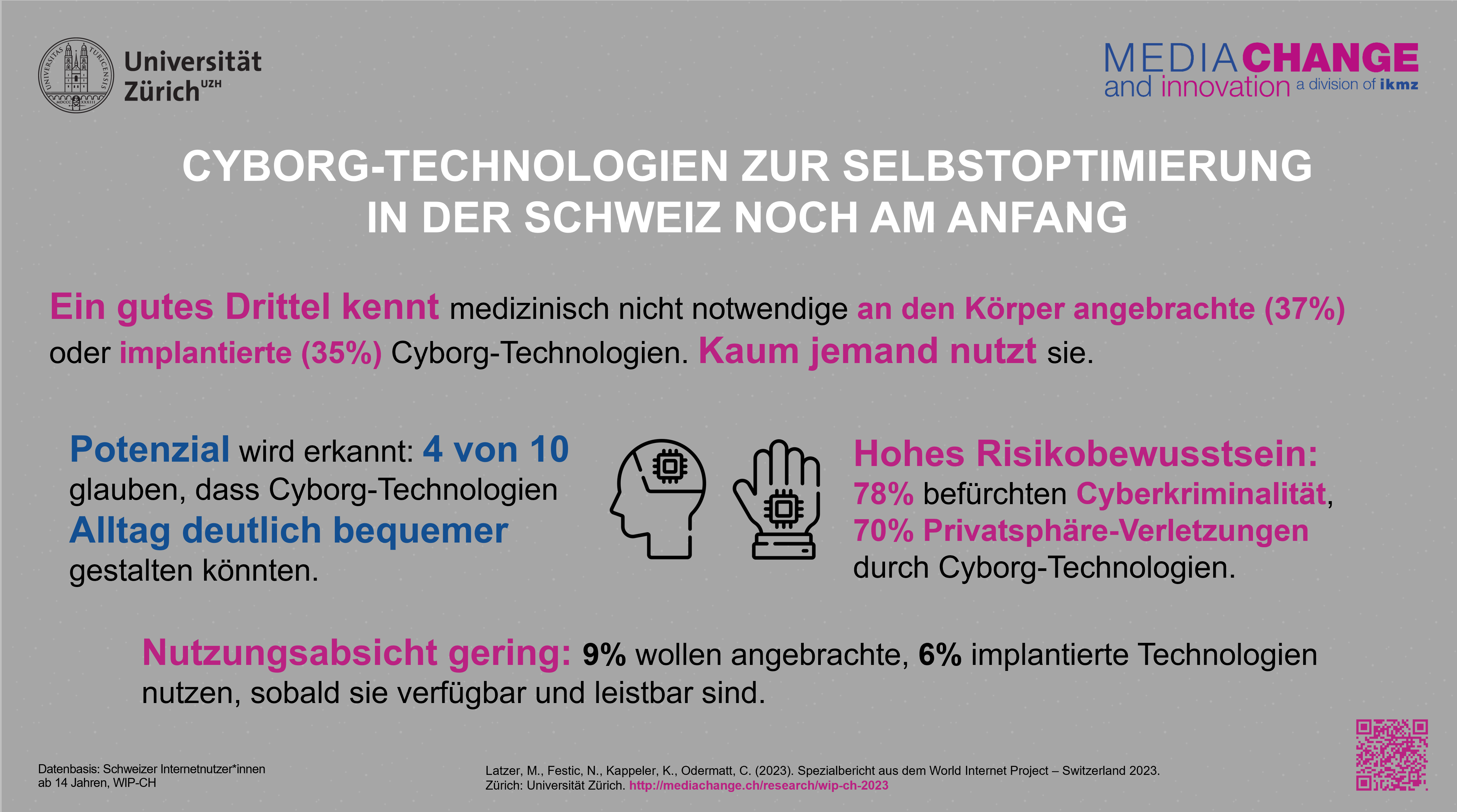
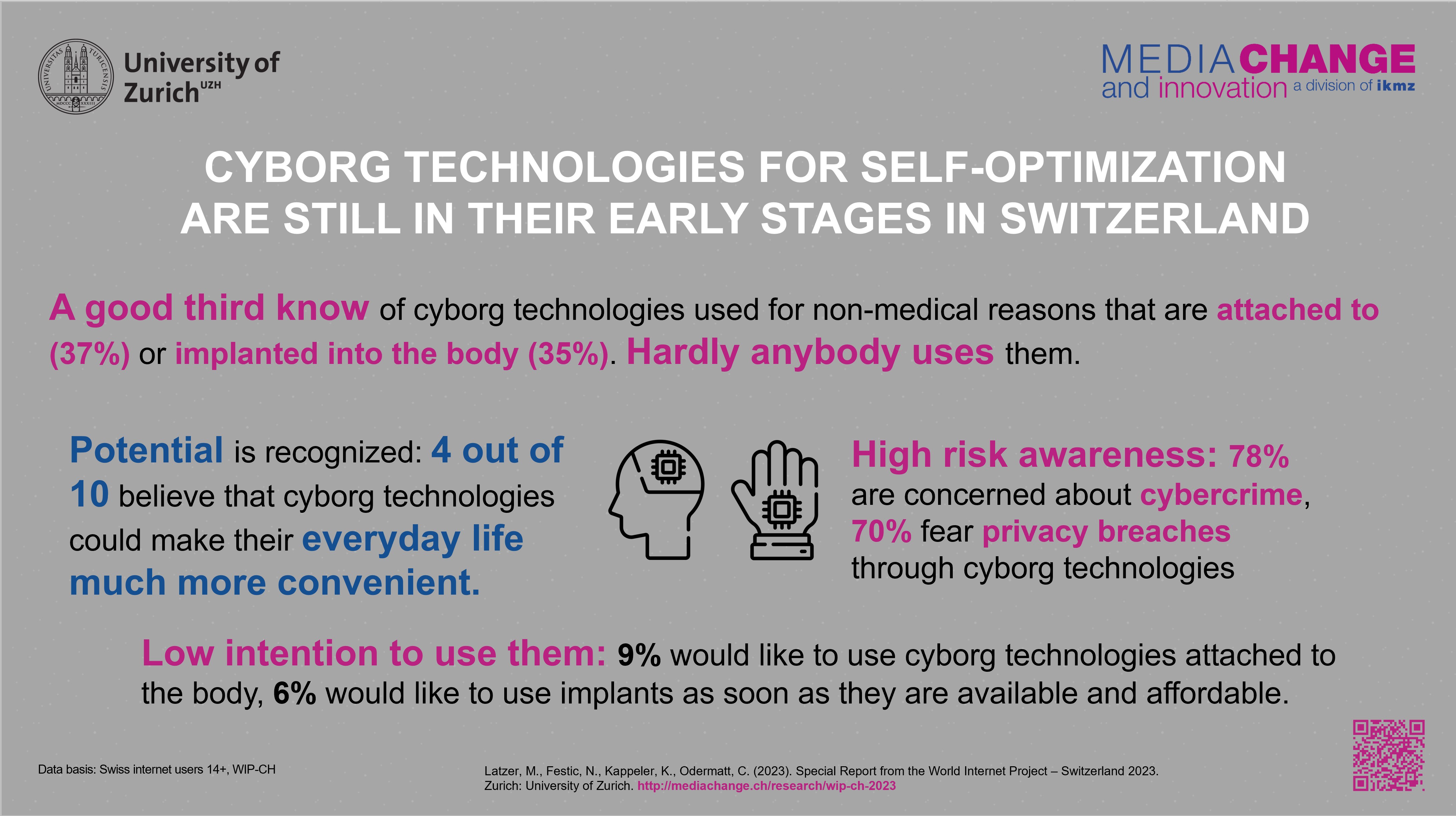
The merging of humans and technology known as cyborgization reinforces the religious nature of digitalization. Cyborg technologies are used to achieve transhumanist goals, i.e., overcoming human limitations and thus also reaching divine characteristics such as omniscience and eternal life. The study examines non-medically required cyborg technologies for self-optimization such as stick-on patches for electronic brain stimulation or chips implanted in the hand for making payments. They are used to improve physical and mental abilities, exceed biological limits and thereby increase longevity and well-being.A good third of the Swiss online population is familiar with cyborg technologies attached to the body (37%) or implanted in the body (35%). Their distribution is currently low and lies in the low single-digit percentage range. However, 4 out of 10 internet users believe that they could make their everyday life much more convenient by using them (39%). At the same time, there is a high level of risk awareness, particularly with regard to cybercrime (78%) and privacy breaches (70%).
- News Release WIP-CH 2023 (in English)
- News Release WIP-CH 2023 (in German)
- News Release WIP-CH 2023 (in French)
- News Release WIP-CH 2023 (in Italian)
The full results can be accessed below in four research reports (in German) and 6 infographics.Special Report 2023: Everyday digital religion and cyborgization
Research Reports 2023 (Themenberichte)
- Internetverbreitung und digitale Bruchlinien in der Schweiz
- Internetanwendungen und deren Nutzung in der Schweiz
- Vertrauen und Sorgen bei der Internetnutzung in der Schweiz
Infographics






- Internet use is becoming an everyday religion especially among young people in Switzerland (English / German)
- Applications with artificial intelligence have arrived in online everyday life in Switzerland (English / German)
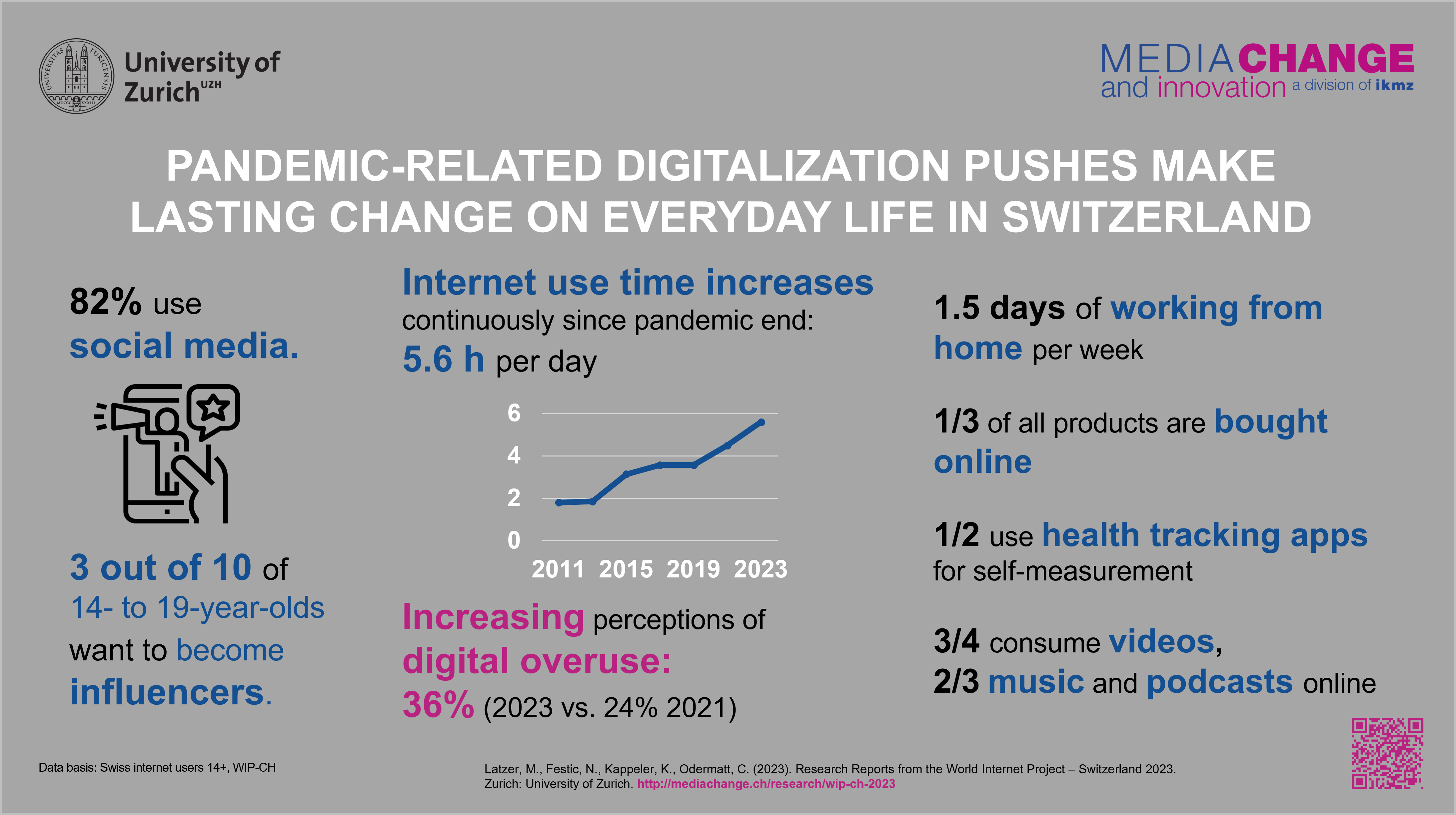
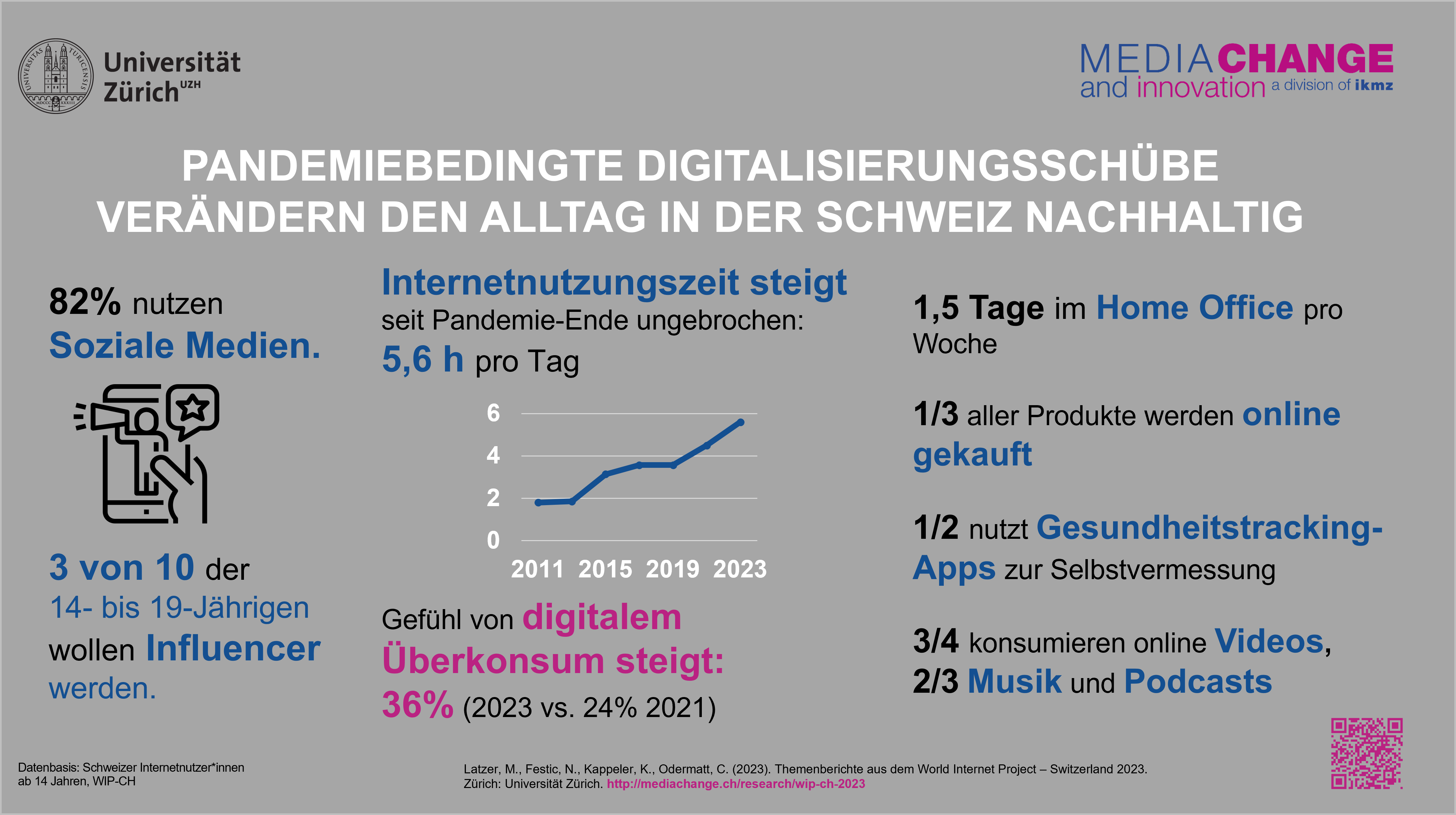
- Pandemic-related digitalization pushes make lasting change on everyday life in Switzerland (English / German)
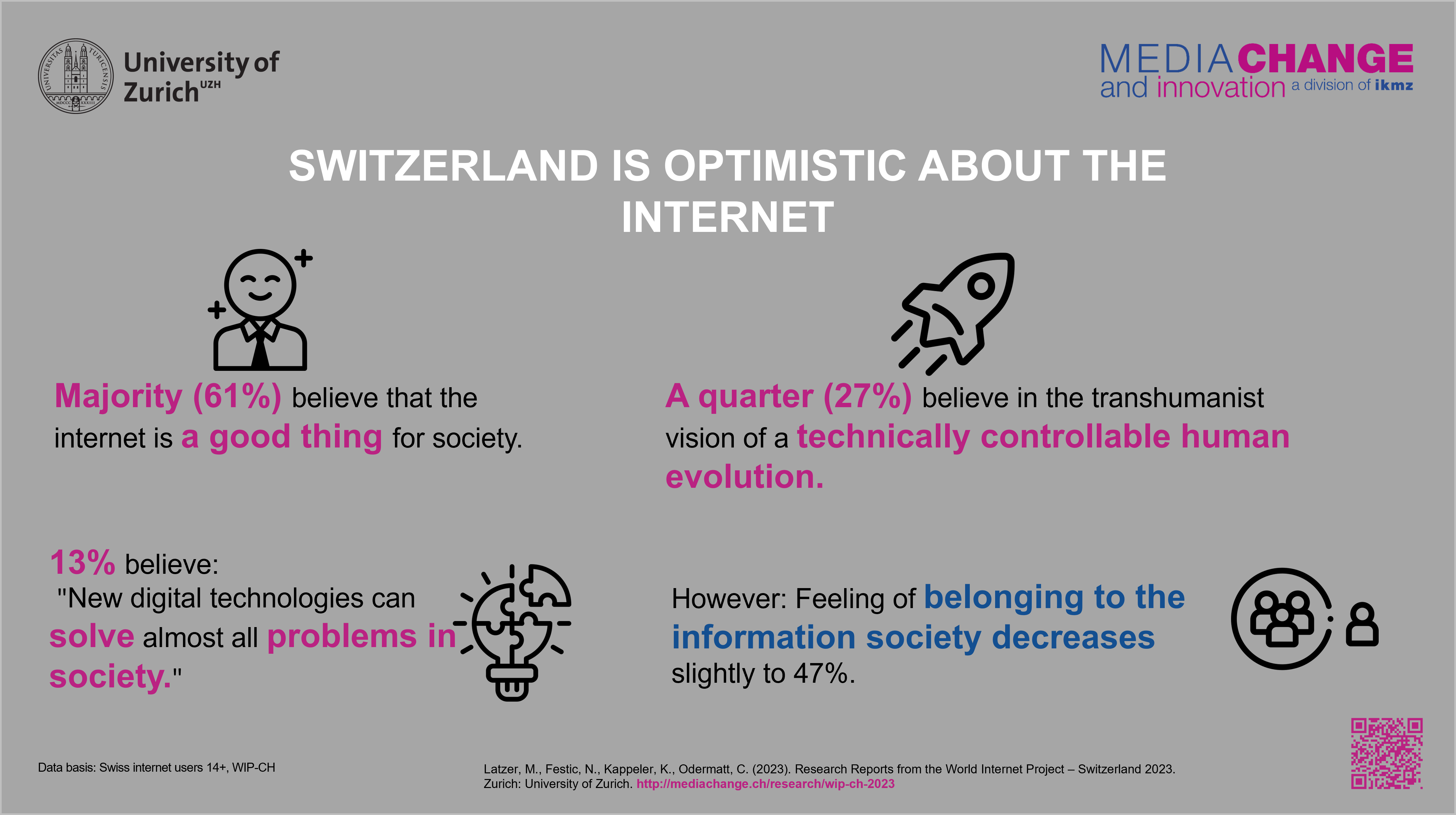
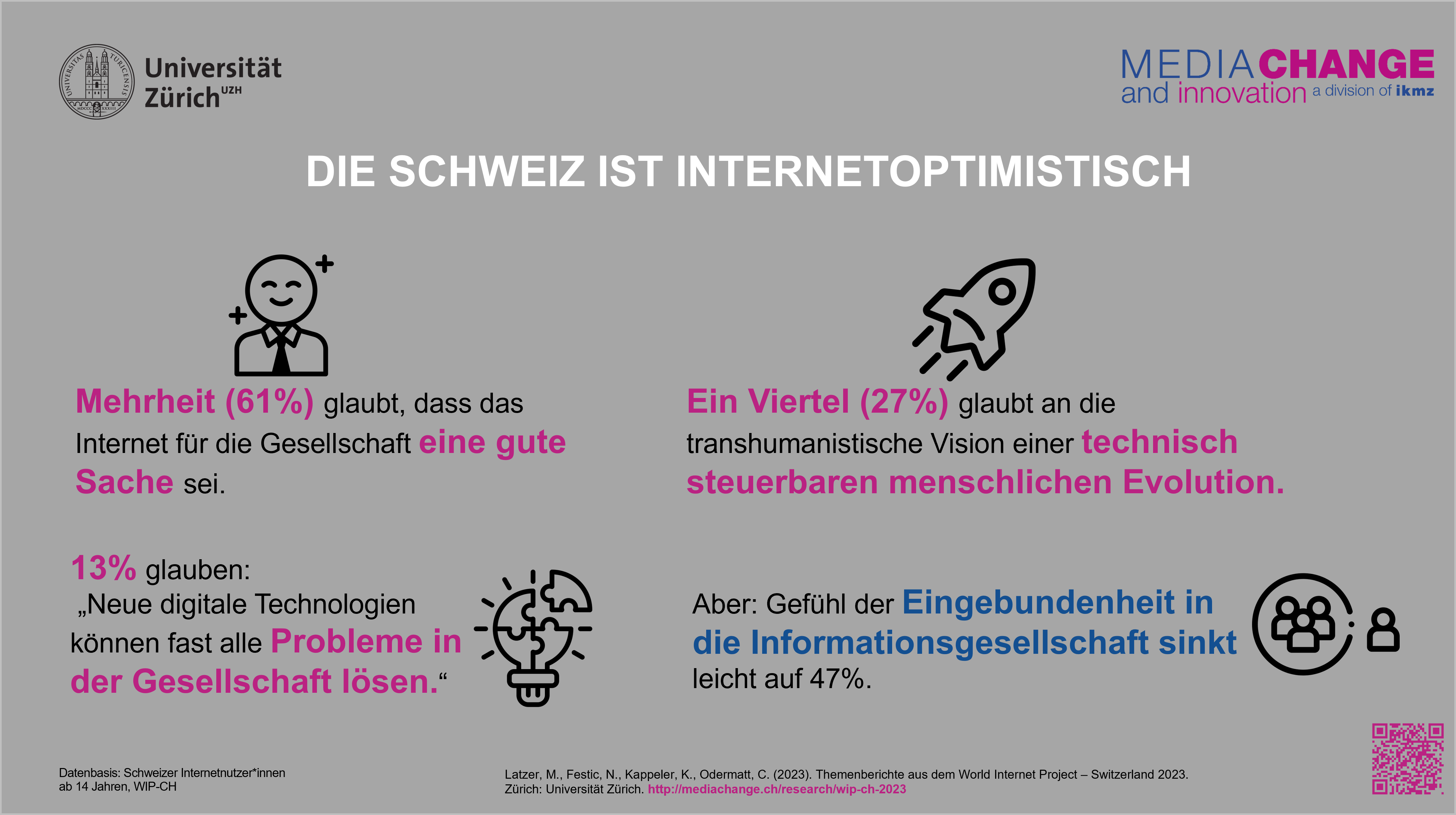
- Switzerland is optimistic about the internet (English / German)
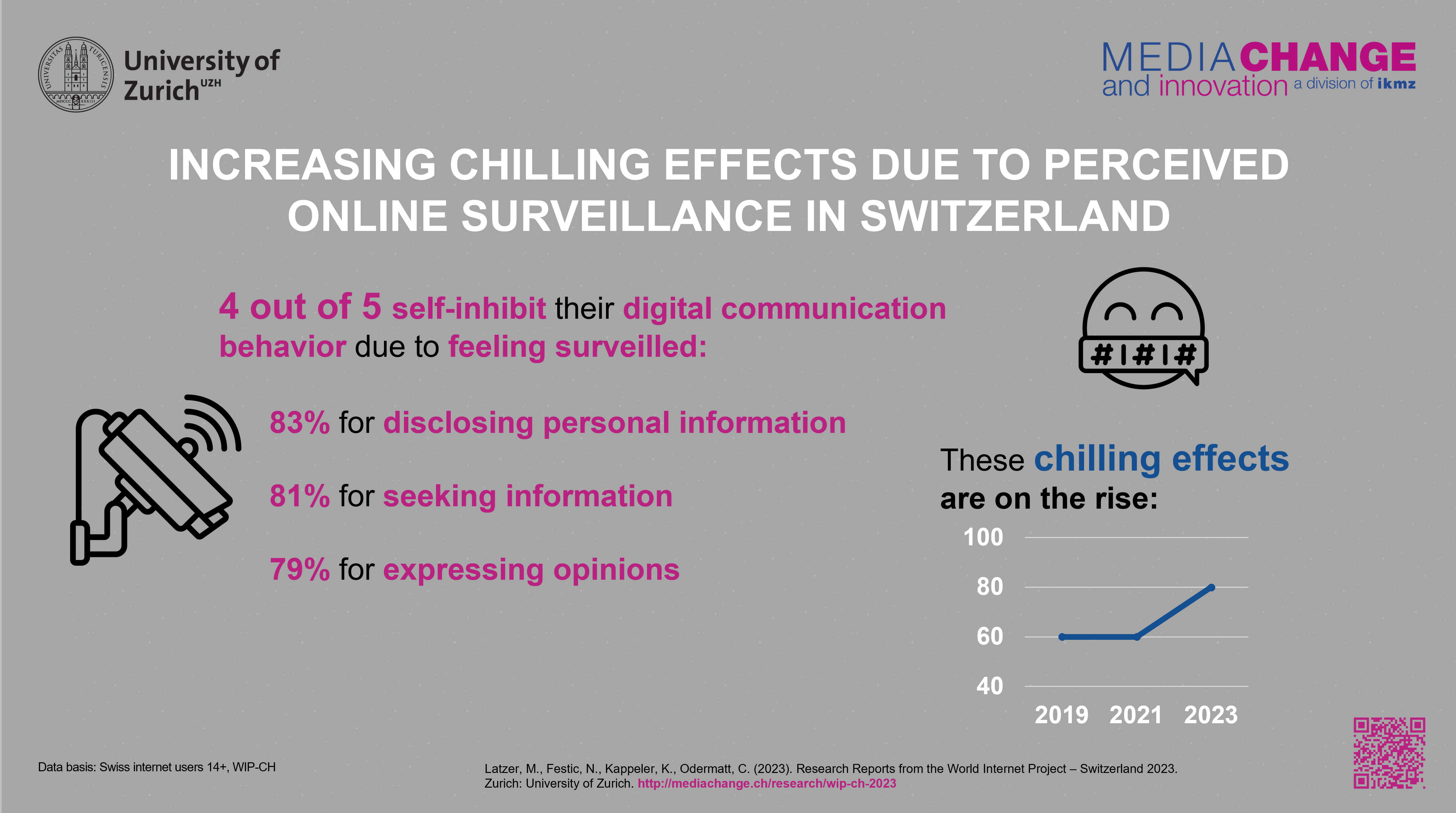
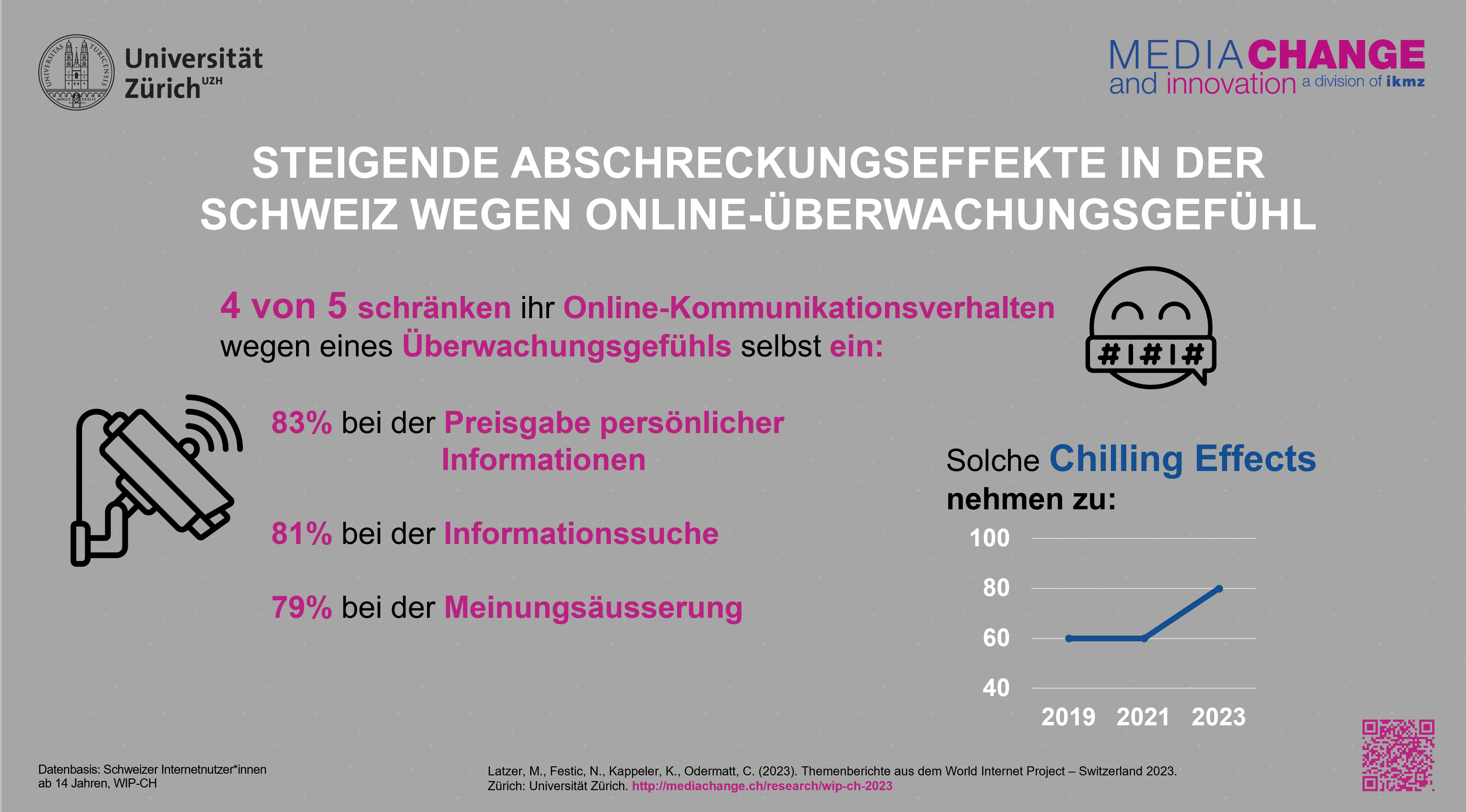
- Increasing chilling effects due to perceived online surveillance in Switzerland (English / German)
- Cyborg technologies for self-optimization are still in their early stages in Switzerland (English / German)
Icons made by Freepik, Ehtisham Abid, monkik and juicy_fish from www.flaticon.com
-
Michael Reiss successfully defended his cumulative dissertation
7th November 23
Our former team member, Michael Reiss, successfully completed his doctoral studies at the end of October. He defended his cumulative dissertation entitled “News must die for news to live. Empirical, methodological, conceptual, and theoretical perspectives on contemporary news consumption and a proposal for a normative turn.”
Michael worked for the Media Change & Innovation Division for five years. He recently joined the Leibniz Institute for Media Research | Hans-Bredow-Institut in Hamburg as a postdoc.
We congratulate him on this important achievement and wish him every success in this new stage in his career.
-
Daniela Jaramillo-Dent elected to ICA Board of Directors
18th October 23
Our team member Daniela Jaramillo-Dent will join the Board of Directors of one of the most important associations in communication and media research. She was elected Board Student and Early Career Representative of the International Communication Association (ICA) in October 2023.
Daniela will begin her two-year term in June 2024 on the closing day of the annual ICA conference, which will take place in Australia. She will support student and early career members through various initiatives and represent them at the Board of Directors meetings. She currently serves as the Student and Early Career Representative for the ICA Intercultural Communication Division.
The Media Change & Innovation Division warmly congratulates Daniela for her election. We wish you good luck in your new role!
-


Foto von UZH Alumni
Vor zwei Wochen fand der gut besuchte Talk im Turm, organisiert von UZH Alumni statt. Michael Latzer und die Slavistin Sylvia Sasse diskutierten hier zum Einfluss von Desinformation und Algorithmen auf die Meinungsbildung. Wer das Event verpasst hat, findet hier eine Zusammenfassung und kann den ganzen Talk sogar im Podcast nachhören.
-
DSI Apéro Philo Session: Digital Wellbeing
2nd May 23Next week on 11th of May, Michael Latzer and Noemi Festic are giving a talk at the Digital Society Initiative of the University of Zurich at the Apéro Philo Session. The talk is titled: Digital Wellbeing: Conceptualization, Empirical Results, Challenges. This will be the first installment of this new format and aims to facilitate discussions in a more relaxed, friendly, and inclusive environment. Consequently, the talk is followed by a discussion and an Apéro.
You find more information and can register here: https://ethics.dsi.uzh.ch/project/apero-philo/
-
Am 18.04.2023 von 18.15 - 19.30 Uhr findet im Restaurant UniTurm ein Gespräch unter dem Titel "Göttliche Algorithmen und Putins Desinformation" statt. Neben anderen Gästen wird Michael Latzer hierbei darüber sprechen wie Digitalisierung und Desinformation Wahrnehmung und Weltbilder von Menschen beeinflussen. Ticketverkauf und weitere Infos gibt es hier: https://uzhalumni.ch/events/102271
-
Campus Oerlikon Lecture Series: Digital Worlds
22nd September 222nd Campus Oerlikon Lecture Series: Digital Worlds
On Wednesday, 28th of September, 2022 Kiran Kappeler gives a talk on ‘Challenges of Our Digitalized Everyday Life – Before and After Covid-19’ as part of the 2nd Campus Oerlikon Lecture Series- The overarching theme of the lecture series is ‘Digital Worlds: Research on Digitalization and Digitalized Research’. The event starts at 6:30 pm at Affolternstrasse 56 at the University of Zurich (Room: AFL-F-121) and is followed by an Apéro. For more information see: https://www.campus-oerlikon.uzh.ch/de/projekte-campus-oerlikon/veranstaltungen/vortragsreihe-HS22.html
-
Public Guest Lecture: Alternative Post-Digital Futures
23rd August 22The Media Change and Innovation Division cordially invites the interested public to a guest lecture by Prof. Dr. Tsekeris on "Alternative post-digital futures: A deep technoethical foresight perspective in a turquoise world" on 6 September, 15:00 - 16:30 in AFL-E-022. We are looking forward to welcoming everyone who is interested. It is not necessary to register.More information on the lecture and on Prof. Dr. Tsekeris can be found here. -
The Media Change and Innovation Division, Department of Communication and Media Research (IKMZ), University of Zurich is seeking applications for a fully funded senior research and teaching associate / postdoctoral position in societal implications of the Internet. The successful applicant will devise and conduct original theoretical and empirical research in the area of digital media use, well-being, social impacts of algorithmic selection and AI, governance of media change, privacy, and dataveillance starting in October 2022 (see recent Publications for research focus areas and our new project on the chilling effects of dataveillance).
→ Read the full job description and apply
Contact for further information: Dr. Noemi Festic (n.festic@ikmz.uzh.ch)
-
Religion-like Digital Trinity
8th June 22
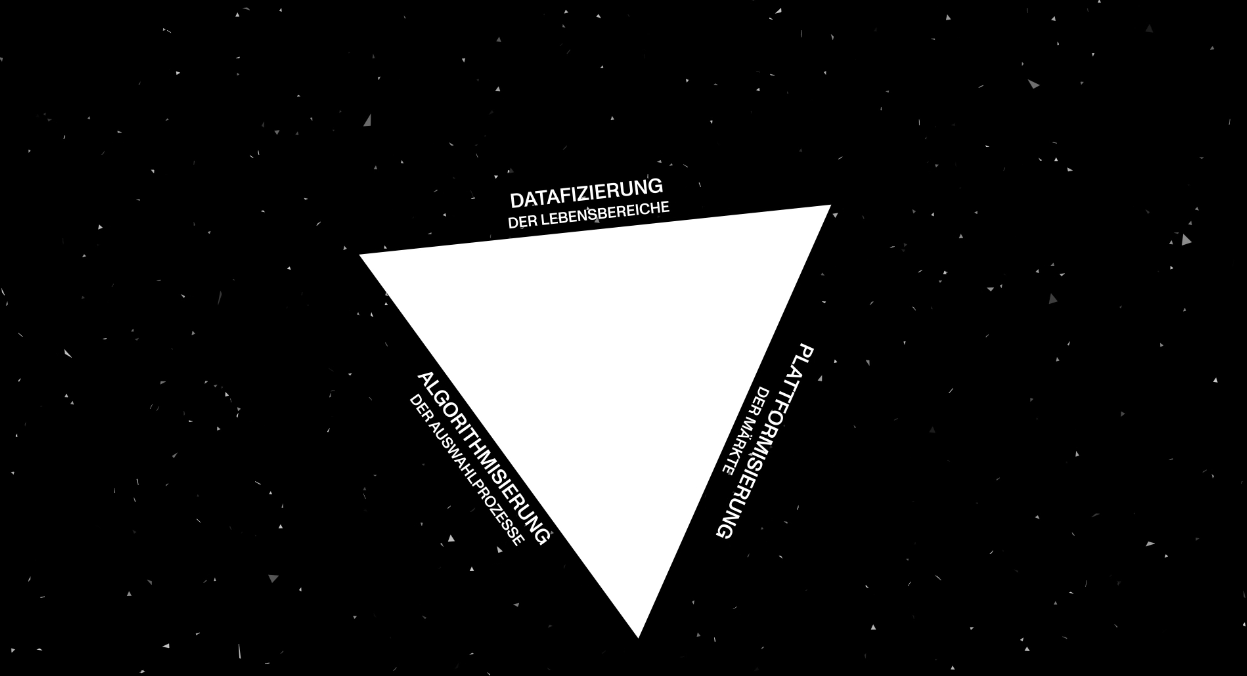
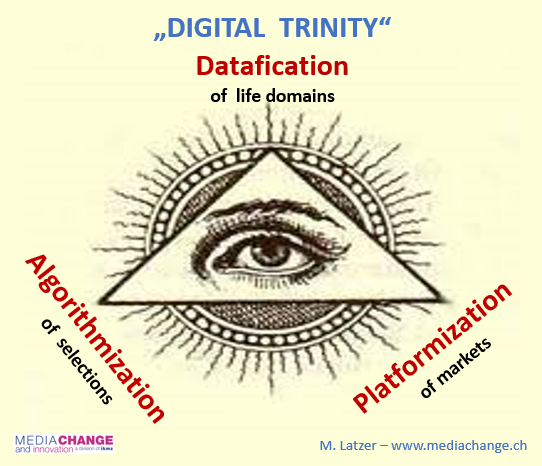
What is concealed behind the sober technological facade of the omnipresent digitalization? Its current phase reveals itself to us in a threefold form, as a co-evolutionary interplay of the datafication of areas of life, the algorithmization of selection processes and the platformization of markets. The Digital Trinity is driven by the belief system of Silicon Valley prophets and transhumanism, as well as by an implicit digital everyday religion of users. It is geared towards influencing our behavior, changing our view of the world, and thus shaping a digitally transformed social order.
The corresponding journal article can be found here.
The video is available on YouTube, see below:
New layer...New layer...For the German version see here:
The Digital Trinity was presented as an immersive installation as part of the Planet Digital exhibition at the Museum für Gestaltung in Zurich from February to June 2022.
Credits: Michael Latzer, Media Change & Innovation Division, IKMZ, University of Zurich • Hubertus Design Valentin Kaiser, Kerstin Landis, Nathan Meyer, Jonas Voegli • Sound Design Andalus, Kochstudio Zürich.
-
Die Abteilung Medienwandel & Innovation (Prof. Dr. Michael Latzer – http://www.mediachange.ch) des IKMZ – Institut für Kommunikationswissenschaft und Medienforschung der Universität Zürich sucht zur Verstärkung ihres Teams ab September 2022 oder nach Vereinbarung eine:n Hilfsassistierende:n (30%) im Rahmen des SNF-Projekts «The Chilling Effects of Dataveillance: Conceptual Advances and Empirical Evidence for Switzerland».
Interessieren Sie sich für wissenschaftliches Arbeiten und möchten Einblicke in die internationale Forschungspraxis erhalten? Als Hilfsassistierende:r sind Sie Teil unseres Forschungsteams und unterstützen die Abteilung Medienwandel & Innovation in Forschung, Lehre und Administration.
Zu Ihren Aufgaben zählen:
- Mitarbeit im SNF-geförderten Projekt «The Chilling Effects of Dataveillance: Conceptual Advances and Empirical Evidence for Switzerland» (https://mediachange.ch/research/chilling/) sowie Unterstützung in anderen Forschungsprojekten der Abteilung
- Unterstützung bei der Vorbereitung, Durchführung und Auswertung empirischer Studien
- Literaturrecherche
- Editieren von Manuskripten und wissenschaftlichen Berichten
- Administrative Aufgaben in der Abteilung
- Unterstützung in der Lehre
Wir bieten:
- Einblick in die universitäre Forschungspraxis
- Beschäftigung mit hochaktuellen Themen (Medienwandel, Internetnutzung in der Schweiz, Auswirkungen von Dataveillance, usw.)
- Erwerb und Vertiefung analytischer und methodischer Fähigkeiten
- Einbindung in ein motiviertes und global vernetztes Team
- Angemessene Bezahlung
Sie bringen mit:
- Grundkenntnisse der Kommunikationswissenschaft (idealerweise am Ende Ihres BA- bzw. am Anfang Ihres MA-Studiums)
- Hohes Interesse an wissenschaftlichem Arbeiten und den Lehr- und Forschungsschwerpunkten der Abteilung
- Sehr gute Deutsch- und Englischkenntnisse in Wort und Schrift
- Hohes Engagement und Teamfähigkeit
- Exakte, verlässliche und selbständige Arbeitsweise sowie flexible Einsatzbereitschaft
Bitte senden Sie Ihre Bewerbung mit einem kurzen Motivationsschreiben in der Mail, Ihrem CV und Ihrem aktuellen Leistungsausweis bis zum 16.05.2022 an Michael Latzer (m.latzer@ikmz.uzh.ch) und Noemi Festic (n.festic@ikmz.uzh.ch). Bei Nachfragen können Sie sich gerne an Noemi Festic (n.festic@ikmz.uzh.ch) wenden.
-
Digitale Dreifaltigkeit - Planet Digital
11th February 22Kunst + Wissenschaft + Digitalisierung = Planet Digital
Heute beginnt die 4-monatige interaktive, immersive Ausstellung über die allgegenwärtige Digitalisierung unserer Welt. An den 25 transdisziplinären Kollaborationen sind über 100 Forscher:innen und Gestalter:innen der Universität Zürich, der ZHdK und der ZHAW beteiligt.
Auch Michael Latzer ist mit dem kollaborativen Projekt DIGITALE DREIFALTIGKEIT vertreten. Diese Arbeit wirft einen Blick hinter die technisch-nüchterne Fassade jener gesellschaftlichen Transformation, die als Digitalisierung bezeichnet wird. Entstanden ist die Installation in Zusammenarbeit mit Jonas Voegeli (Visual Communication, ZHdK) und Hubertus Design.
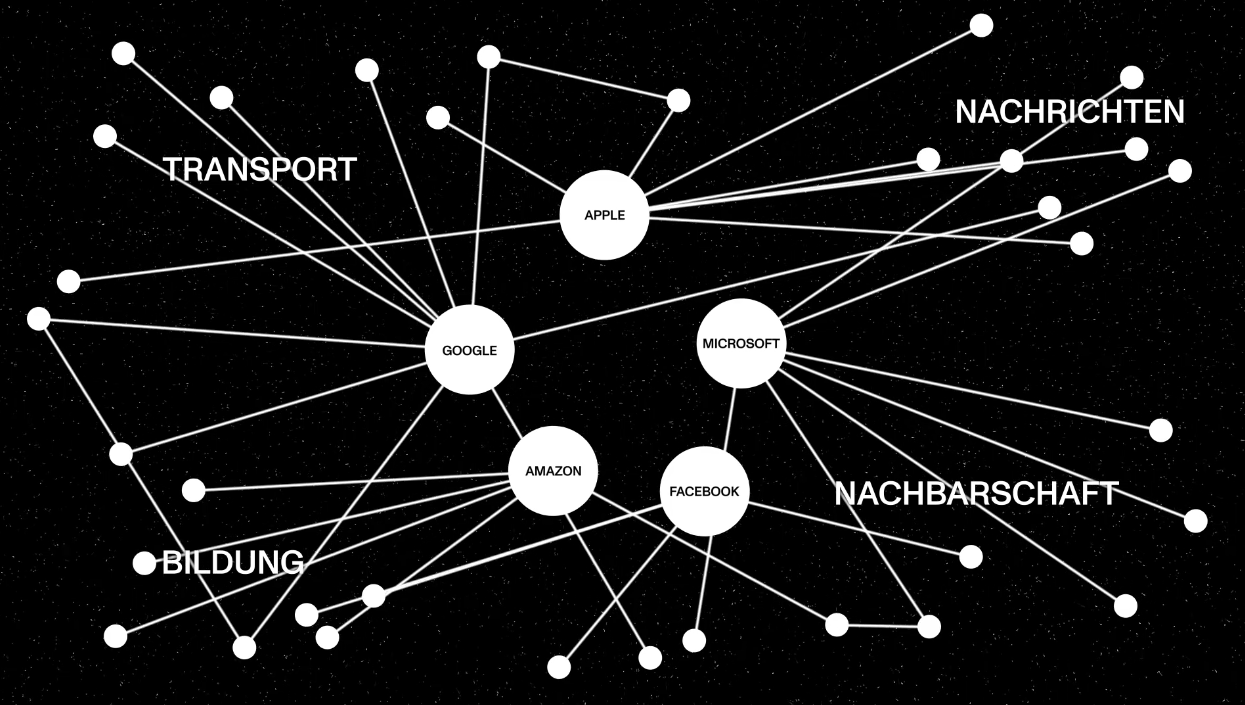
Die Ausstellung kann bis 6. Juni 2022 im Museum für Gestaltung Zürich, Ausstellungsstrasse 60, besichtigt werden.
Weitere Informationen zur Ausstellung Planet Digital finden Sie auf planetdigital.ch
Zur Installation von Michael Latzer hier und zum wissenschaftlichen Hintergrundtext über die religionsartige digitale Dreifaltigkeit hier.
-
Covid-19 Leads to Short-Term and Long-Term Push in Digitalization
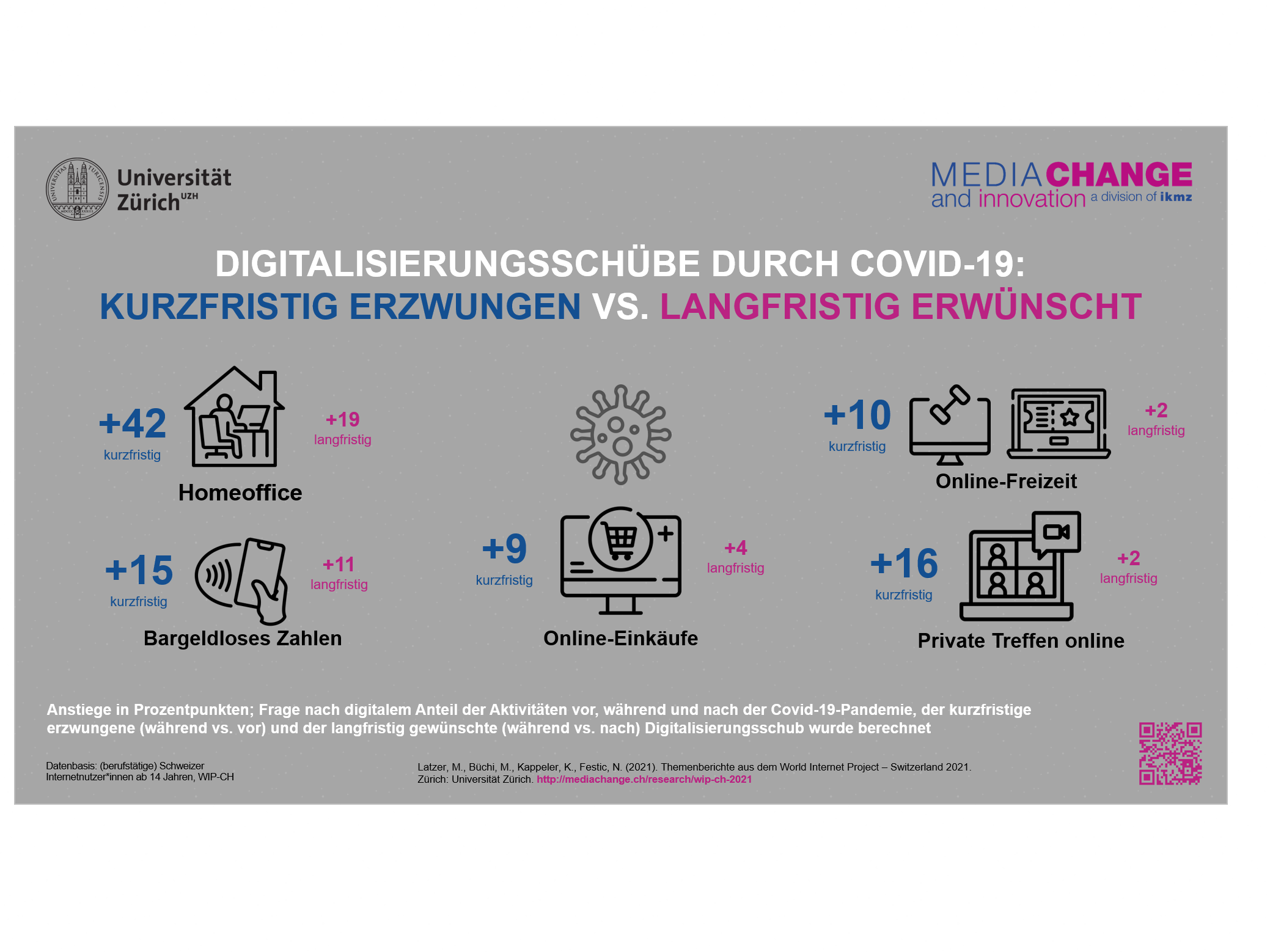
18th November 21The Covid-19 pandemic has accelerated the digitalization of everyday life. Especially when it comes to working and shopping, Swiss people want to see most of these changes remain in the long run. These are results of the World Internet Project – Switzerland 2021. Due to the Covid-19 pandemic, everyday life in Switzerland has been severely restricted since March 2020 and many activities have increasingly shifted to digital spaces. This forced digitalization push is most pronounced in the area of remote working: Whereas before the pandemic, employed internet users spent just under 20 percent of their employed hours working from home, during the pandemic it was more than 60 percent. Post-pandemic, they wish to work from home about two days of the week.
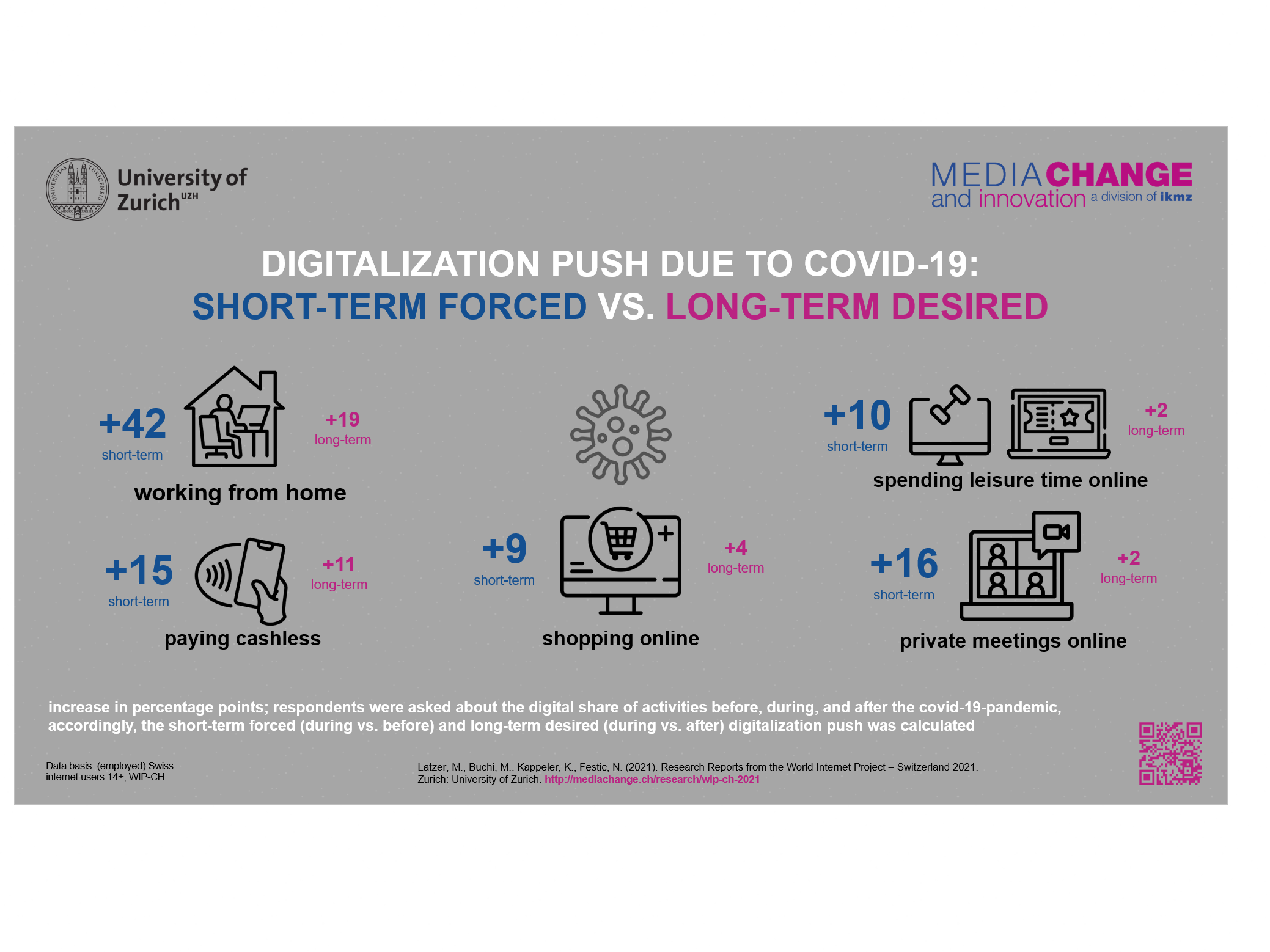
"There are clear differences between the digitalization push forced by Covid-19 in the short term and what is desired in the long term," emphasizes Prof. Michael Latzer: "Many Swiss internet users discovered the advantages of working from home and of using cashless payments during the pandemic, but the limits of digital alternatives also became apparent, particularly in personal relationships." For example, the share of social gatherings taking place online increased from 9 to 25 percent because of the pandemic; in the long term, the ideal share is 12 percent.
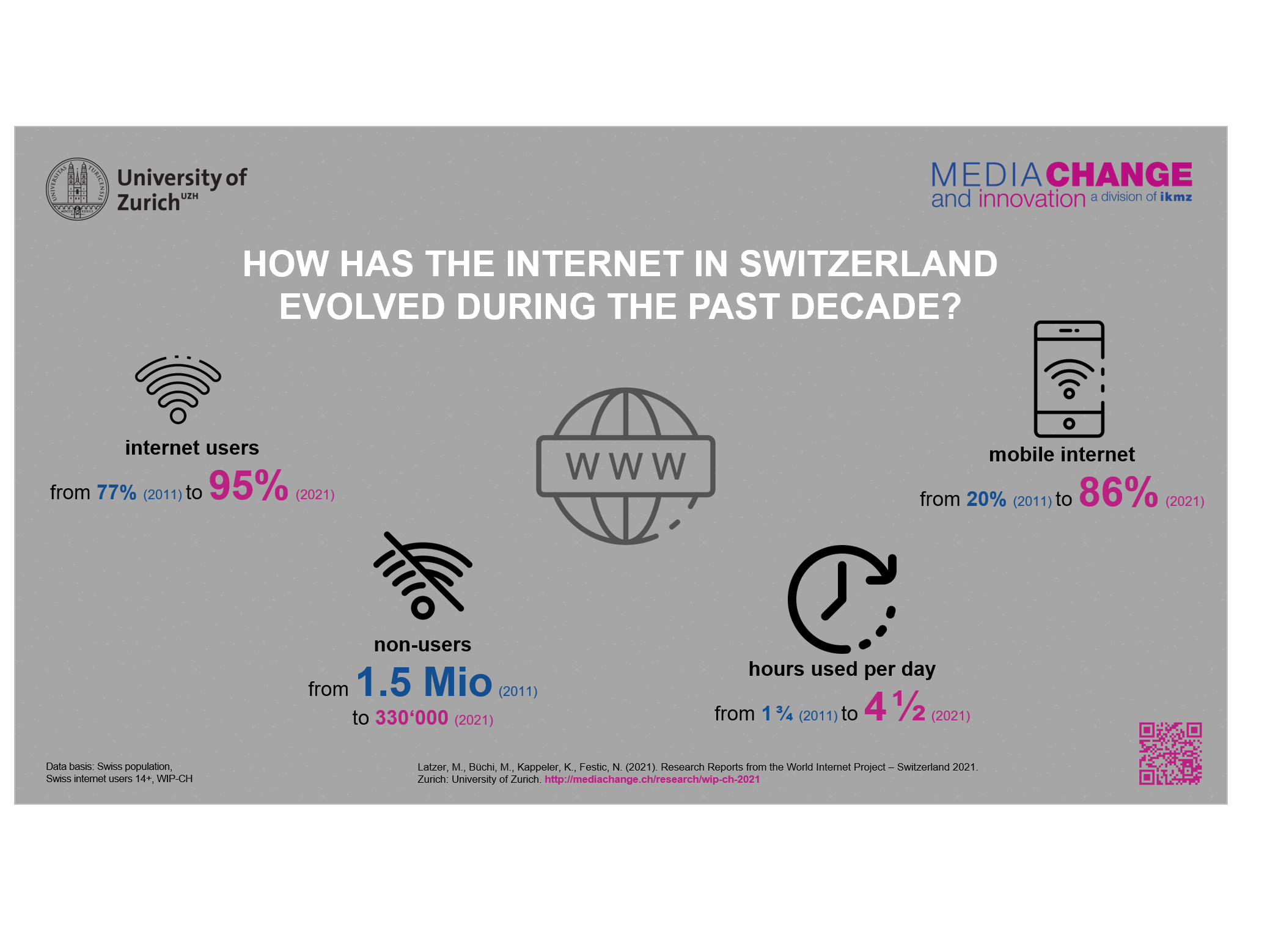
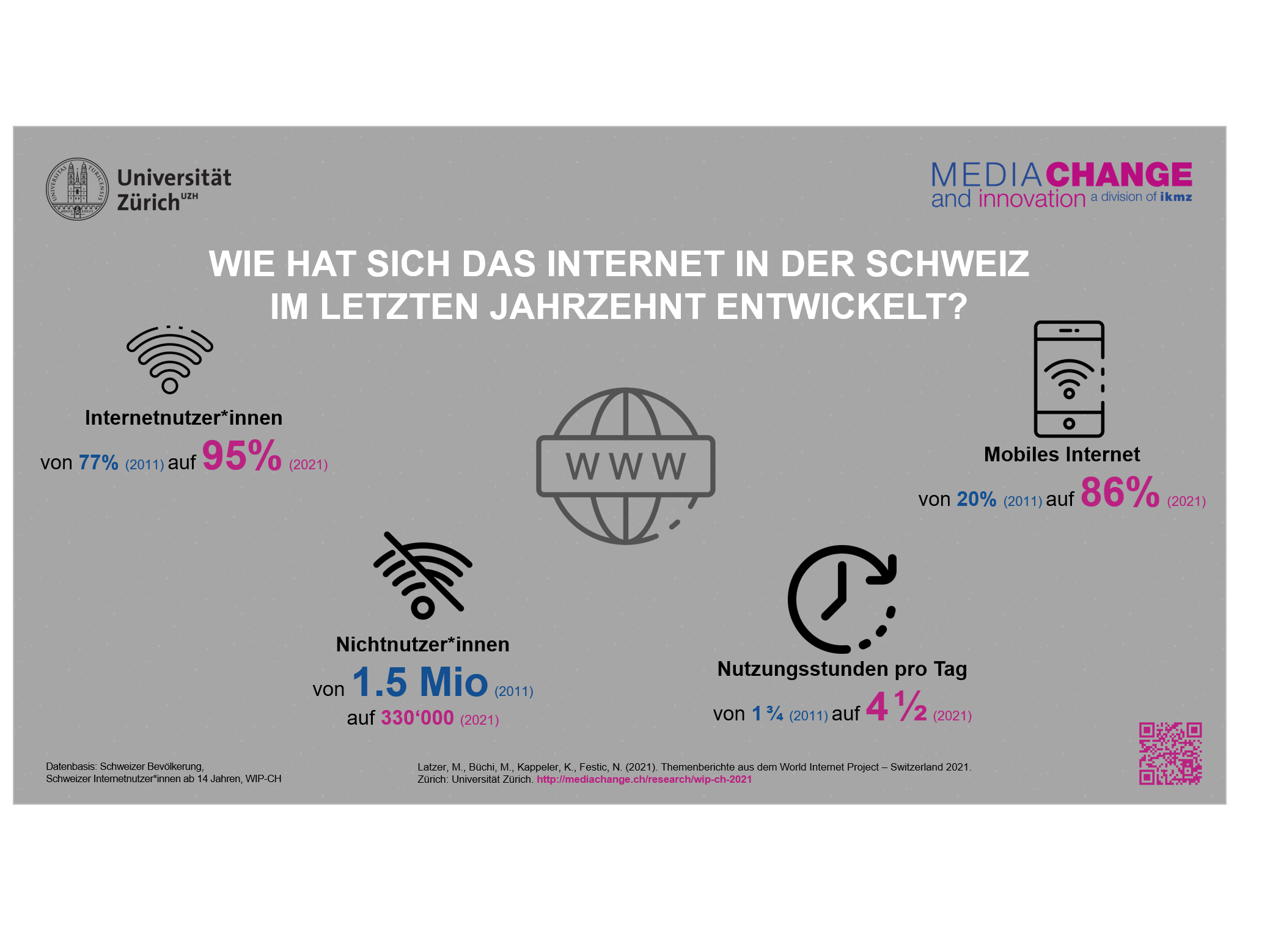
95 percent of the Swiss population use the internet in 2021. Among those under 70, it is almost 100 percent. 86 percent of the total population also use mobile internet in 2021, which is more than four times as many as ten years ago. Internet usage time doubled between 2011 and 2019 to 3.5 hours and experienced another significant increase during the corona crisis, reaching 4.5 hours a day in 2021.
The full results can be accessed below in five research reports (in German) and seven infographics.Special Report 2021: Digitalization Push due to Covid-19
Research Reports 2021 (Themenberichte)
Infographics







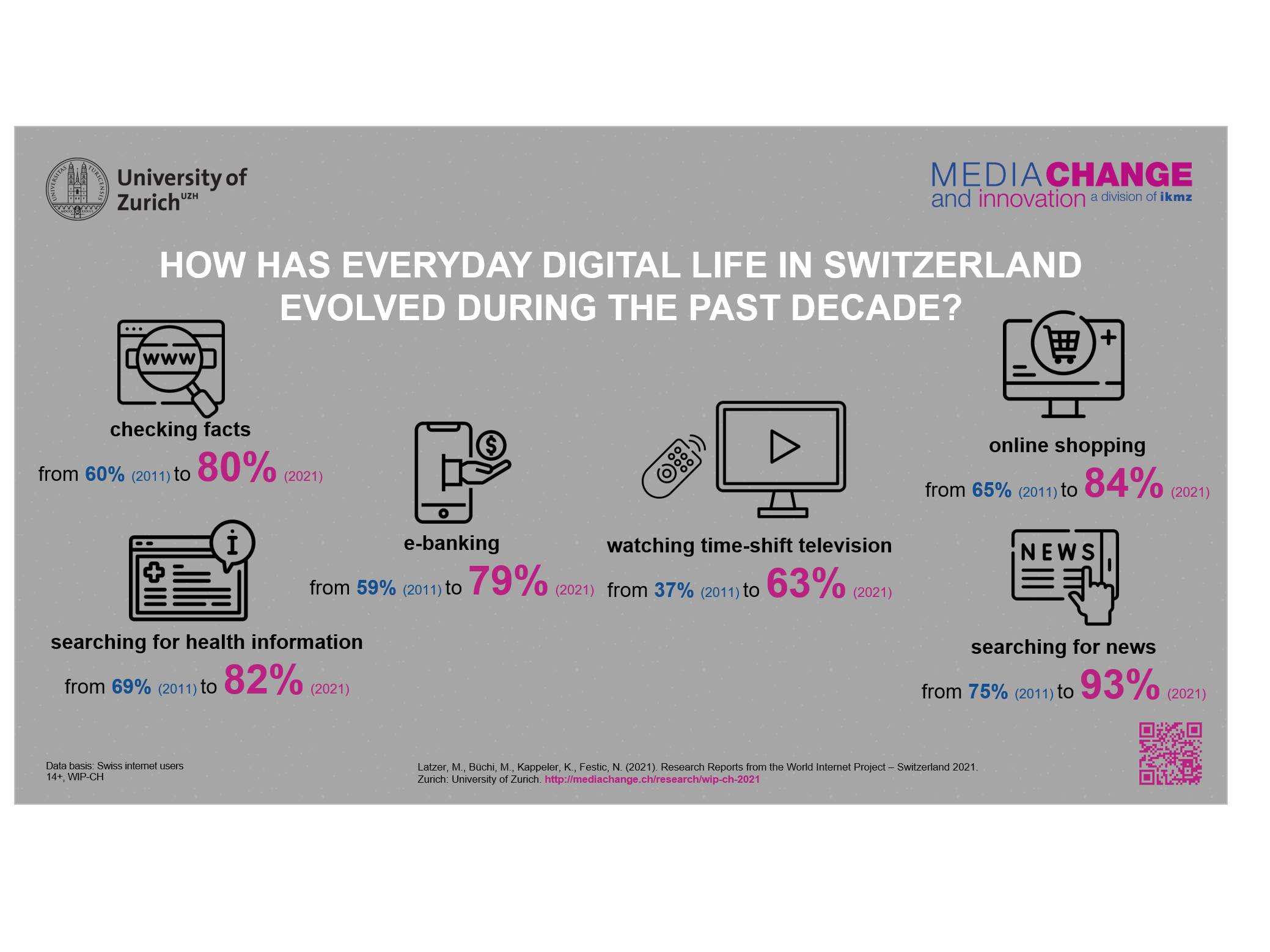
- How has the Internet in Switzerland evolved during the past decade? (English / German)
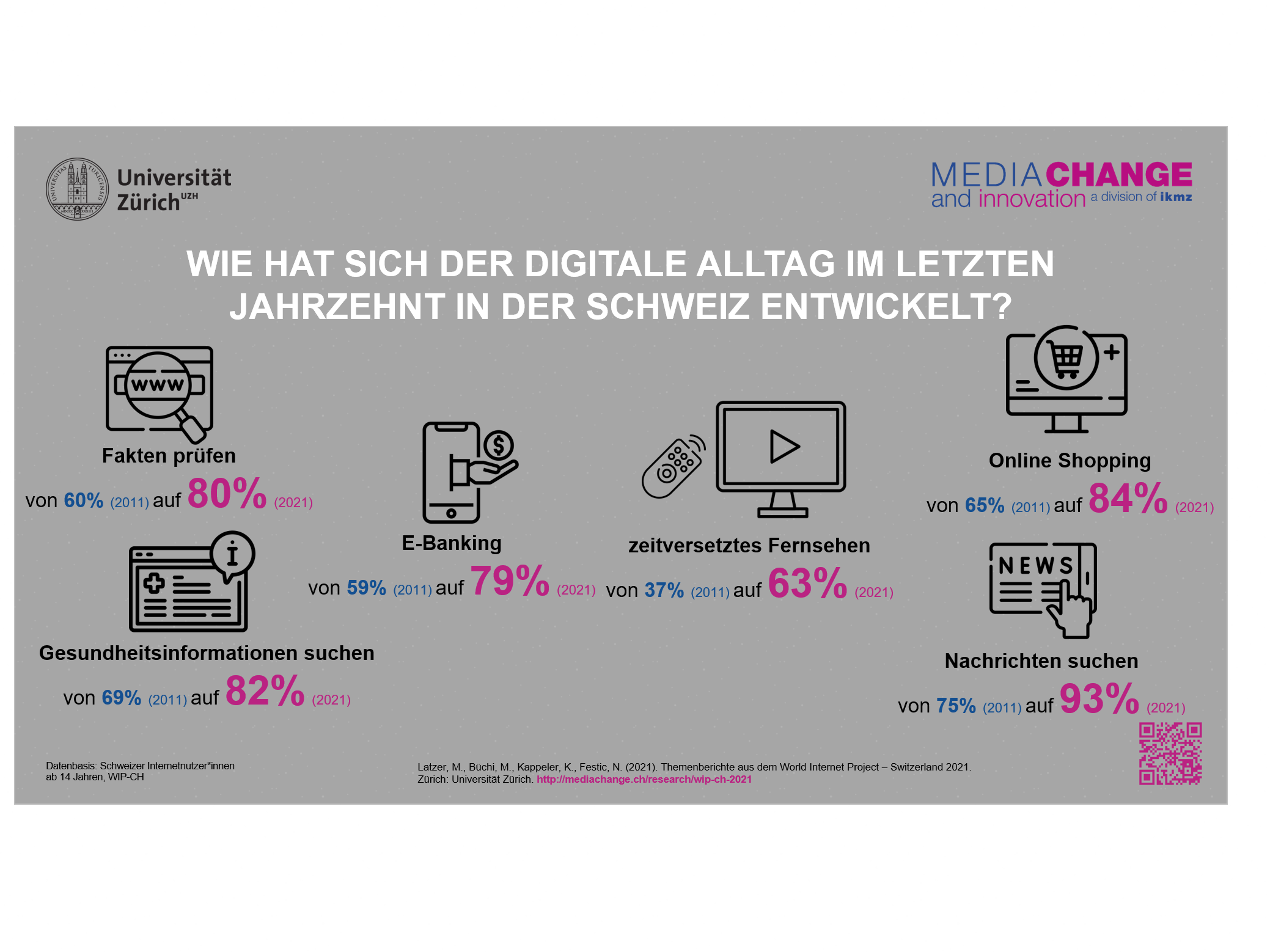
- How has everyday digital life in Switzerland evolved during the past decade? (English / German)
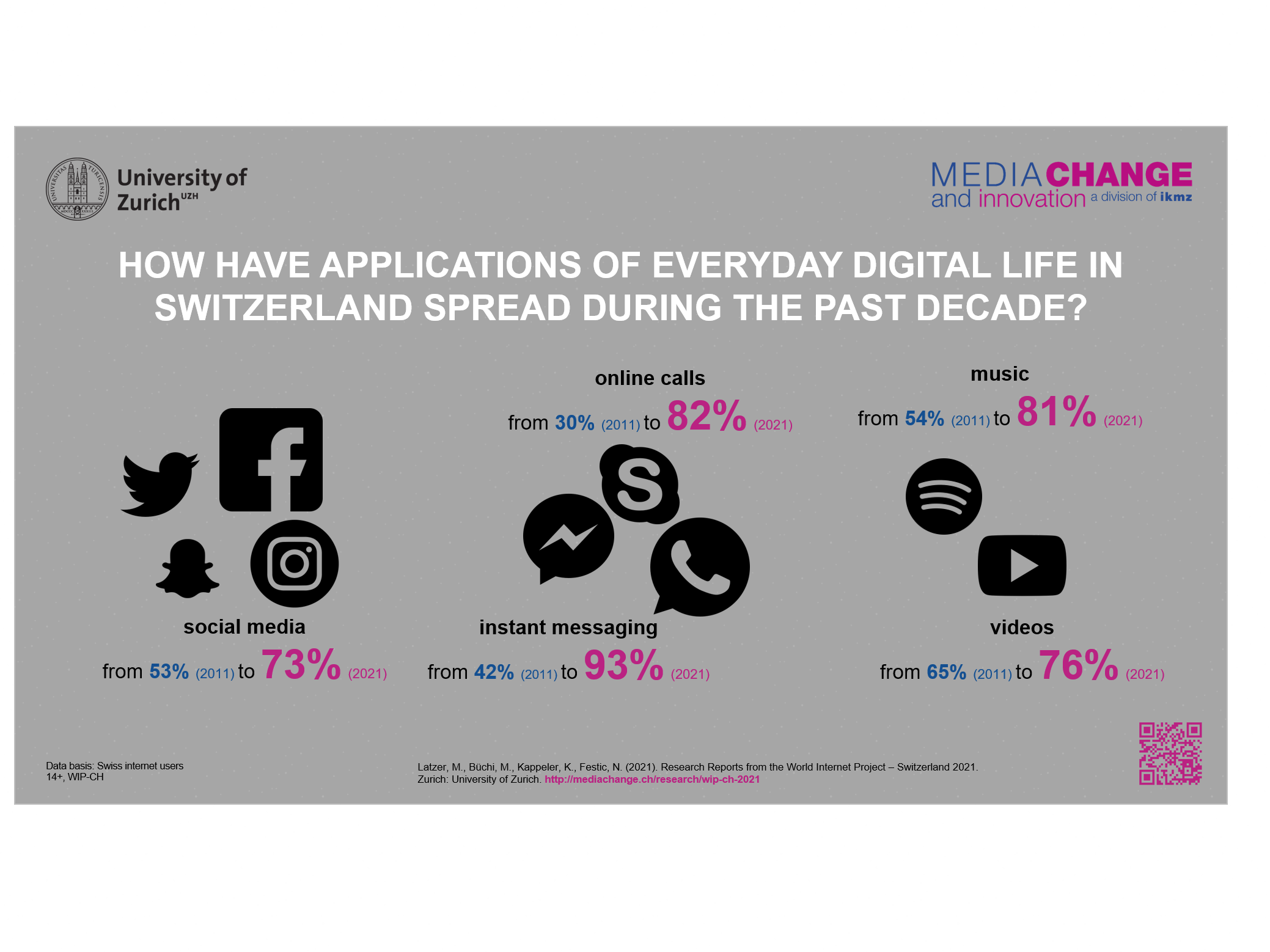
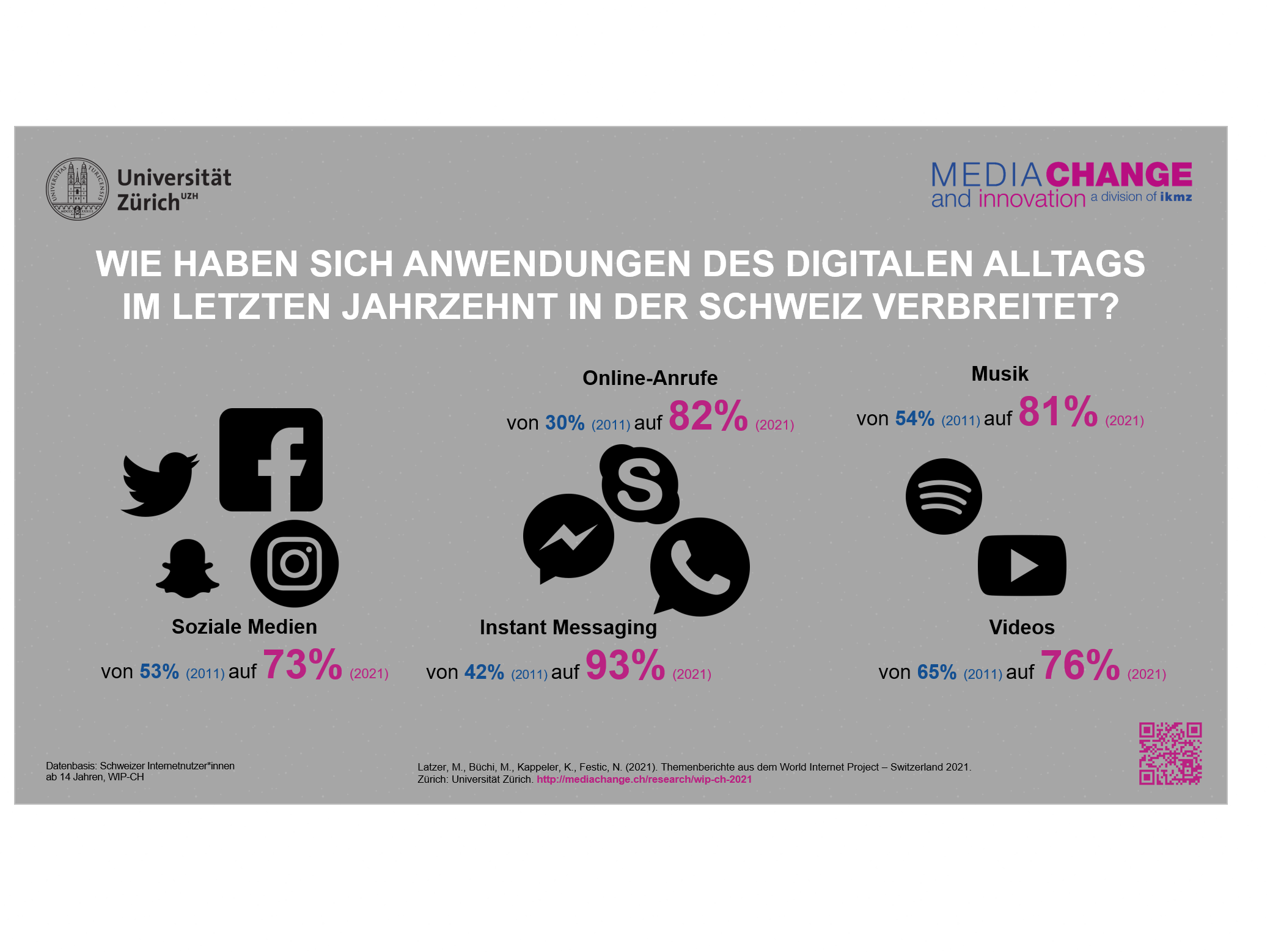
- How have applications of everyday digital life in Switzerland spread during the past decade (English / German)
- Digitalization push due to Covid-19: Short-term forced vs. long-term desired (English / German)
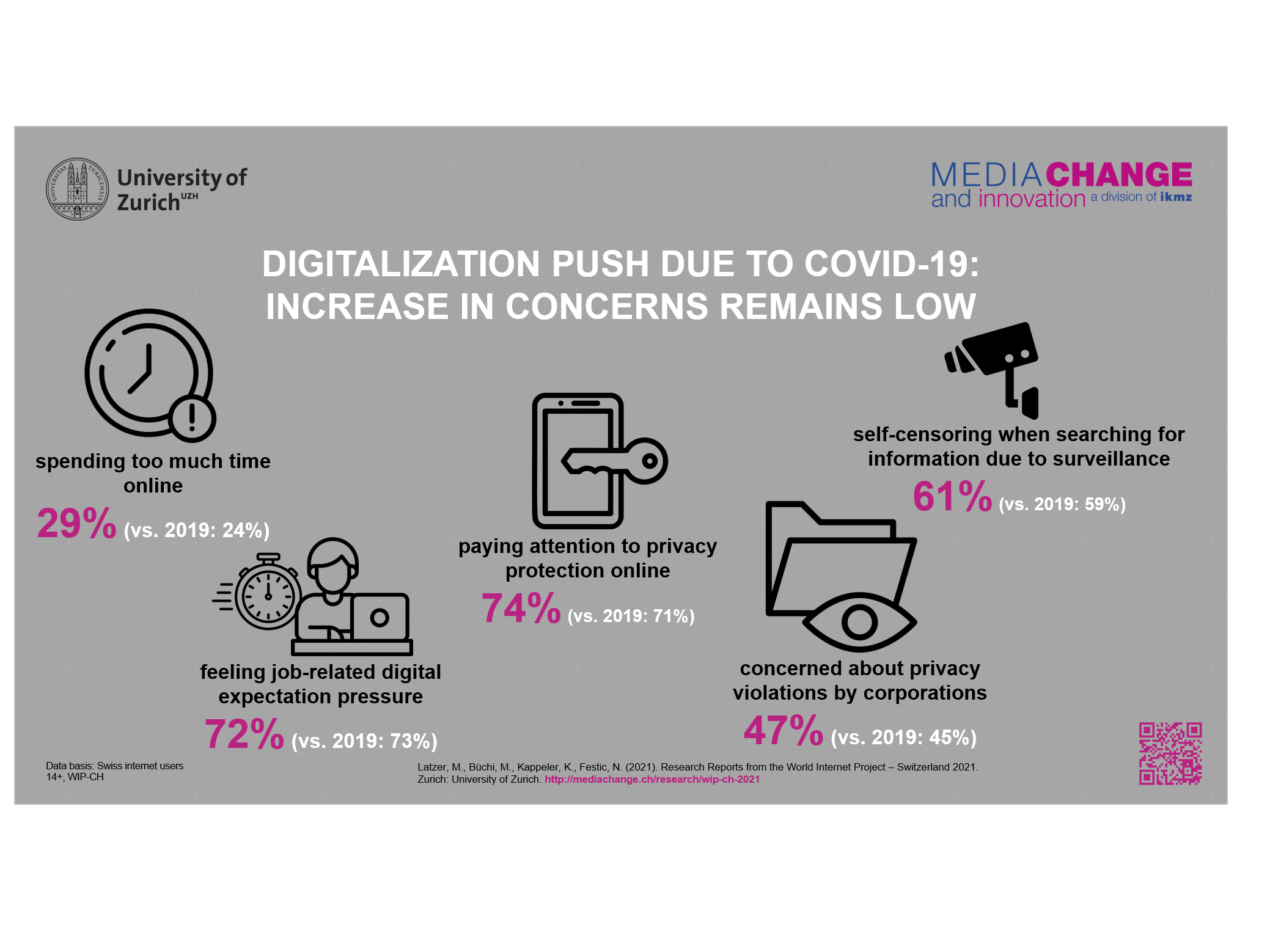
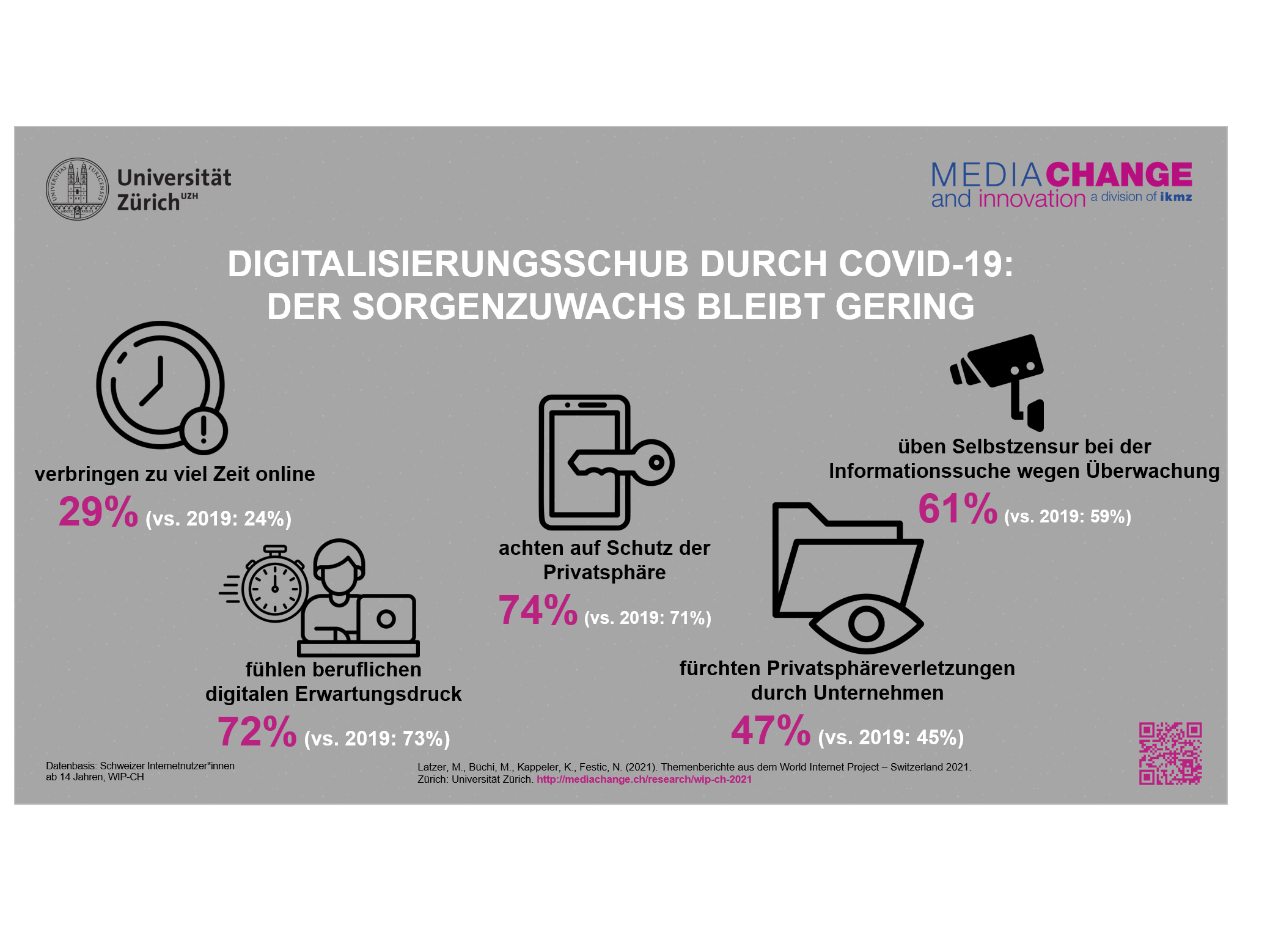
- Digitalization push due to Covid-19: Icrease in concerns remains low (English / German)
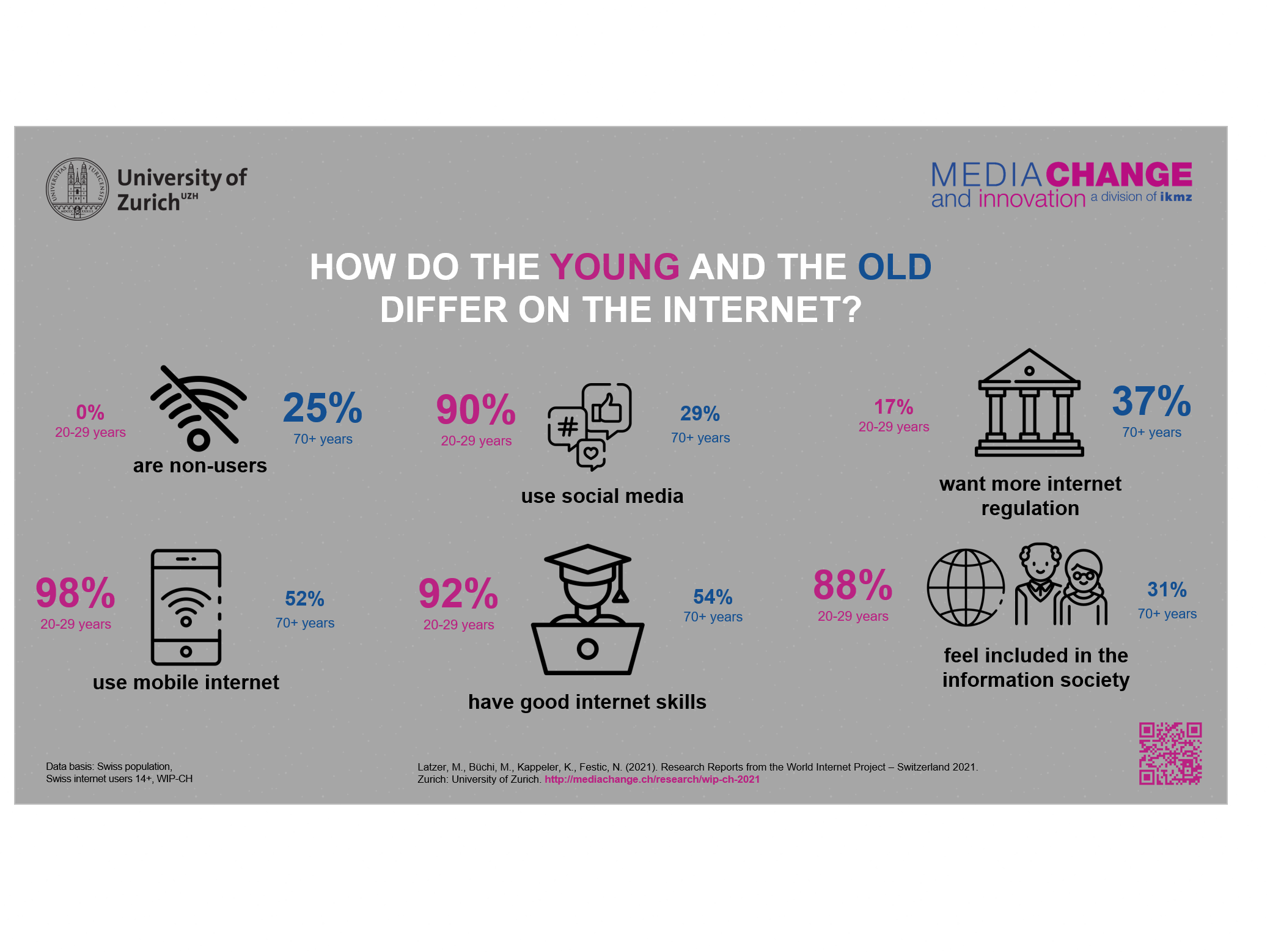
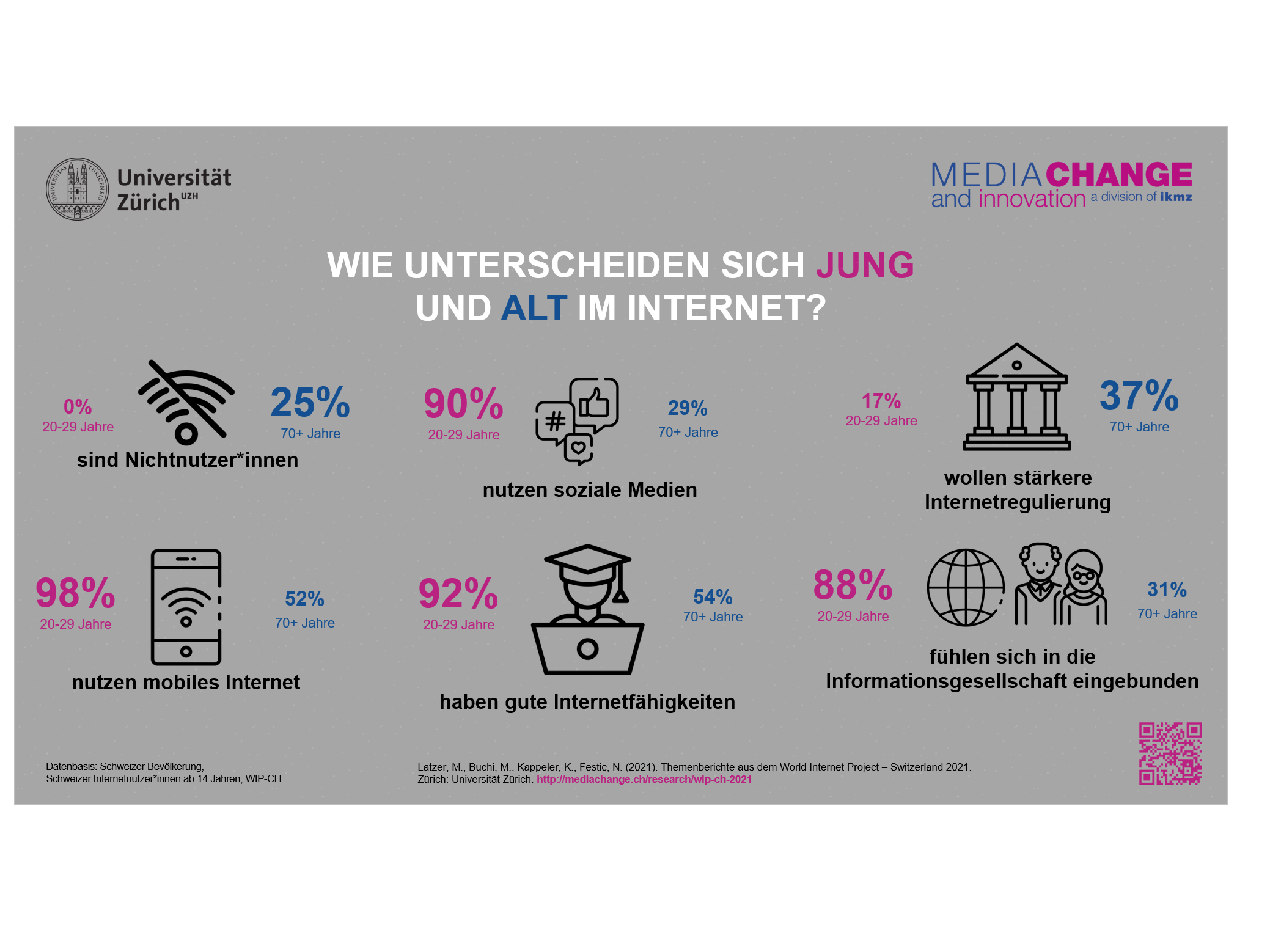
- How do the young and the old differ on the Internet? (English / German)
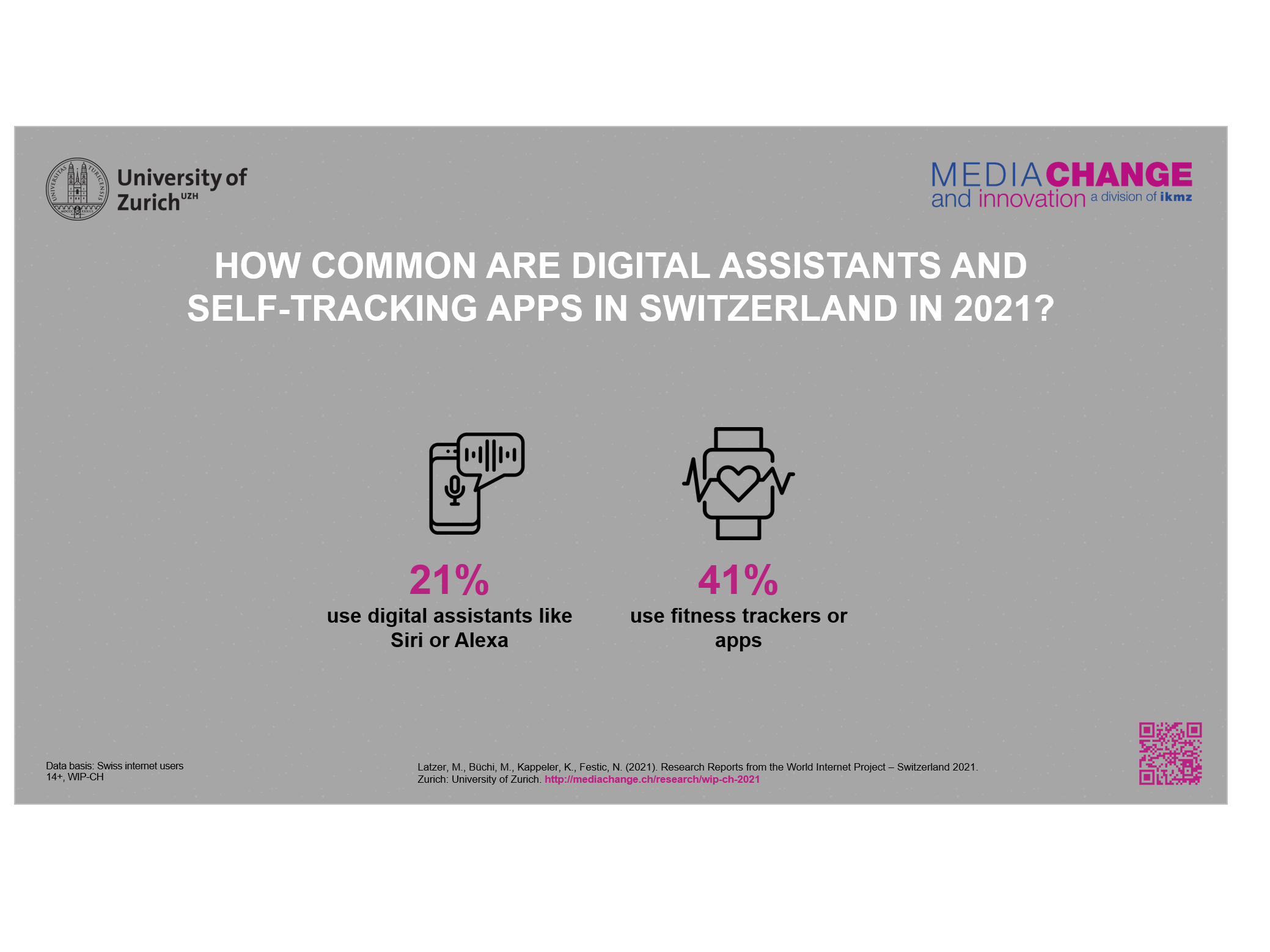
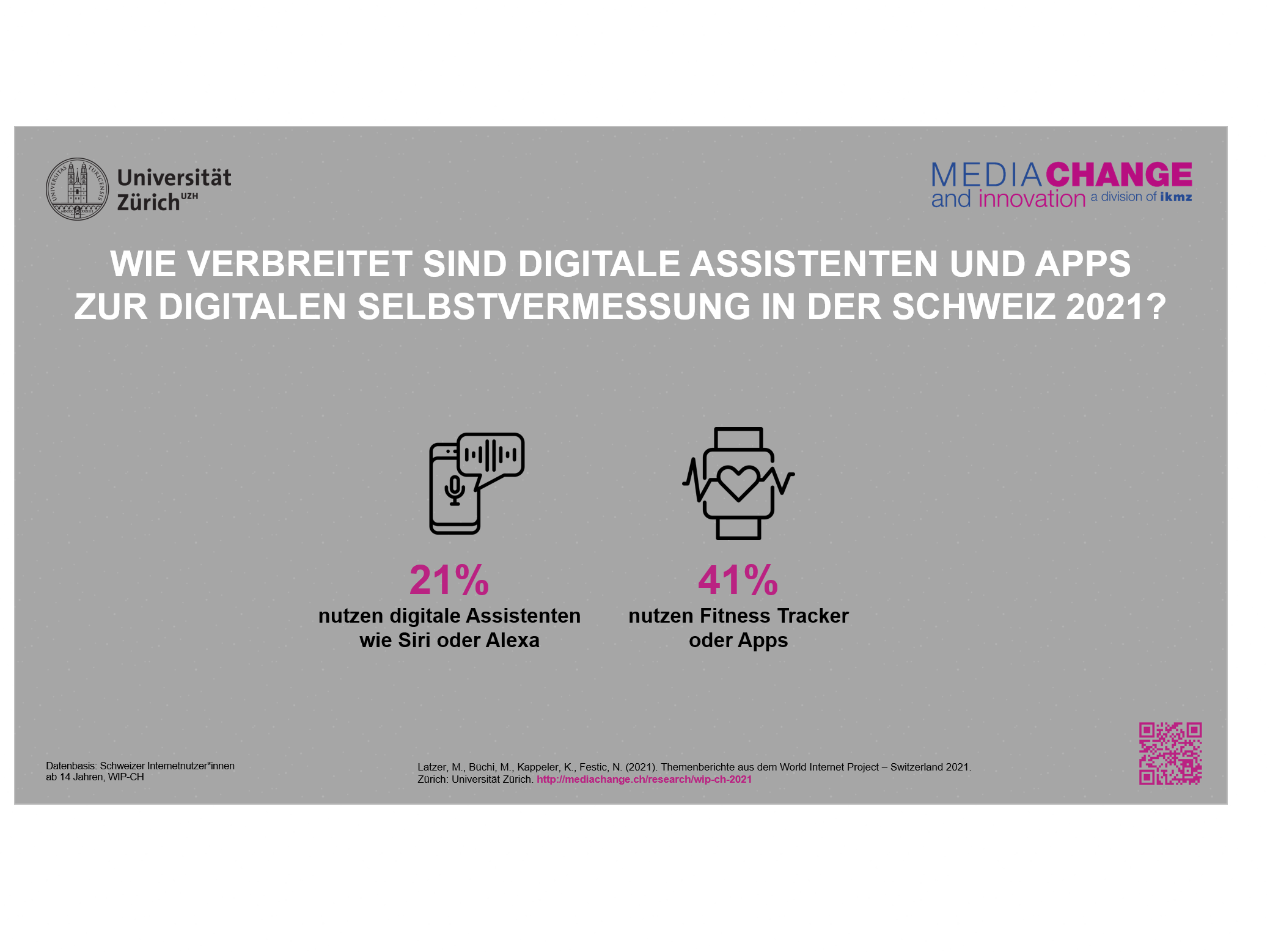
- How common are digital assistants and self-tracking apps in Switzerland in 2021? (English / German)
-
Open Postdoctoral Position
6th October 21The Media Change and Innovation Division, Department of Communication and Media Research (IKMZ), University of Zurich is seeking applications for a fully funded postdoctoral position. The successful applicant will devise and conduct original theoretical and empirical research in the fields of digital media use, well-being, algorithms, governance, privacy, and dataveillance starting in early 2022 (see recent Publications for research focus areas and our new project on the chilling effects of dataveillance).
→ Read the full job description and apply
Contact for further information: Dr. Moritz Büchi (m.buechi@ikmz.uzh.ch)
-
Research Presentations at ECREA
6th September 21
The Media Change & Innovation Division is featured in this year’s virtual European Communication Research and Education Association (ECREA) European Communication Conference. The conference theme is “Communication and Trust” and parallel sessions will take place from 7 to 9 September. 
Wednesday, September 8th, 09:00 - 10:30, Room 23
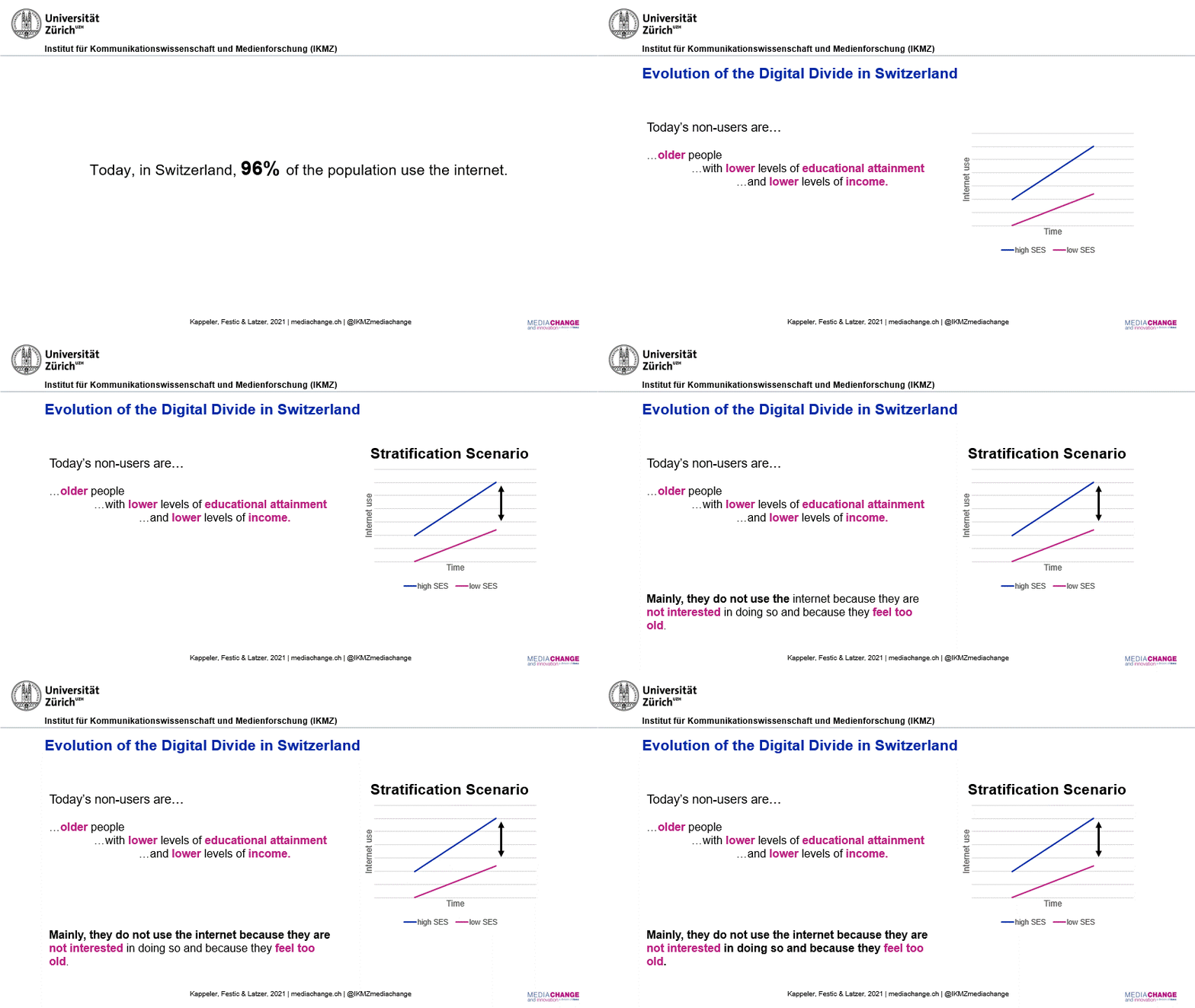
In a Digital Culture and Communication session on vulnerabilities and inclusion, Kiran Kappeler will present research conducted with Noemi Festic and Michael Latzer on who remains offline and why in a highly digitized society based on long-term data from the World Internet Project – Switzerland.
Thursday, September 9th, 11:00 - 12:30, Room 4
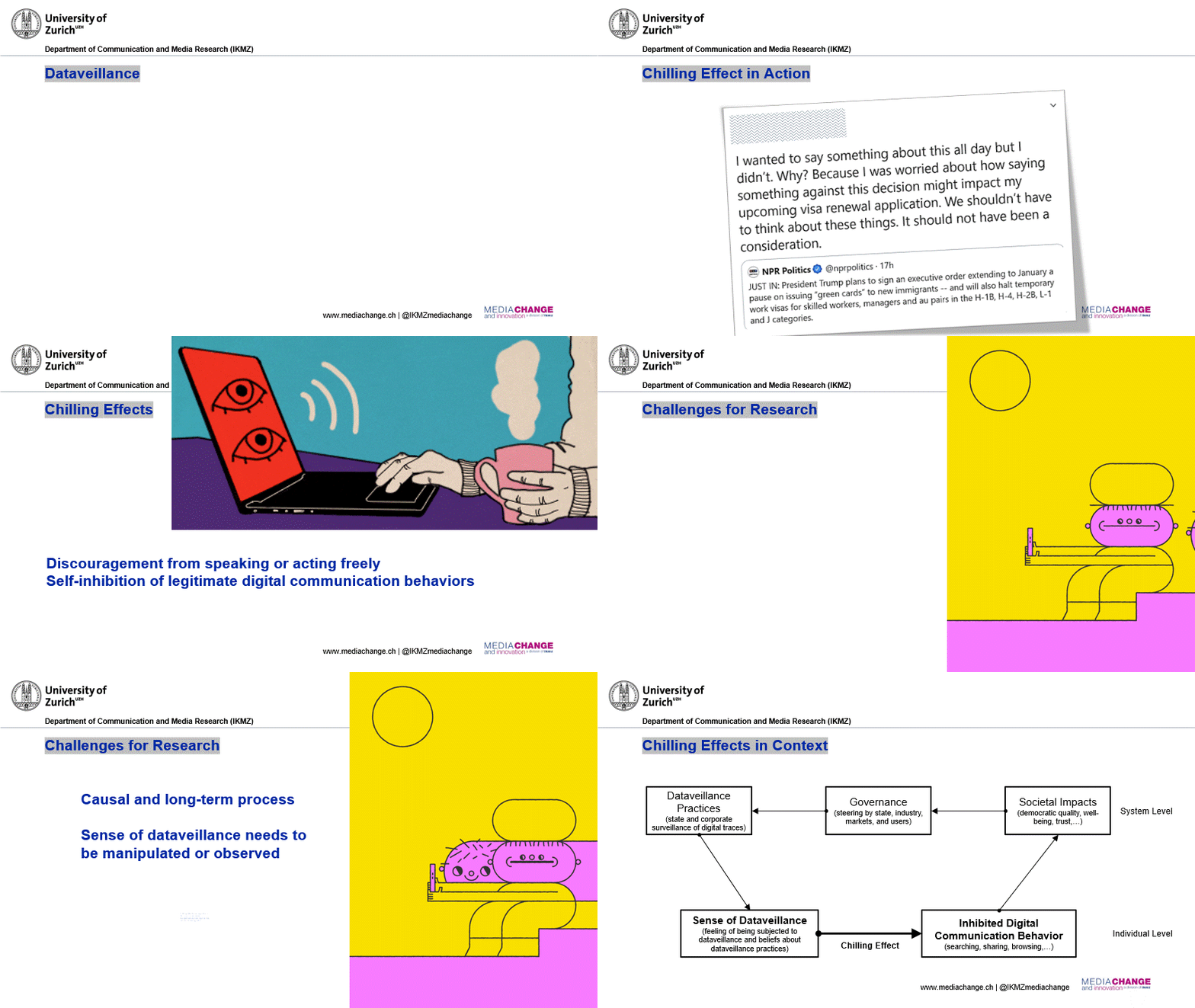
Moritz Büchi will chair the Communication and Democracy session on participation and community and present a paper on conceptual and empirical advances in the chilling effects of dataveillance (co-authored by Noemi Festic and Michael Latzer) from the division’s new research project.
-
The Media Change & Innovation Division received funding from the Swiss National Science Foundation (SNSF) for a new project entitled The Chilling Effects of Dataveillance: Conceptual Advances and Empirical Evidence for Switzerland.
Over the course of 3.5 years, this project will study the inhibitory effects of people's sense of being surveilled on their digital communication behaviors. The project is interdisciplinary and will combine theory development with qualitative, quantitative, and computational methods. The research team will address inter alia the following questions:
- Does an increase in dataveillance increase inhibited digital communication, i.e., lead to chilling effects?
- How do internet users experience chilling effects? What kinds of communication and which groups are most affected?
- What are viable governance options for dataveillance practices?
Altogether, the project will provide critical building blocks for a broad rethinking of what the datafication and digitalization of everyday life mean for privacy, autonomy, democracy, and human well-being. More information on the project page.
-
The new article "Digital Trinity – Controllable Evolution – Everyday Religion. Characteristics of the Socio-Technical Transformation of Digitalization" by Michael Latzer takes a look behind the technologically sober facade of the concept of digitalization. You can access the full article here. A German version of the article is available here.

-
Recent Media Change & Innovation Publications
13th October 20There are two new publications available online:
Festic (2020) provides empirical evidence for how algorithmic-selection applications govern different life domains from qualitative interviews with internet users in Switzerland. http://dx.doi.org/10.1111/rego.12333
Based on representative survey data, Kappeler, Festic and Latzer (2020) reveal an increasing social stratification in internet non-use in the Swiss society. https://www.mediachange.ch/media//pdf/publications/nonuse.pdf
-
Sind Corona Contact-Tracing Apps zu empfehlen?
Auf Basis der alleinigen Debatte des Datenschutz-Designs der App is dies nicht der Fall, bzw. kann das nicht seriös beantwortet werden. Ein umfassende Abwägung fehlt und hat auch folgende Fragen zu berücksichtigen:
Technologisch fehlerfrei? Wie beeinflusst die unmittelbare Umgebung die Funktion bzw. Bluetooth-Signalqualität? Können beispielsweise Trennwände berücksichtigt werden? Gemäss der sog. Heinsberg-Studie (als Pre-Print am 04.05.20 bei der Universität Bonn erschienen) zeigen 22% der Infizierten gar keine Symptome. Wie hilft eine App hier?
Die App-Wirksamkeit variiert mit der App-Nutzung und der Smartphone-Verfügbarkeit. Alte Menschen, Kinder oder Arme sind hier am schlechtesten eingebunden - mögliche blinde Flecken? Findet die App-Nutzung stets in beabsichtigter Form und fehlerfrei statt? Ist das Verständnis und die korrekte Befolgung auch bei Gruppen mit geringen digitalen Fähigkeiten plausibel? Erweckt die App ein falsches Sicherheitsgefühl was folglich eine schädliche Leichtfertigkeit im Handeln begünstigt?
Was sind politische Folgekosten? Handelt es sich um einen Dammbruch durch den Aufbau technischer Überwachungsstruktur? Reduziert eine Einführung heute die Anwendungs-Hemmung bei zukünftigen Krisen (z.B. Kontakt zu Gefährdern)? Ensteht ein sozialer Nutzungsdruck anstatt echter Freiwilligkeit? Ähnliche Bedenken existieren zur Einführung eines möglichen Immunitätspasses.
Entstehen hohe ökonomische Folgekosten aufgrund vieler vorbeugender Arbeitsausfälle durch App-Alarm-Quarantänen? Ist Missbrauch davon eine Gefahr?
Ist der Datenschutz optimiert? Ist eine nicht-technische Alternative nicht die datensparsamste Variante?
Zur Beurteilung einer Contact-Tracing App braucht es eine differenzierte Debatte über deren Sinnhaftigkeit und Notwendigkeit. Ein starker Fokus auf Datenschutz maskiert, dass auch technische Funktionsfähigkeit, soziale Nutzung und Folgen sowie empirische Wirksamkeit zu klären sind.
Existieren andere, geeignetere nicht-technische Alternativen wie rigoroses, gezieltes Testen, Ermächtigung zur Selbstverantwortung und geschulte Contact-Tracing Teams?
Viele Aspekte sind derzeit offen und ungeklärt. Fazit: Keine Empfehlung für App-Nutzung ohne systematisches Technology Assessment. Technik ist nicht automatisch die beste Lösung.
-
Risk Factor "Algorithm”: Lack of Knowledge, Uncertainty and Desire for More Control in Switzerland
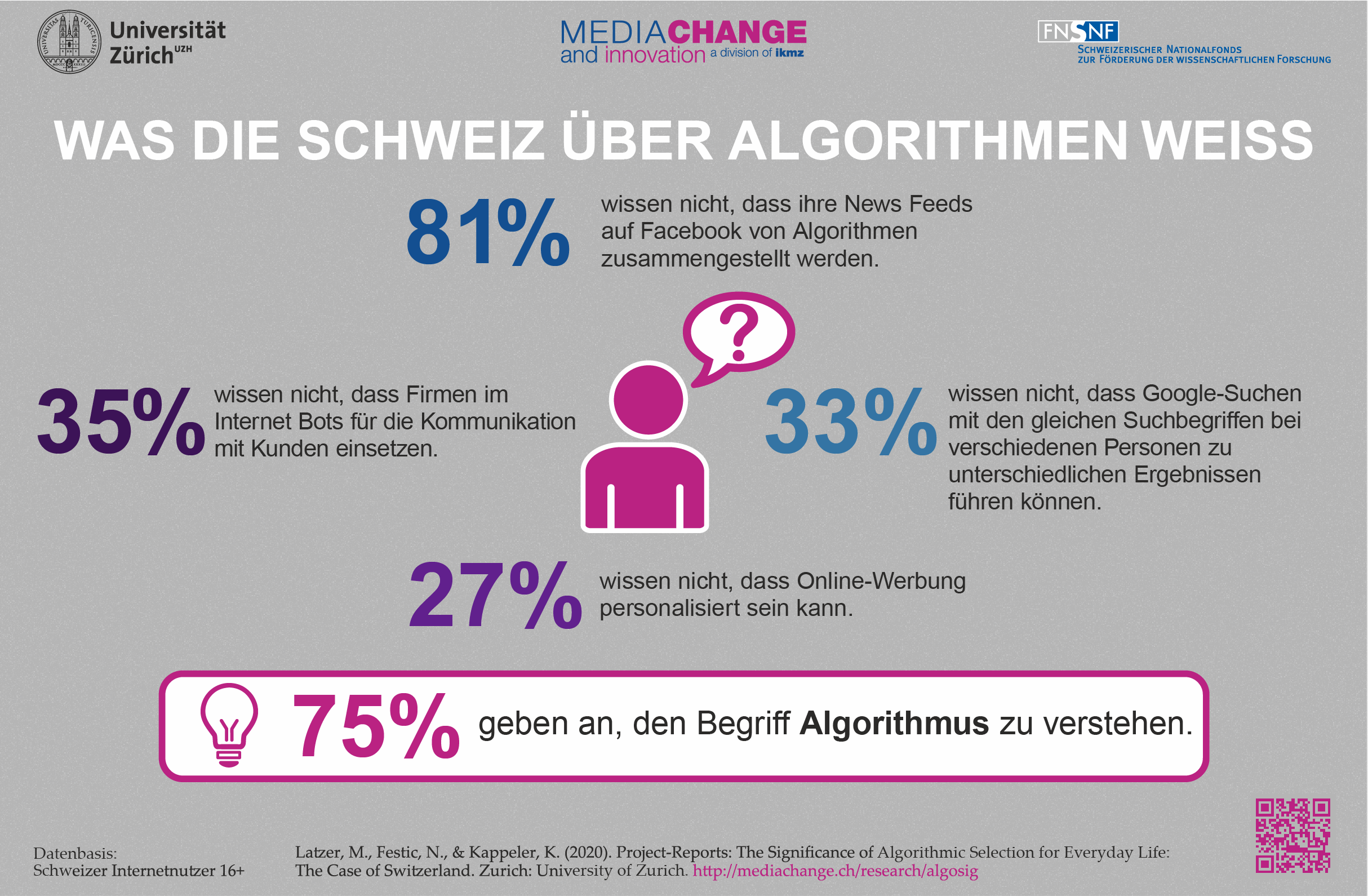
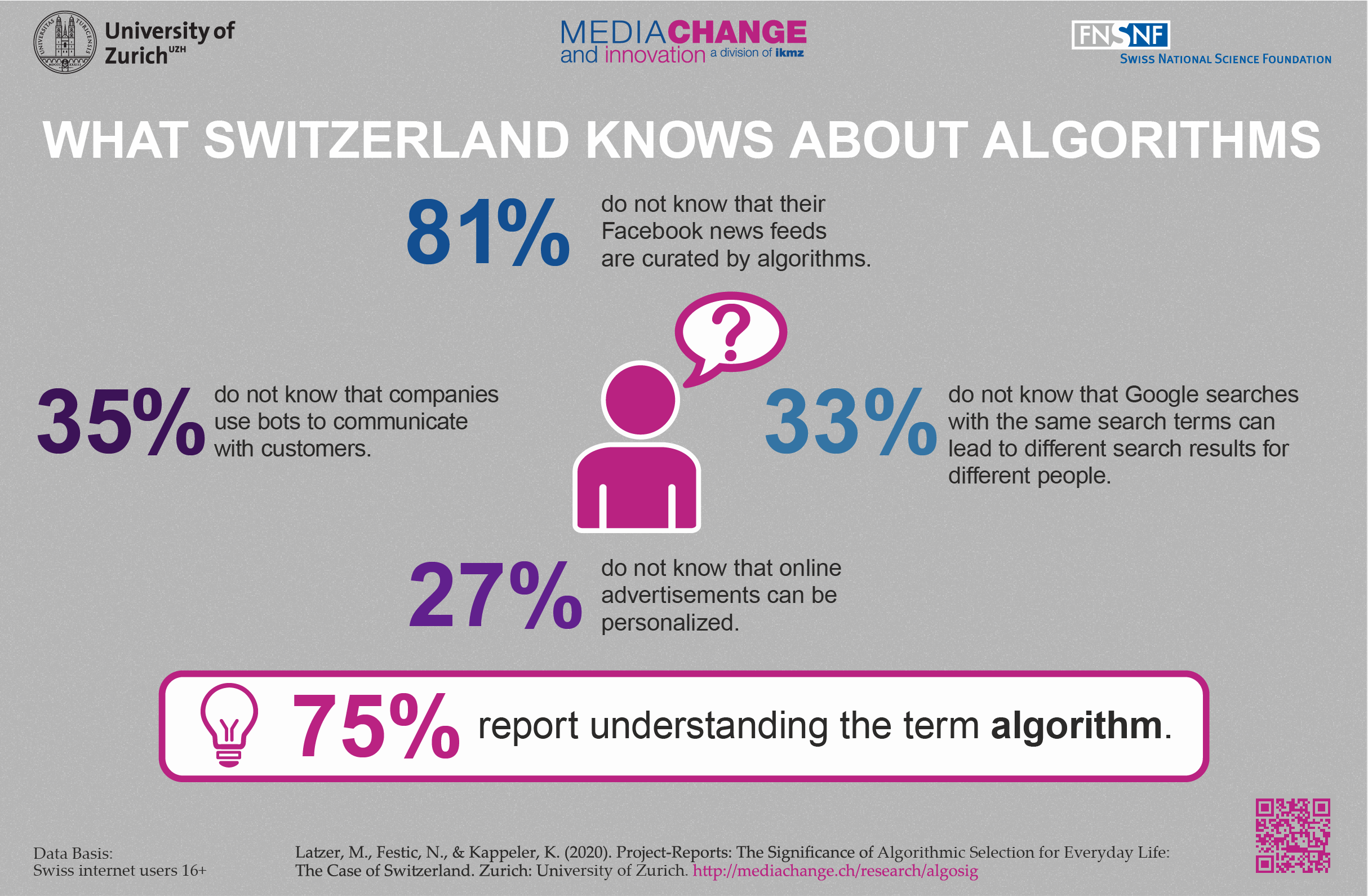
6th April 20Most internet users are confronted with algorithmic selection on a daily basis – but only some of them are aware of this. For example, two thirds (66%) realize that content displayed to them online is similar to what they have viewed in the past. Half of internet users (54%) sometimes feel that search results have been sorted specifically for them. Higher-educated and younger internet users more often report having such experiences with algorithms when using the internet. “Despite high daily use, there is astonishing ignorance. For instance, eight in ten do not know that their Facebook news feeds are curated by algorithms and not by humans,” explains Michael Latzer, Professor of Media Change & Innovation at the University of Zurich.
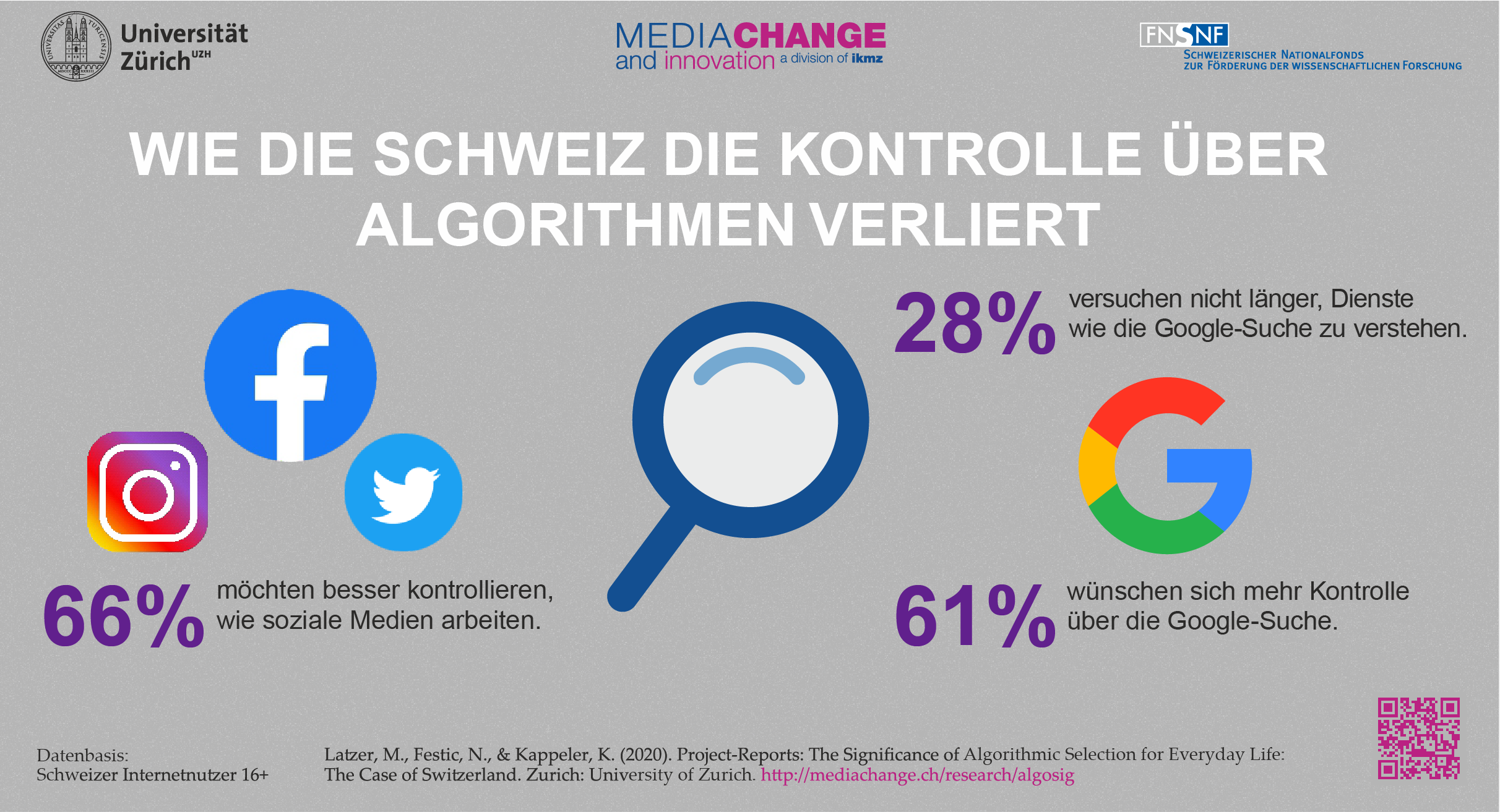
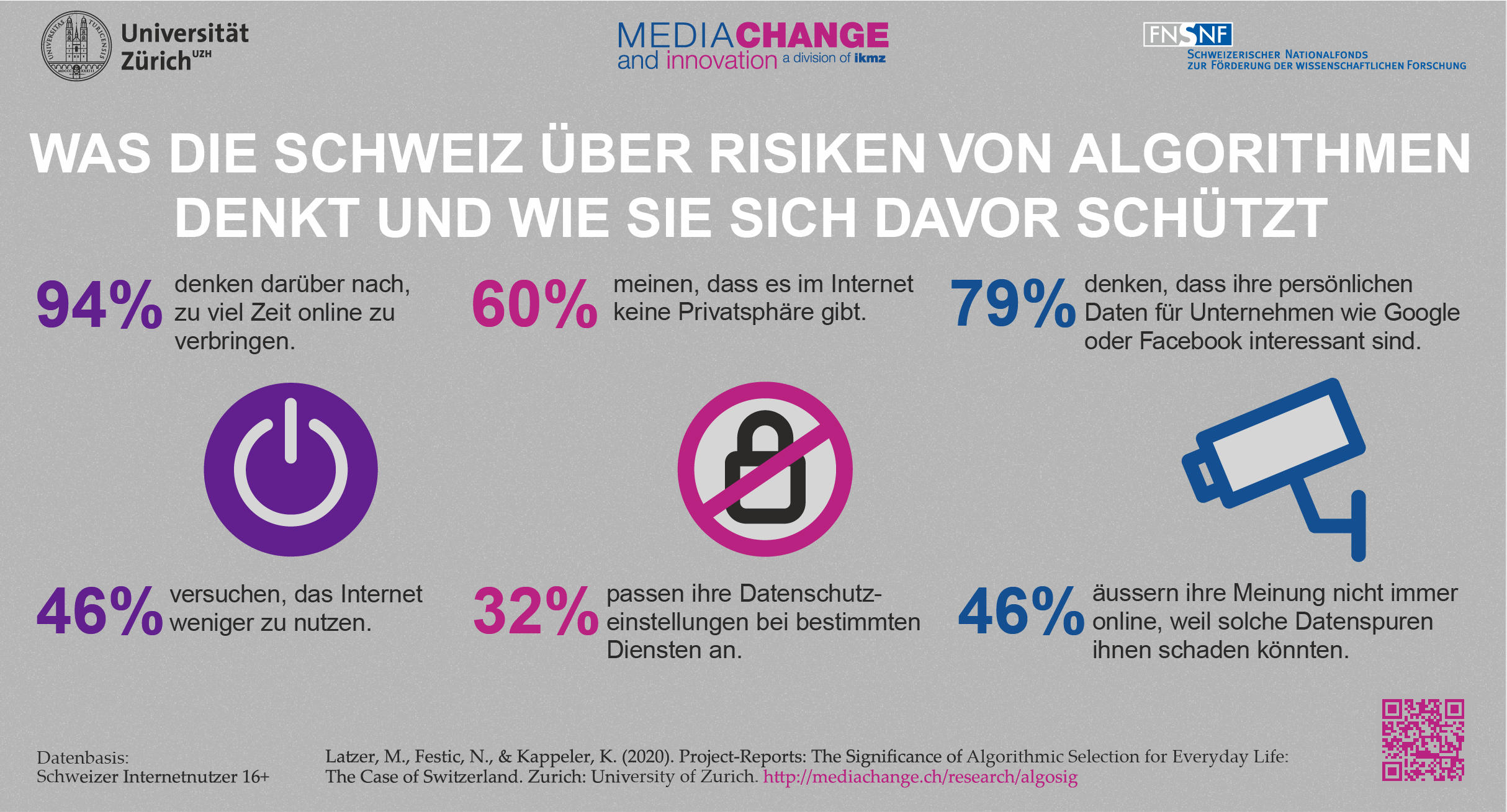
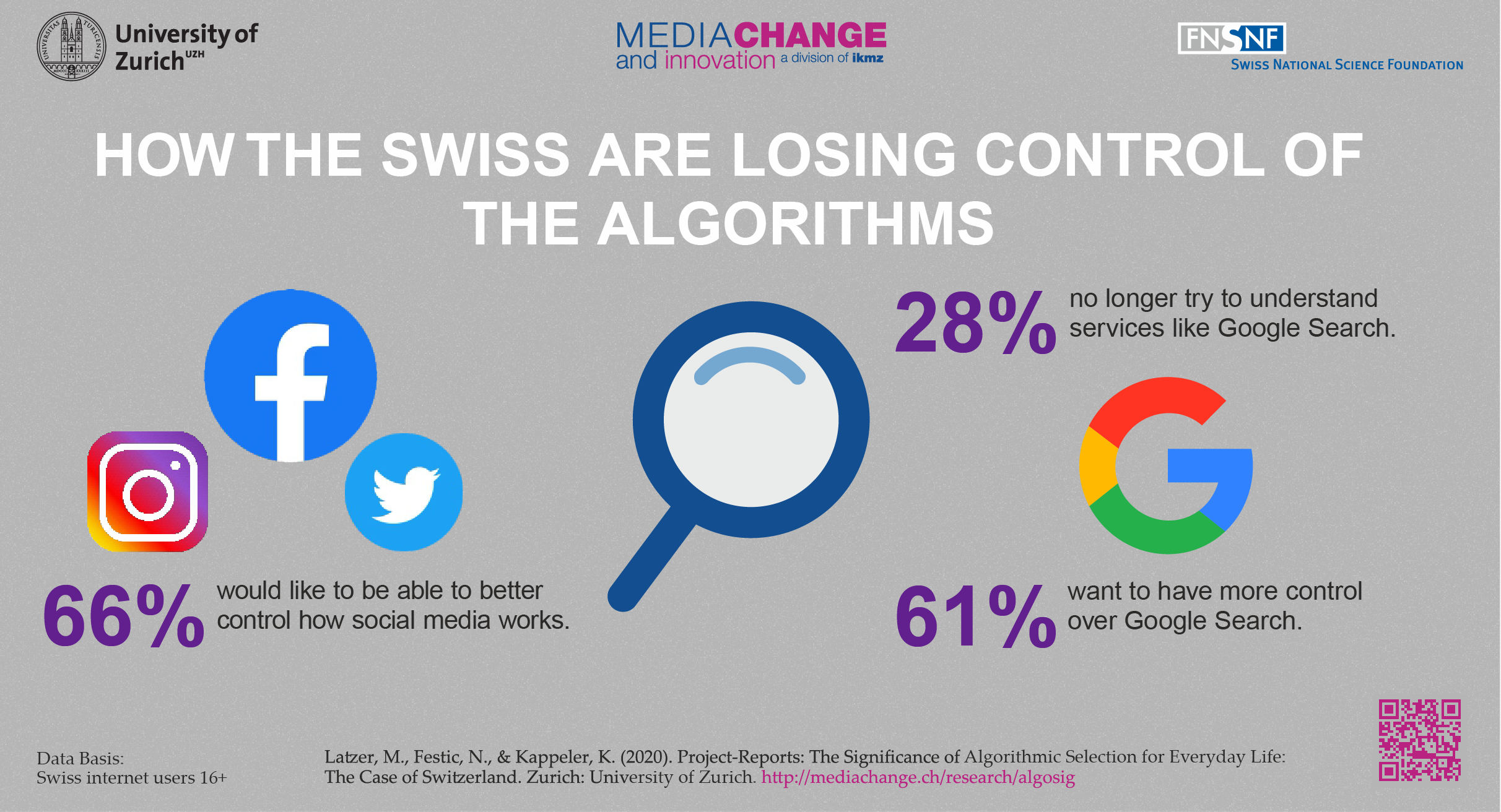
The survey further reveals that trust in algorithmic online services is low in Switzerland. Only a quarter of internet users (27%) state that they trust online services and just 14% consider most information on the internet to be trustworthy. If it were up to them, six out of ten users (59%) would not allow social media such as Facebook and Instagram any influence over topics that are important to them. A third (34%) also feel that they are completely losing control over their data on the internet. Such negative assessments tend to be more common among younger internet users. Six out of ten further believe that they have to accept that privacy no longer exists on the internet and 28% no longer even try to understand how services like Google Search work.
Michael Latzer summarizes: “It should not be neglected that the everyday life of average Swiss internet users is greatly influenced by algorithms, but they know little about them. This creates uncertainty in the population regarding the power of algorithms, results in low self-protection and a feeling of powerlessness. The resulting desire for more control and transparency must be taken seriously.”
Research Reports (Survey)
- Latzer, Michael / Festic, Noemi / Kappeler, Kiran (2020): Use and Assigned Relevance of Algorithmic-Selection Applications in Switzerland. Report 1 from the Project: The Significance of Algorithmic Selection for Everyday Life: The Case of Switzerland. Zurich: University of Zurich. http://mediachange.ch/research/algosig [forthcoming]
- Latzer, Michael / Festic, Noemi / Kappeler, Kiran (2020): Awareness of Algorithmic Selection and Attitudes in Switzerland. Report 2 from the Project: The Significance of Algorithmic Selection for Everyday Life: The Case of Switzerland. Zurich: University of Zurich. http://mediachange.ch/research/algosig [forthcoming]
- Latzer, Michael / Festic, Noemi / Kappeler, Kiran (2020): Awareness of Risks Related to Algorithmic Selection in Switzerland. Report 3 from the Project: The Significance of Algorithmic Selection for Everyday Life: The Case of Switzerland. Zurich: University of Zurich. http://mediachange.ch/research/algosig [forthcoming]
- Latzer, Michael / Festic, Noemi / Kappeler, Kiran (2020): Coping Practices Related to Algorithmic Selection in Switzerland. Report 4 from the Project: The Significance of Algorithmic Selection for Everyday Life: The Case of Switzerland. Zurich: University of Zurich. http://mediachange.ch/research/algosig [forthcoming]
News
Infographics







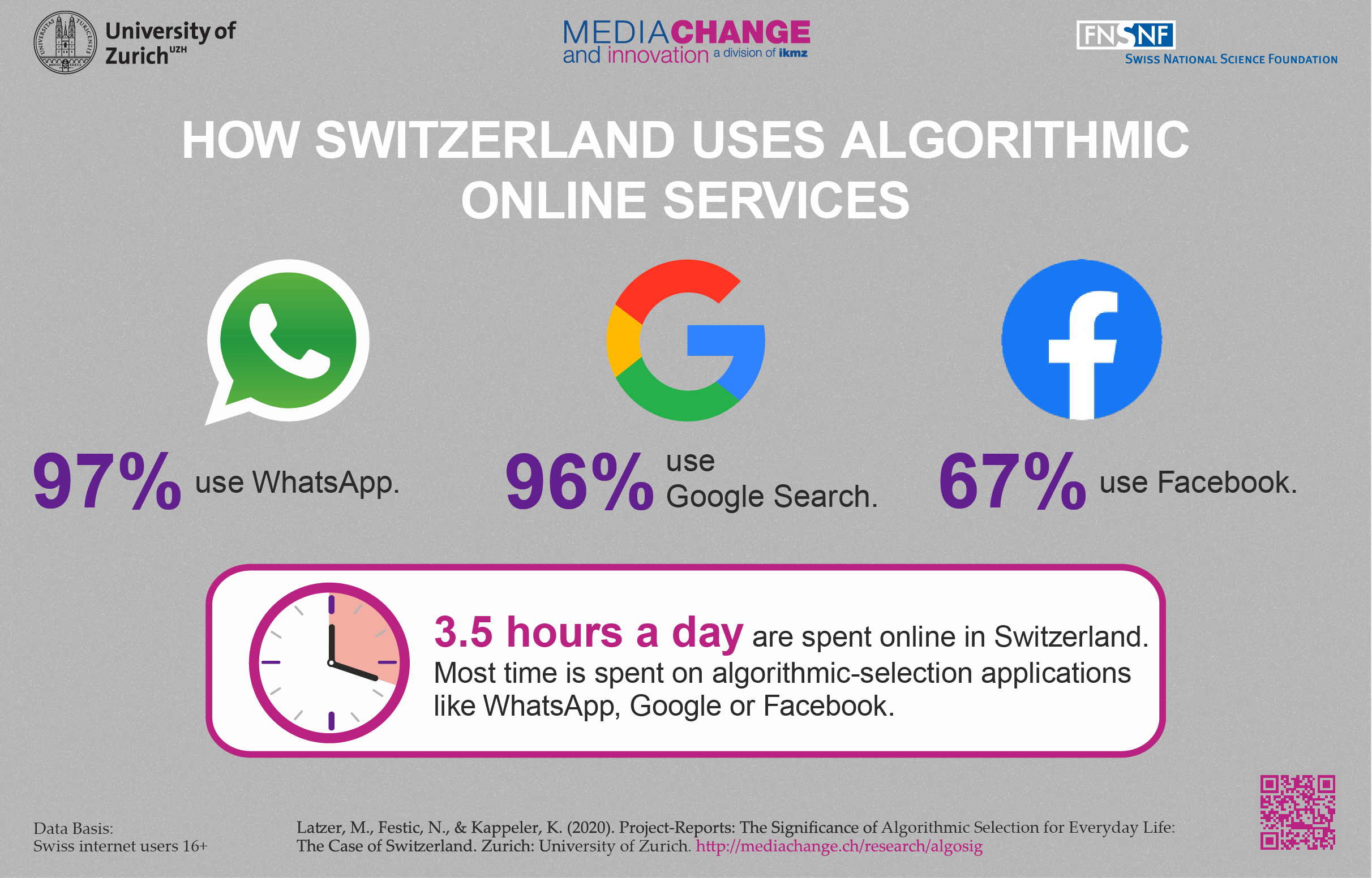
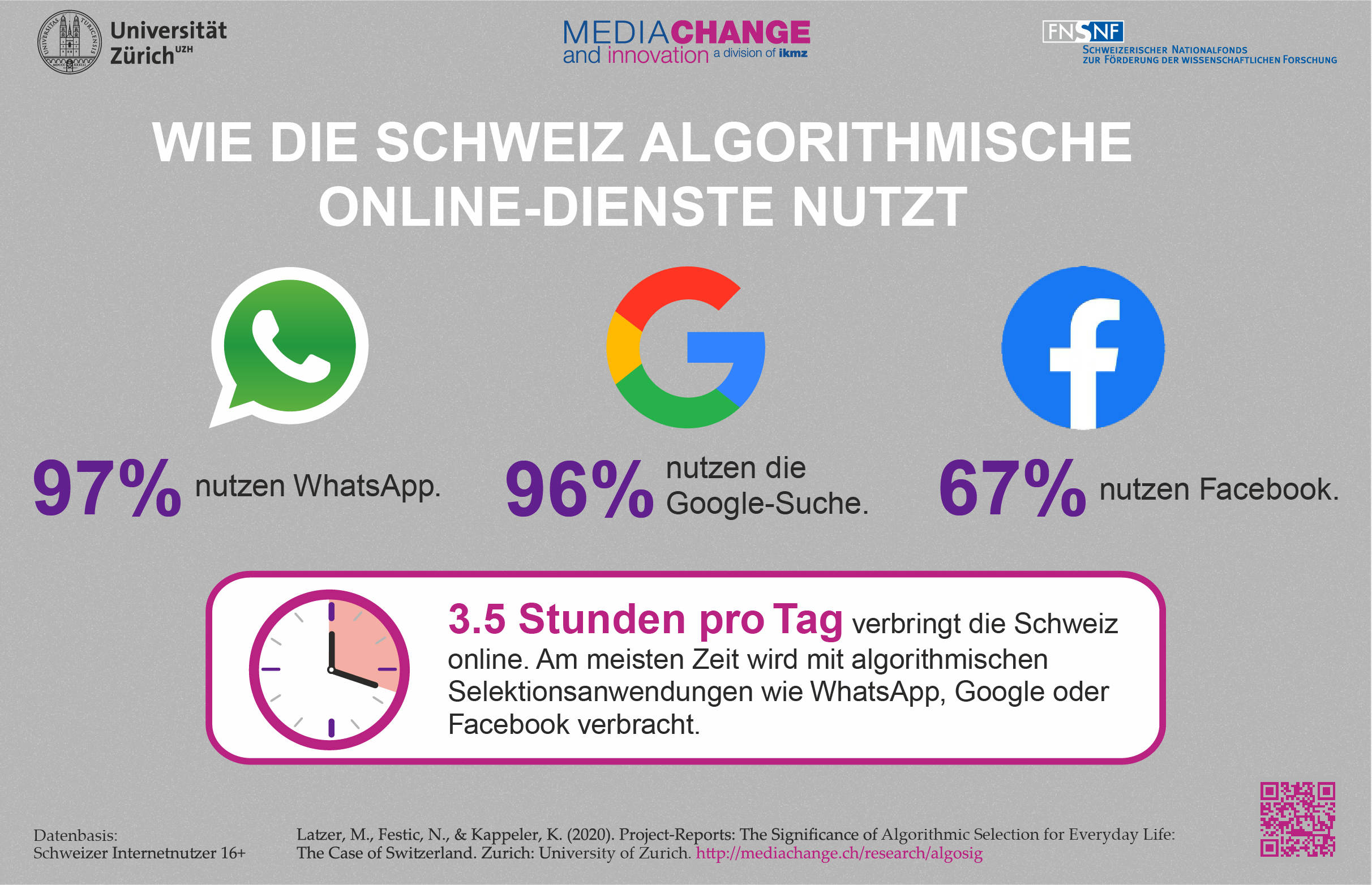
- How Switzerland uses algorithmic online services (English / German)
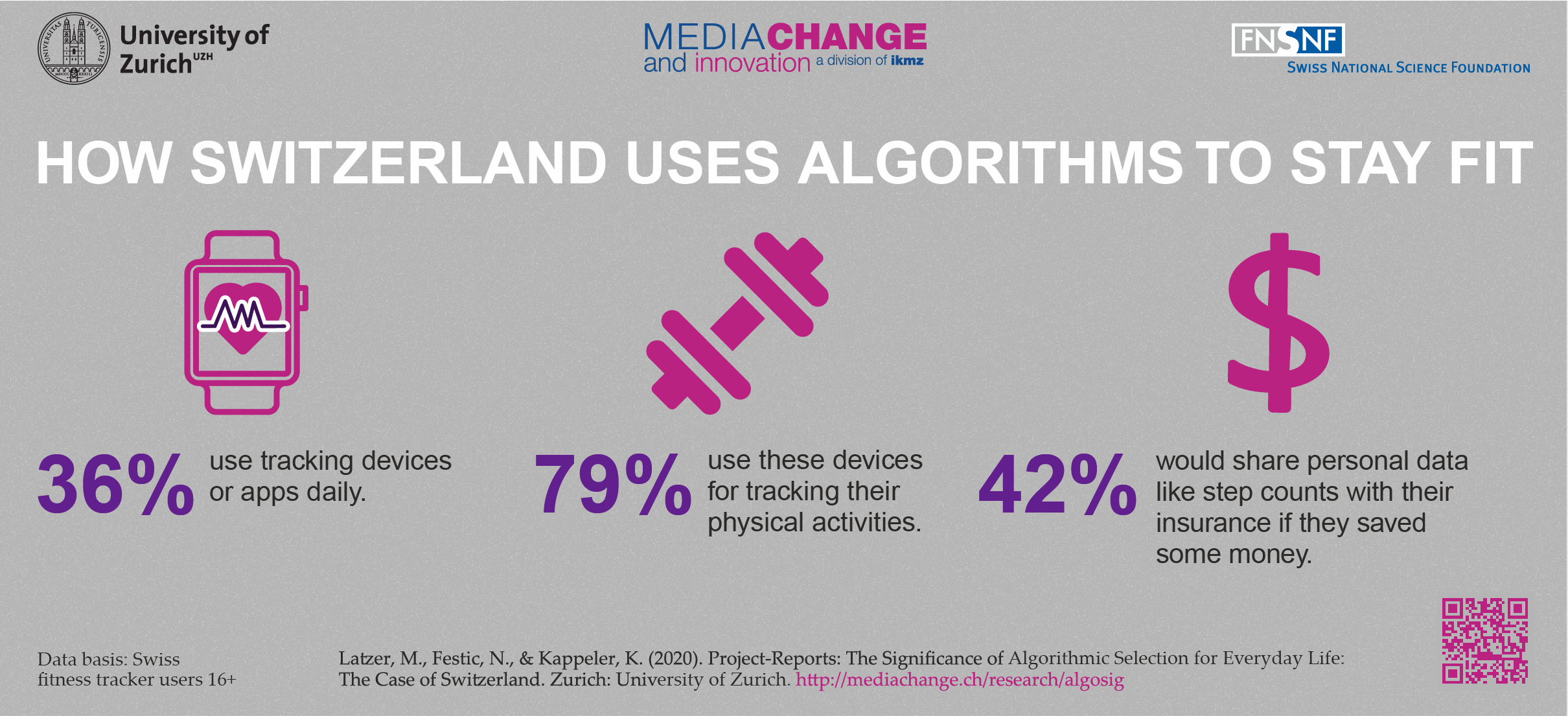
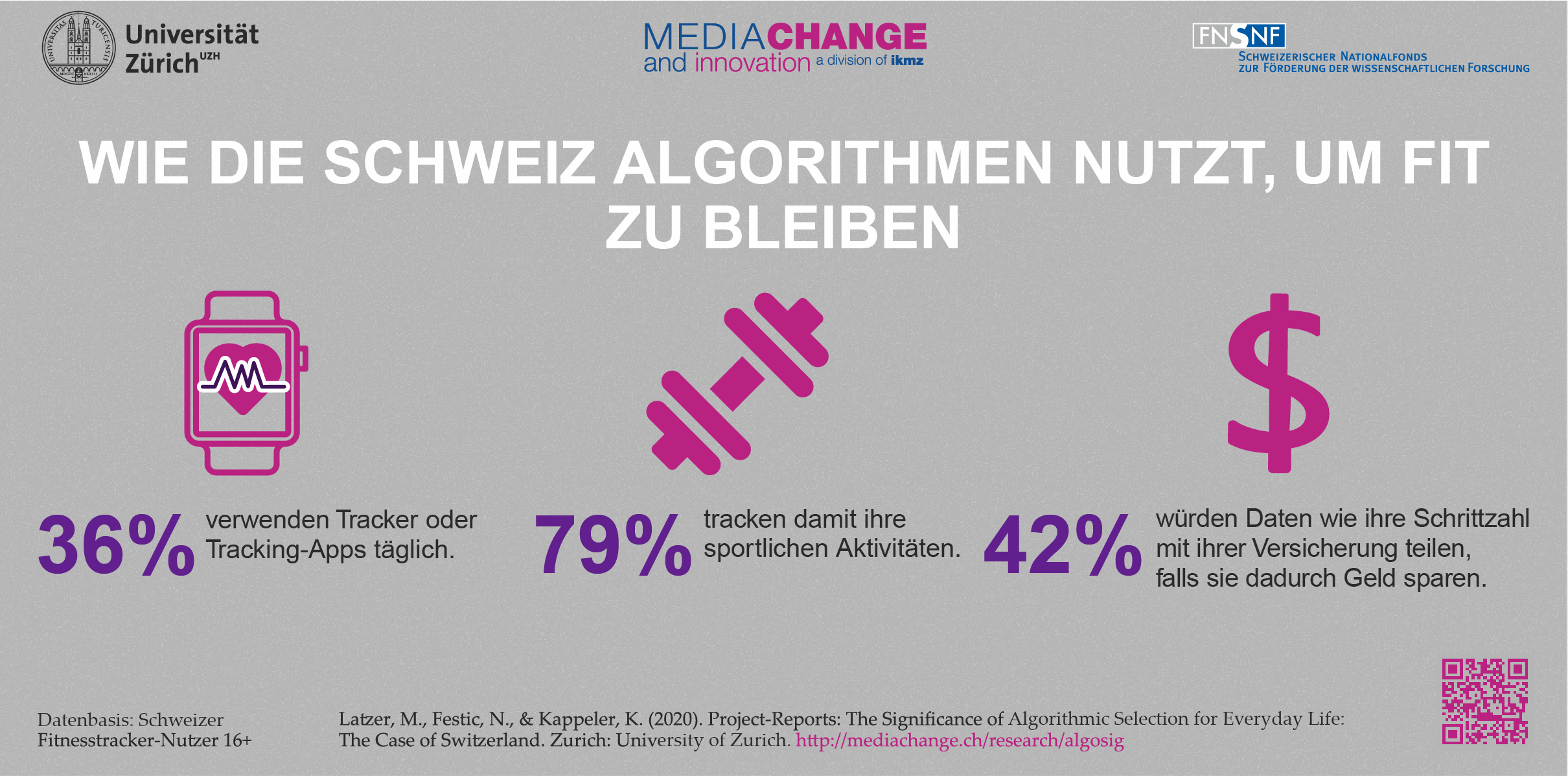
- How Switzerland uses algorithms to stay fit (English / German)
- What Switzerland knows about algorithms (English / German)
- How the Swiss are losing control of the algorithms (English / German)
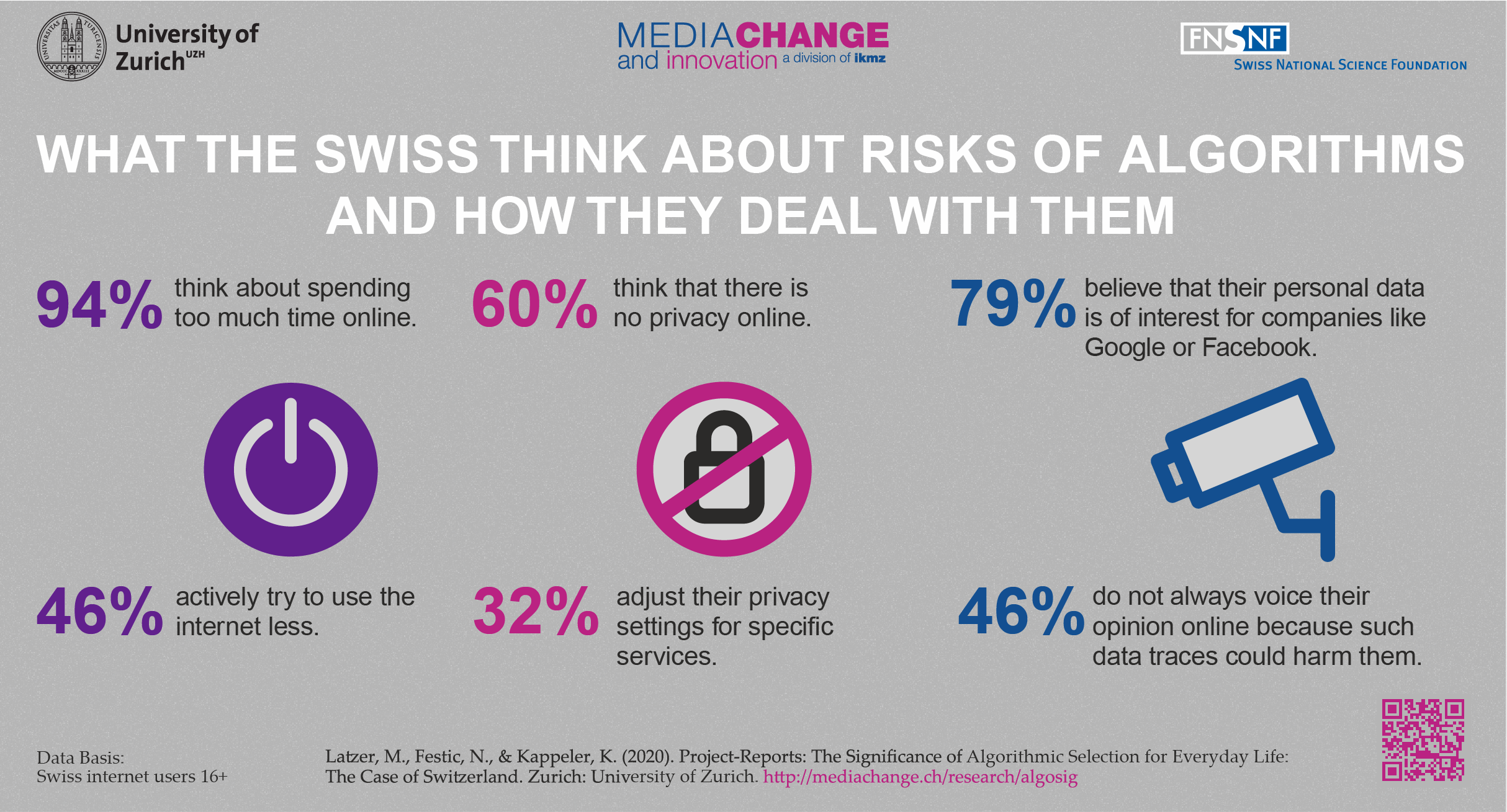
- What the Swiss think about risks of algorithms and how they deal with them (English / German)
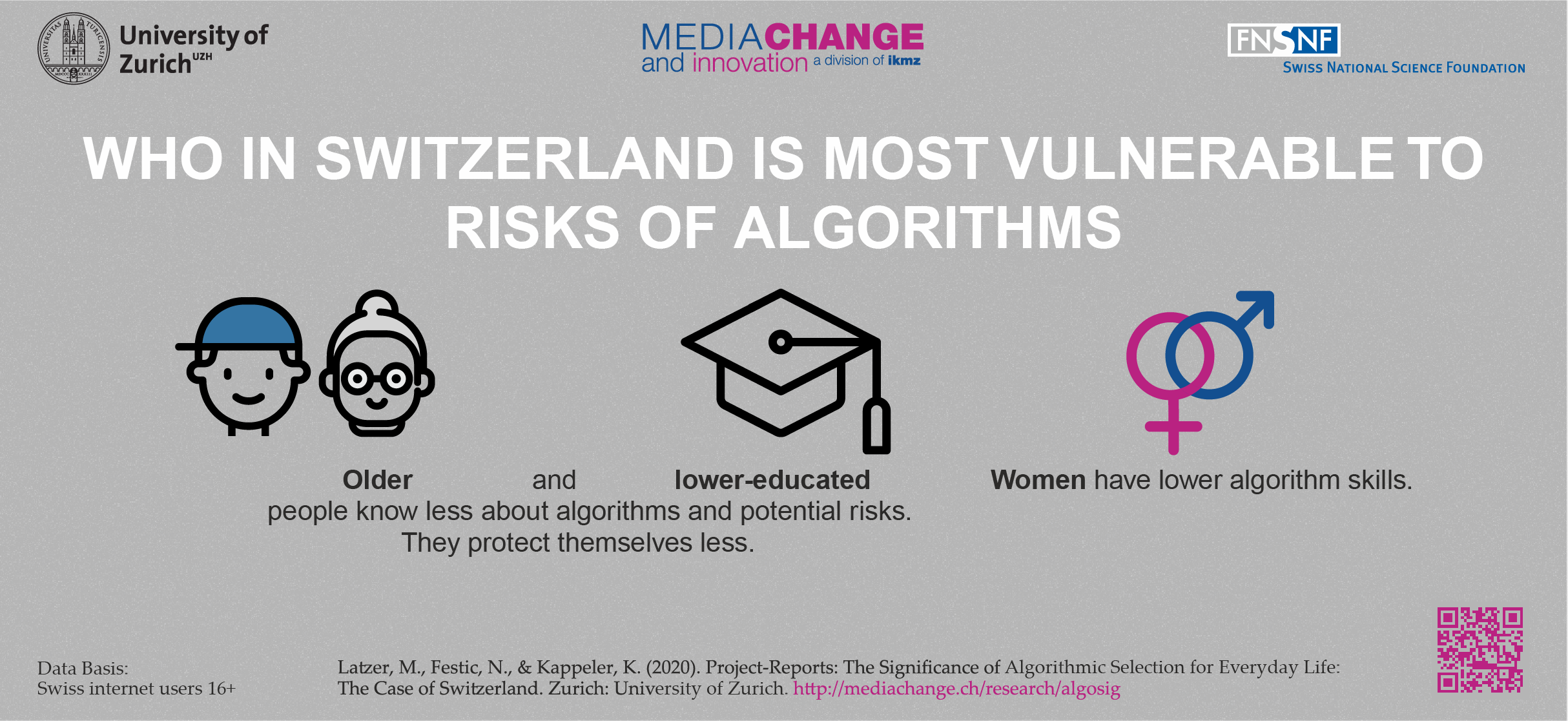
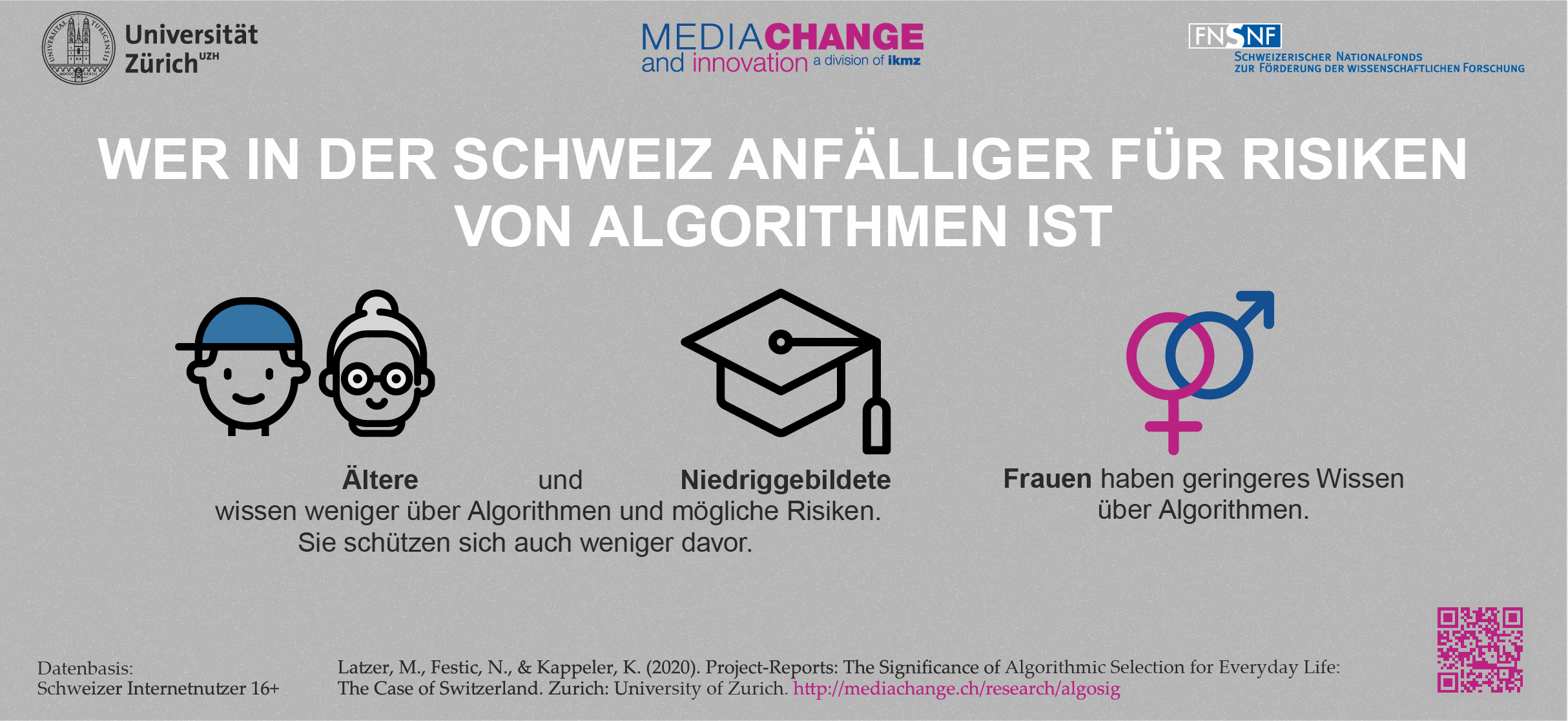
- Who in Switzerland is most vulnerable to risks of algorithms (English / German)
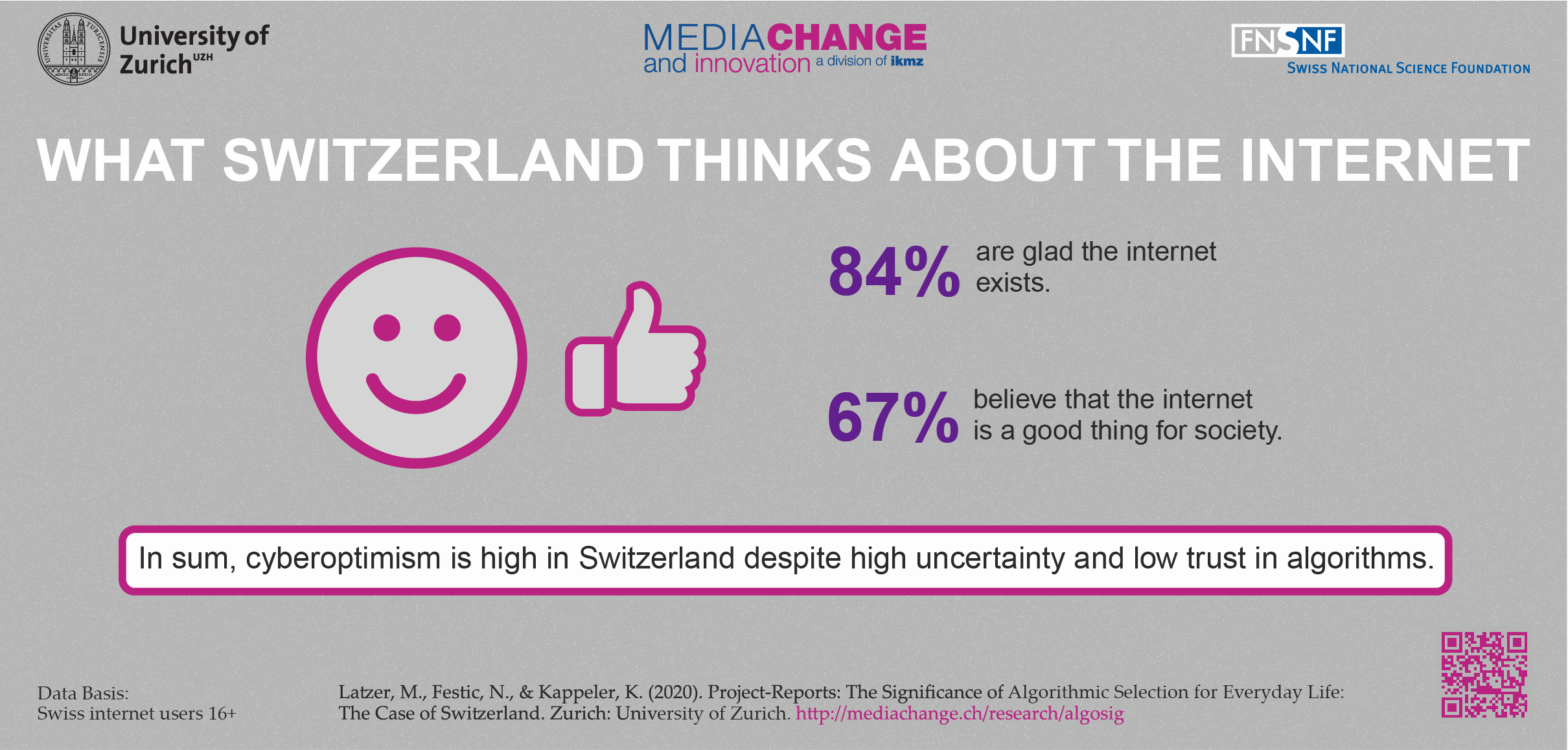
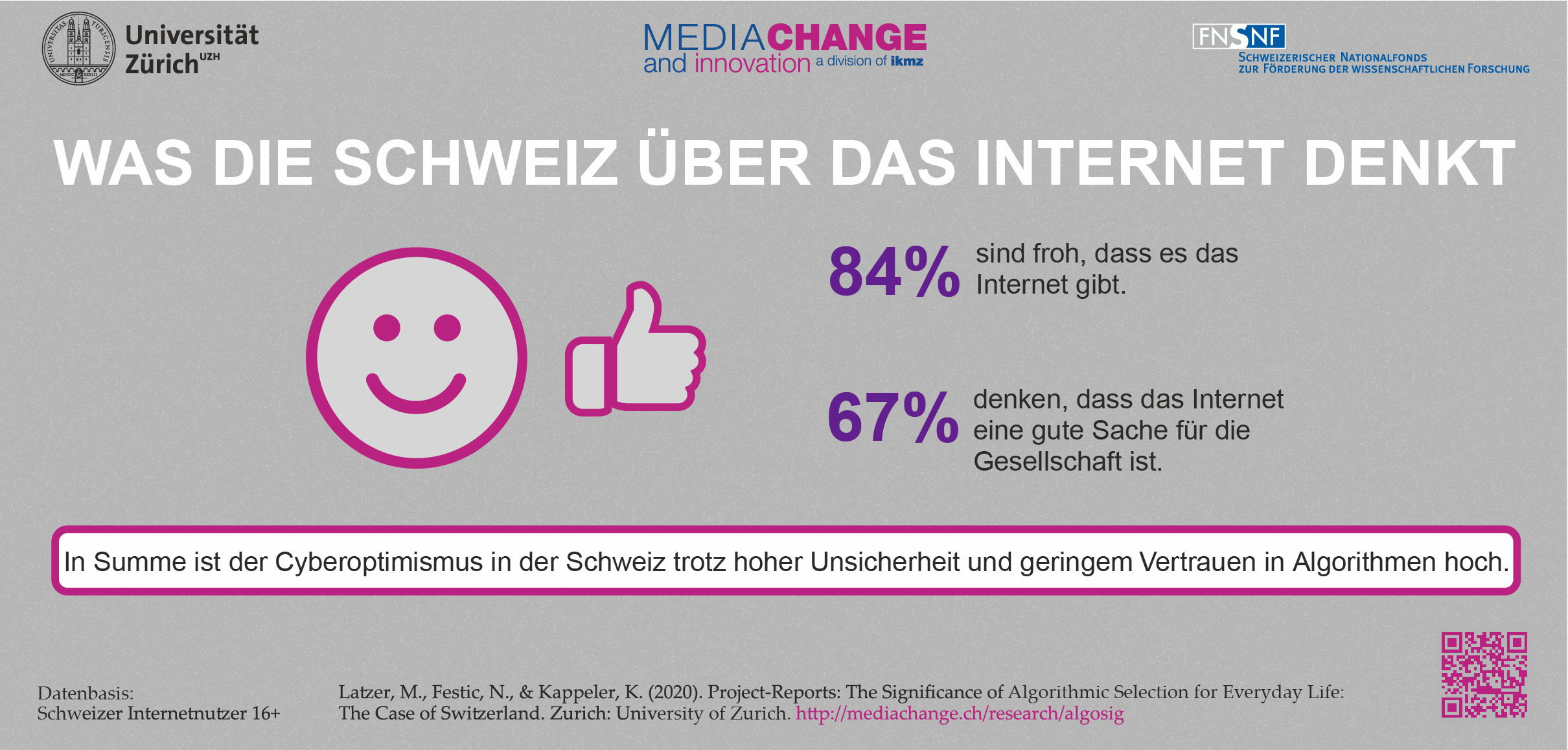
- What Switzerland thinks about the internet (English / German)
Selected Figures for Download
About the Project
The aim of the project “The Significance of Algorithmic Selection for Everyday Life: The Case of Switzerland” is to empirically investigate the significance of online applications that employ algorithmic selection for everyday life in Switzerland. The project evaluates use, awareness, risk awareness and protective behavior in five life domains: social and political orientation, commercial transactions, social interactions, entertainment and health.
The project is carried out by the Media Change & Innovation Division of the Department of Communication and Media Research (IKMZ) at the University of Zurich under the direction of Prof. Michael Latzer. It is based on a representative online survey of 1,202 internet users aged 16 and over, conducted by the LINK Institute from November 2018 to January 2019. The method-mix further included qualitative interviews and a representative tracking of the respondents’ internet usage behaviour using passive metering software. The project is supported by the Swiss National Science Foundation (SNF).
-
Out now in Oxford Research Encyclopedia Communication. Our systematic review of the debate on the impact of and policy reactions to algorithmic-selection applications on the internet. You can access the article here: http://dx.doi.org/10.1093/acrefore/9780190228613.013.904 or directly on our homepage: https://mediachange.ch/media/pdf/publications/Latzer_Just_2020_Governance-by-and-of-Algorithms.pdf
Internet-based services that build on automated algorithmic selection processes, for example search engines, computational advertising, and recommender systems, are booming and platform companies that provide such services are among the most valuable corporations worldwide. Algorithms on and beyond the Internet are increasingly influencing, aiding, or replacing human decision-making in many life domains. Their far-reaching, multifaceted economic and social impact, which results from the governance by algorithms, is widely acknowledged. However, suitable policy reactions, that is, the governance of algorithms, are the subject of controversy in academia, politics, industry, and civil society. In our article we provide an overview on the approaches, assessments and debates regarding the governance by and of algorithms on the internet.
-
Internet Use in Switzerland 2011–2019: Trends, Attitudes and Effects
17th February 20The new World Internet Project – Switzerland summary report highlights major developments and trends of the past decade, based on our representative, long-term biennial studies since 2011 with more than 5500 respondents.
In 2019 more people are online than ever: Today, 92% of the Swiss population use the Internet. Internet penetration in Switzerland is thus among the highest worldwide. One major trend of the 2010s has been the rise of the mobile Internet with now 80% of the population using it compared to 20% a decade ago. The number of non-users has been more than halved in the past eight years. Four out of ten non-users benefit indirectly from the Internet by having others buy something online, search for information, or write emails on their behalf. In 2019, the Internet remains the most important media source for both entertainment and information purposes and is of even greater importance in 2019 than in the years before. Overall, the self-evaluation of Internet users in Switzerland regarding their Internet skills has been remarkably stable since 2011. Women rate their Internet usage skills as poorer compared to men; nearly all 14–19-year-olds rate their skills as very good or excellent. Average usage time has doubled since 2011 and now amounts to 25 hours per week.
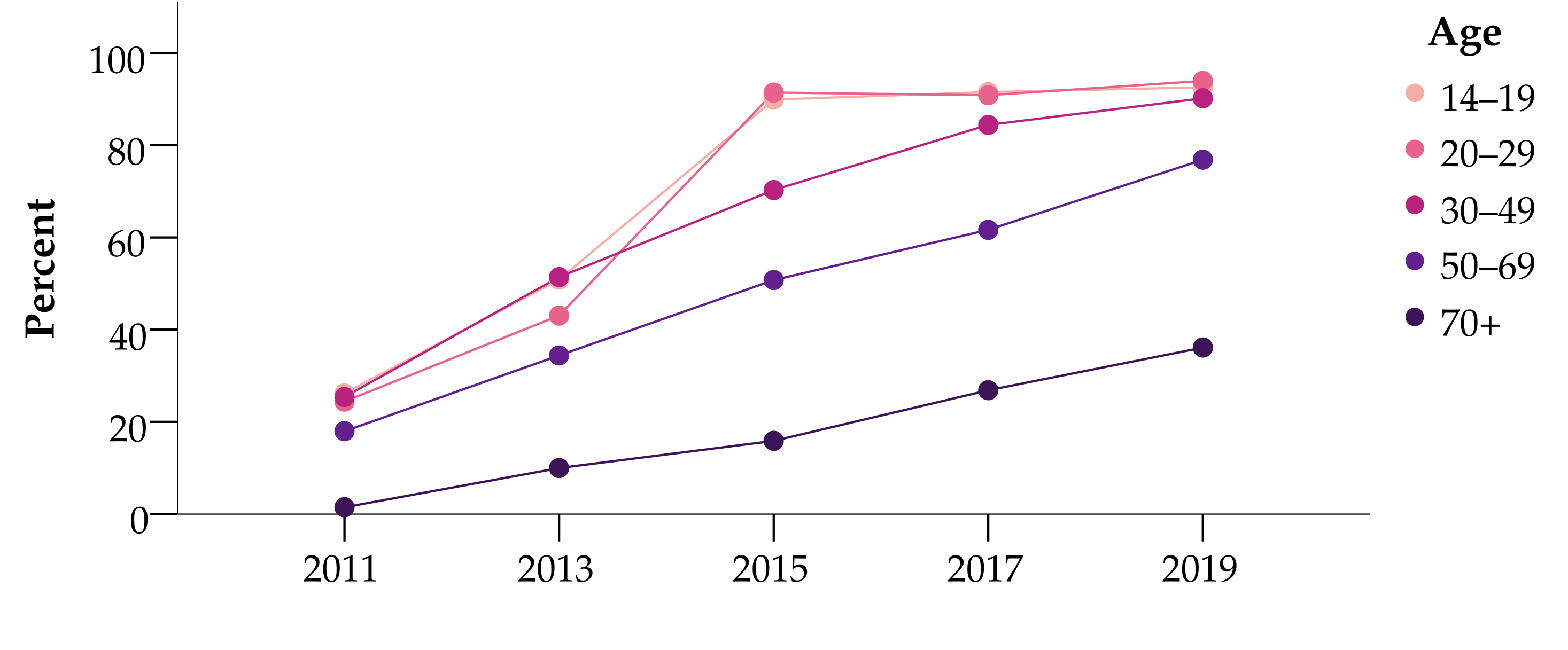
Diffusion of Mobile Internet by Age 2011–2019 in Switzerland | Data basis: Swiss population 14+, WIP-CH.
The Swiss population is skeptical that the Internet can improve the democratic quality of the politics in Switzerland. Surveillance possibilities prompt users to censor their self-expression and information seeking online. A majority acknowledges further risks of Internet use. Around three quarters of respondents worry that people rely too much on the Internet. Especially young users also experience digital overuse. Nevertheless, generally, digital well-being is high as Swiss Internet users rate their abilities to cope with the challenges of the digital era as high.
The English-language summary report, four special reports (in German), and further information is available here.
-
People who use search engines or express their opinions on Facebook and WhatsApp leave behind many digital traces. Internet users believe that these traces are used for surveillance purposes. According to the UZH study, 43 percent of the 1,122 people surveyed believe that online surveillance is detrimental to society. In addition, a large proportion of Swiss Internet users (45 percent) is concerned that companies like Facebook are violating their privacy online. One consequence of this is that Internet users restrict themselves online: more than half state that the possible surveillance dissuades them from searching for information freely (59 percent) – e.g., researching sensitive political content – or from expressing opinions, interests or feelings (56 percent). "Chilling effects due to perceived surveillance are alarming from a democratic political point of view," emphasizes Michael Latzer, Professor of Media Change & Innovation at the University of Zurich. "They threaten the exercise of fundamental rights and social participation via the Internet."
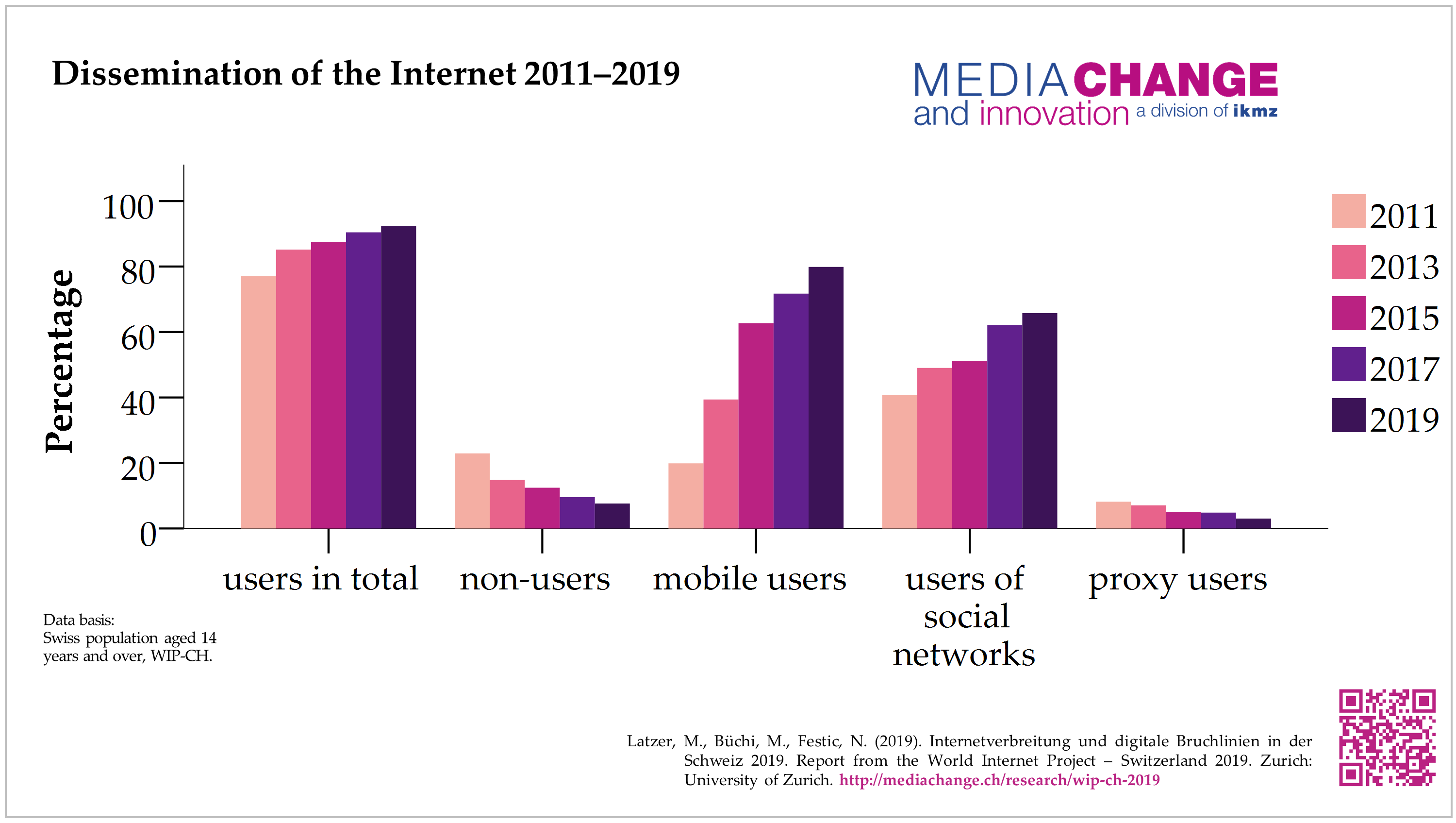
The survey shows that in 2019, more people are online than 2017. 92 percent of the Swiss population use the Internet today, it is almost 100 percent of the under 50 year-olds. 80 percent of the total population also use mobile Internet. The average usage time has doubled since 2011 and now amounts to 25 hours per week. However, 40 percent of offliners benefit indirectly from the Internet by having others do research or tasks for them. The number of non-users has been more than halved in the last eight years. The absolute number of non-users (excluding proxy users) in Switzerland is thus around 340,000. On average, the self-evaluation of Internet users in Switzerland regarding their Internet skills has been relatively stable since 2011. Women rate their Internet usage skills as poorer compared to men.
Special Reports 2019 (Themenberichte)
News
About the Project
Th
 e Media Change & Innovation Division is the Swiss country partner of the World Internet Project (WIP). This international, collaborative project is looking at the social, political and economic impact of the Internet and other new technologies. The project started in 1999 and is chaired by Prof. Jeff Cole from the Annenberg School Center for the Digital Future, University of Southern California (USC), Los Angeles. The consortium includes more than 25 partners in countries and regions all over the world. The WIP conducts detailed, international comparative longitudinal studies on the use and impact of the Internet, publishes national and international reports and holds annual conferences. The representative Swiss WIP-CH 2019 survey (computer-assisted telephone interviews) was supported by the Federal Office of Communications.
 -
Digital Well-Being – Moritz Büchi starting project as Digital Society Initiative Fellow
31st July 19Starting in the fall semester 2019, Moritz Büchi will hold a one-year Fellowship from the Digital Society Initiative, University of Zurich. The supported project addresses the question of what the effects of new ICTs on users’ well-being are and will focus in particular on the theoretical foundations of digital well-being research.
-
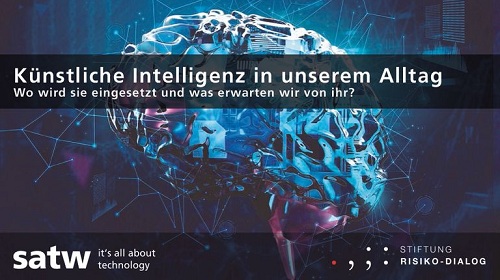
Am Donnerstag, 6. Juni 2019 veranstaltet die Schweizerische Akademie der technischen Wissenschaften einen öffentlichen Workshop zum Thema "Künstliche Intelligenz in unserem Alltag". Interessierte Bürger und Bürgerinnen können sich über satw.ch/KI anmelden und auf der Veranstaltung aktiv mitdiskutieren. Tanja Rüedy und Michael Reiss sind mit Input zur Thematik "KI in Fake News & Filter Bubble" vor Ort präsent. Herzliche Einladung an alle Interessierten, wir freuen uns auf eine spannende Veranstaltung.
-
Moritz Büchi participated in a workshop and international webinar on "Tackling Digital Inequalities: Outcomes Based Approaches and Methodological Innovation" at the London School of Economics and Political Science. The event included invited academics from around the world and various stakeholders such as the Citizens Online charity. It was organized and led by Ellen Helsper as part of the Digital Skills to Tangible Outcomes project.
-
Algorithmic decision making and online platforms - Michael Latzer @ European Commission workshop
24th January 19Michael Latzer will participate in the expert workshop “Algorithmic decision-making and online platforms”, organized by the Directorate for the Digital Single Market of the European Commission. The workshop on January 25th will focus on “algorithmic awareness building” and “emerging governance and policy approaches”. Michael Latzer will present a governance-choice method to find the right mix of public and private interventions, and a mixed-method approach to empirically explore the significance of algorithmic selection in everyday life from a user-perspective.
-
Open Positions @ MC&I
15th January 19The Media Change & Innovation Division (Prof. Dr. Michael Latzer) at the IKMZ – Department of Communication and Media Research, University of Zurich invites applications for:
or
1 Doctoral researcher / PhD student
in Internet, Algorithms and Society
Read the full job descriptions here: http://mediachange.ch/open-positions/
Contact: Dr. Moritz Büchi (m.buechi@ikmz.uzh.ch)
Starting date: May 2019 or as agreed upon
-
Neues Video zum Medienwandel in der Schweiz
5th December 18„Funktioniert dein Alltag noch ohne Internet?"
Es gibt ein neues Video zum Medienwandel in der Schweiz. Die Abteilung Medienwandel & Innovation (Prof. Michael Latzer) des Instituts für Kommunikations- wissenschaft und Medienforschung (IKMZ) der Universität Zürich gibt damit einen kurzen Einblick in ihre Forschung. Das Video fasst wissenschaftliche Befunde zusammen, geht auf gegenwärtige Entwicklungen ein und bietet Anstoss für Diskussionen über die Digitalisierung und ihre Auswirkungen.
(If the video below does not show, please click here to see it on YouTube: Media Change in Switzerland 2018)
Die Themen reichen vom Internetnutzungsverhalten der Schweizer Bevölkerung, über die Dominanz von US-Plattformfirmen und die Bedeutung automatisierter, algorithmischer Entscheidungen für den Alltag, bis hin zu Auswirkungen der Internetnutzung auf unser Wohlbefinden.
Infos zum Film
Gesamtleitung: Prof. Dr. Michael Latzer
Projektleitung: Noemi Festic, Benjamin Gerwoll-Ronca, Julian Wallace, Kevin Witzenberger
Recherche: Benjamin Gerwoll-Ronca, Kiran Kappeler, Julian Wallace, Kevin Witzenberger, Luca Gnos, Tanja Rüedy, Michael Reiss
Animation: Matyas Fabian
Musik: Luca Gnos, J.A.Y.F.O.X.
-
New Team Members - Michael Reiss and Tanja Rüedy
6th November 18
Welcome, Michael and Tanja!
Michael Reiss, M.Sc., joined the Media Change & Innovation Division at the Department of Communication and Media Research (IKMZ) as Research and Teaching Associate in September 2018.
Tanja Rüedy, B.A., joined the Media Change & Innovation Division at the Department of Communication and Media Research (IKMZ) as Student Assistant in October 2018.
We are looking forward to working with them as new members of the IKMZ team!
-
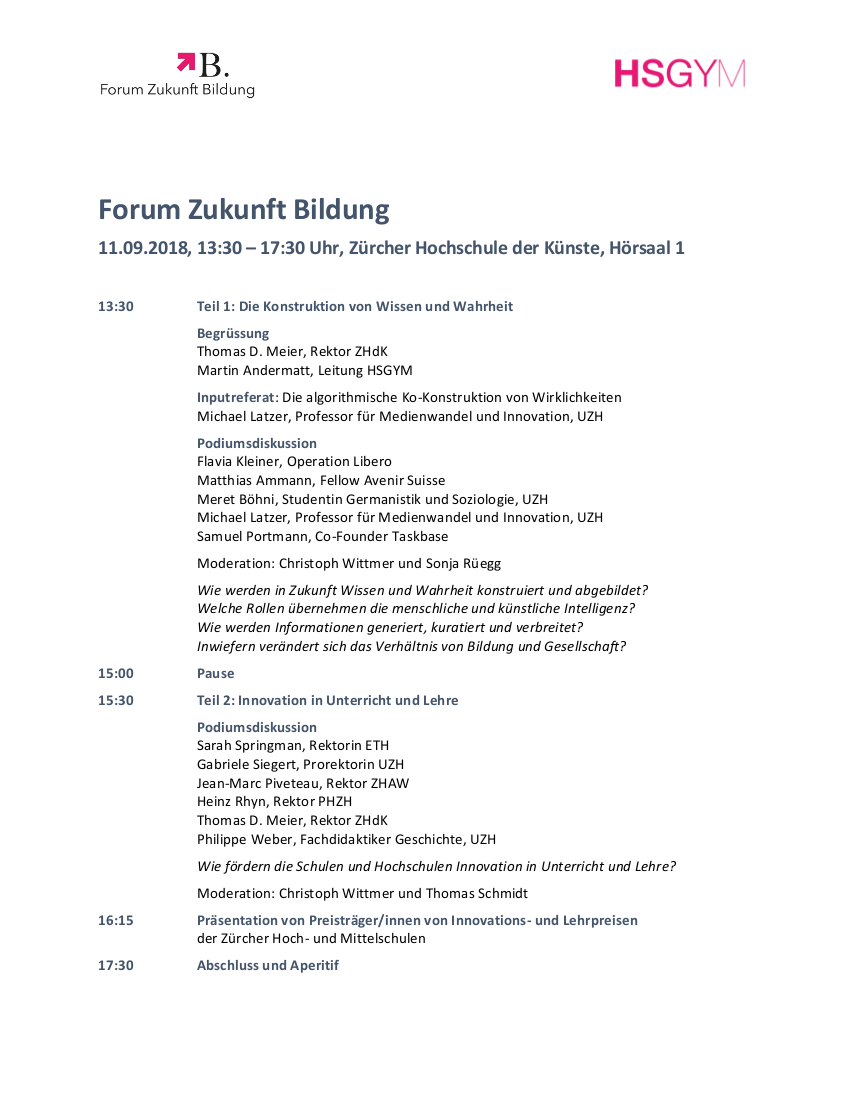
Michael Latzer @ Forum Zukunft Bildung 2018
4th September 18Wie werden in Zukunft Wissen und Wahrheit konstruiert und abgebildet? Welche Rolle spielen menschliche und künstliche Intelligenz, individuelles und „maschinelles“ Lernen? Wie werden Informationen generiert, kuratiert und verbreitet?
Prof. Dr. Michael Latzer spricht auf dem diesjährigen Forum Zukunft Bildung 2018 über die algorithmische Ko-Konstruktion von Wirklichkeiten.
-
Open Positions @ MC&I
21st June 18The Media Change & Innovation Division (Prof. Dr. Michael Latzer) at the IKMZ – Department of Communication and Media Research, University of Zurich invites applications for:
and
1 Doctoral researcher / PhD student
in Internet, Algorithms and Society
Read the full job descriptions here: http://mediachange.ch/open-positions/
Contact: Dr. Moritz Büchi (m.buechi@ikmz.uzh.ch)
Starting date: September 2018 or as agreed upon
The University of Zurich strives for the equality of men and women in academic positions and therefore particularly invites applications of qualified female researchers.
-
The Media Change & Innovation Division of IKMZ has started a new research project that empirically investigates the significance of automated algorithmic selection applications for central domains of everyday life: political orientation, commercial transactions, socializing and recreation.
- How extensively are algorithmic selection applications used in different domains of everyday lives?
- What subjective importance do people attribute to algorithmic selection applications?
- How aware are people of algorithms, and how do they react to identified risks?
This project (Significance of Algorithmic Selection), chaired by Prof. Michael Latzer and supported by the Swiss National Science Foundation (SNF), applies an innovative mixed-methods research design to answer these questions: It includes qualitative interviews and the combination of a representative Swiss online survey with the tracking (passive metering) of online activities both on desktop/laptop computers and mobile devices.
The results of this first country-wide, representative empirical study will provide an empirical basis for public policies.
-
New Team Member - Kevin Witzenberger
18th May 18 Kevin Witzenberger, M.Sc., joined the Media Change & Innovation Division at the Department of Communication and Media Research (IKMZ) as Research and Teaching Associate in February 2018. Welcome, Kevin!
 -
Im Interview mit dem Magazin Gesunde Stadt (Frühling 2018) spricht Prof. Michael Latzer über die Digitale Dreifaltigkeit von Daten, Algorithmen und Plattformen sowie über Chancen und Risiken der Automatisierung im Gesundheitsbereich.
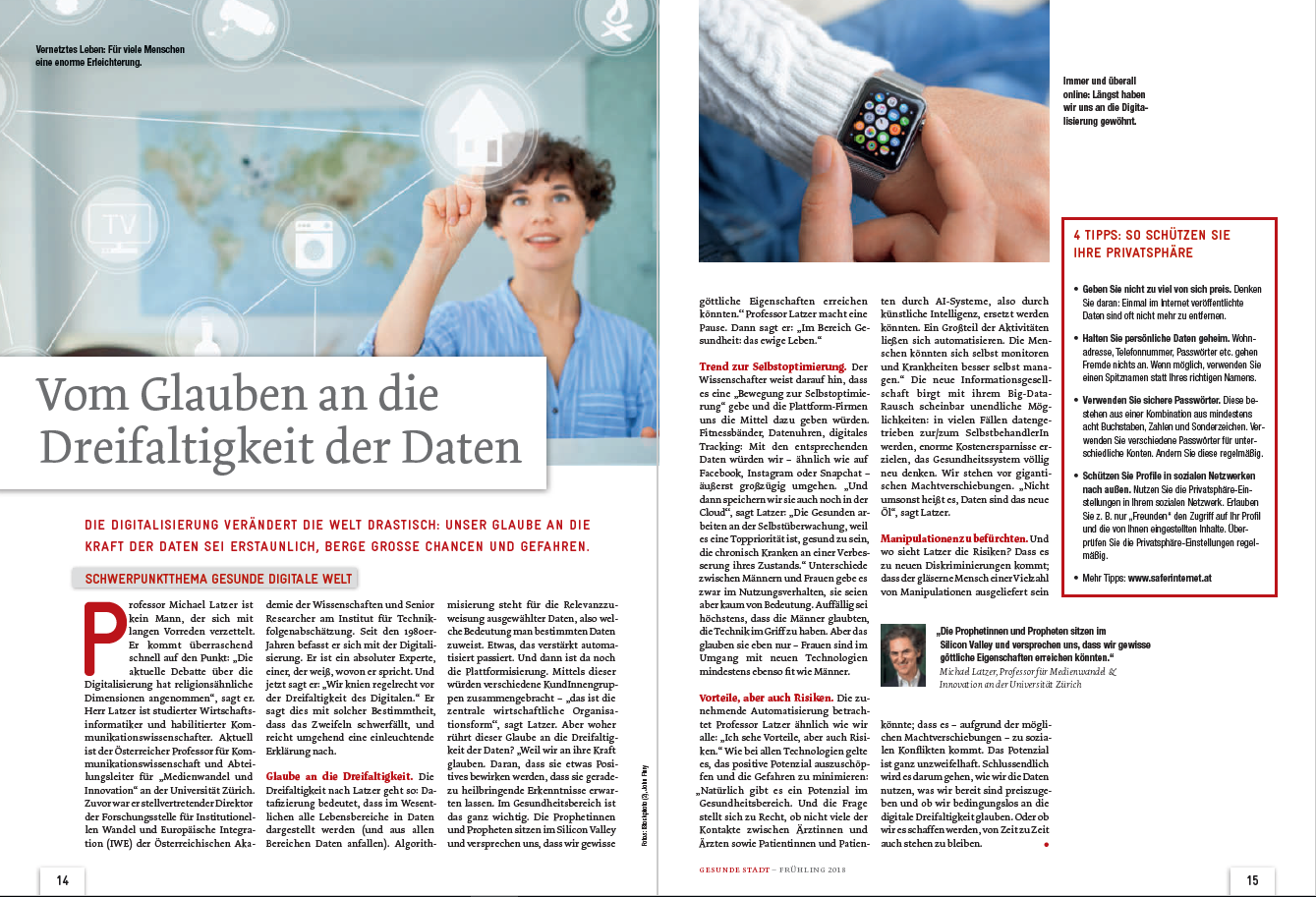
«Vom Glauben an die Dreifaltigkeit der Daten», Interview mit Michael Latzer, Gesunde Stadt (Frühling 2018). -
Julian Wallace earns PhD
2nd May 18 Julian Wallace, Research and Teaching Associate in the Media Change & Innovation Division, has successfully completed his doctorate with the dissertation entitled «Gatekeeping im Wandel: Akteure, Plattformen und Gatekeeping-Mechanismen in digitaler Nachrichtendiffusion». Congratulations!
Since April, Julian Wallace is working as project manager in the program strategy division of Schweizer Radio und Fernsehen (SRF). We wish him all the best in his future career! -
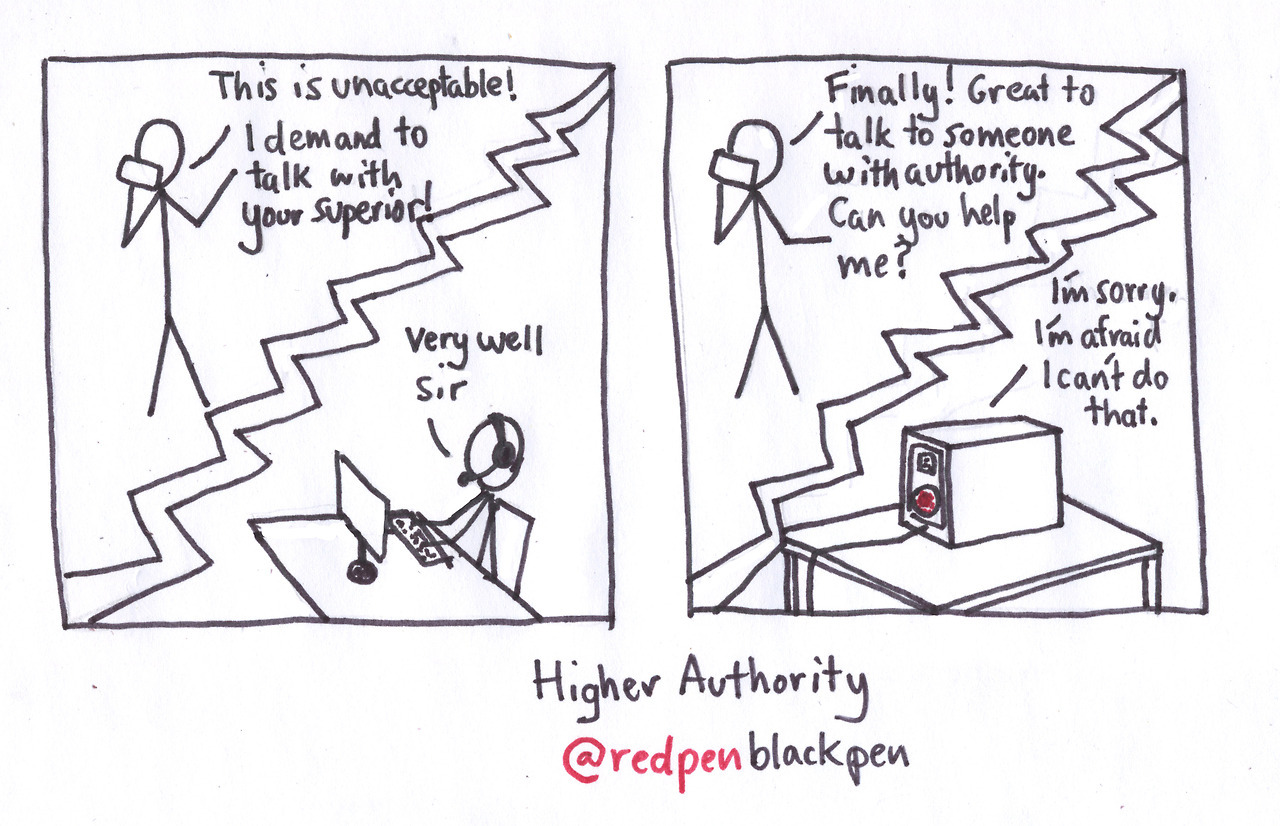
Der Einfluss von Algorithmen auf vielfältige Entscheidungen des täglichen Lebens steigt. Doch Algorithmen entscheiden auch zunehmend alleine, beispielsweise in der öffentlichen Verwaltung.
Wie können die Vorteile algorithmischer Entscheidungen genutzt und gleichzeitig die sozialen Risiken – z. B. Diskriminierung, Manipulation oder der Verlust von Grundrechten – minimiert werden? Wie soll das Rechtssystem darauf reagieren?
Die Abteilung Medienwandel und Innovation des IKMZ lädt zusammen mit dem Center for Information Technology, Society, and Law – ITSL (UZH) am 25. April zu einer spannenden Diskussionsrunde ein.
«Computer says no!»
Algorithmische Entscheidungen und deren Governance
25. April 2018, 18:15 – 19:45 Uhr
Universität Zürich, Hauptgebäude
Rämistrasse 71, 8006 Zürich
Raum KOL-E-18
Nach einer thematischen Einführung durch Prof. Dr. Michael Latzer (IKMZ – Abt. Medienwandel & Innovation, UZH) folgen Inputreferate zum aktuellen Diskussionsstand in der Europäischen Union und Deutschland durch Prof. Dr. Mario Martini (Lehrstuhl für Verwaltungswissenschaft, Staatsrecht, Verwaltungsrecht und Europarecht, Universität Speyer) sowie zur Situation in der Schweiz von Prof. Dr. Florent Thouvenin (Lehrstuhl für Informations- und Kommunikationsrecht, UZH).
Die Teilnahme ist kostenlos. Eine Anmeldung ist nicht notwendig.
Flyer herunterladen -
«The turn to artificial intelligence in governing communication online», Michael Latzer @ HIIG
16th March 18Michael Latzer will participate at the expert workshop «The turn to artificial intelligence in governing communication online» at the Humboldt Institute for Internet and Society (HIIG), Berlin.
The workshop on March 20th focuses upon the technological advancements, the extent of Artificial intelligence (AI) deployment and the range of approaches to understanding the status and future impact of AI systems to govern social communication on the internet.
The technology underlying AI research has increasingly found applications in the area of content moderation and communication governance on digital platforms. While the scale of problematic online content makes a stronger move reasonable, taking down content through automated means can be risky for online expression and access to information. Amid an obscure use of AI-systems, opaque implementation, vague definitions and a lack of accountability, governments and policy-makers are heavily pressuring companies to take action.
To map challenges of this development, the workshop addresses three problem-oriented questions:- Who are the primary agents of the socio-technical change to AI in content moderation?
- How is the turn to AI influenced (e.g. governance instruments)?
- Why is the process of change accepted, or not?
-
New Team Member - Kiran Kappeler
22nd January 18
Kiran Kappeler, B.A. joins the Media Change & Innovation Division at the Department of Communication and Media Research (IKMZ) as Student Research Assistant in January 2018.
-
William Drake @ Internet Governance Forum (IGF) 2017
13th December 17
William Drake, International Fellow & Lecturer in the Media Change & Innovation Division at IPMZ will be active at the annual Internet Governance Forum (IGF) meeting to be held at the United Nations in Geneva on 18-21 December. Hosted this year by the Swiss government, the IGF brings together several thousand Internet specialists for multistakeholder dialogue and coordination on a wide variety of global governance issues. Among other appearances at the event, Dr. Drake is co-organizer with Chinese colleagues of a workshop on, Social Responsibility and Ethics in Artificial Intelligence; lead presenter in a United Nations Conference on Trade and Development (UNCTAD) workshop on, Digitalization and International Trade; and the organizer of a workshop on, Data Localization and Barriers to Crossborder Data Flows, where a group of senior practitioners and analysts will discuss a new policy initiative proposed in a paper he has prepared for the World Economic Forum (WEF).
The entire IGF 2017 meeting offers those participating remotely a rich interactive online participation experience. Real-time transcription is also available to augment the overall participatory experience for delegates following around the globe. To participate (make remote interventions, follow transcriptions, chat in real-time with others) online using Webex, use the schedule at https://igf2017.intgovforum.org to find the room number(s) of the sessions you would like to join and register and enter the webex rooms using the links that will appear in this page. -
"Algorithmische Wirklichkeitskonstruktion & Machtverschiebungen", Michael Latzer @ Fraunhofer FOKUS
20th November 17Michael Latzer hält am 23. November 2017 um 16 Uhr einen Vortrag zum Thema „Algorithmische Wirklichkeitskonstruktion & Machtverschiebungen“ im Rahmen der Vortrags- und Diskussionsrunde: "Algorithmen und Automatisierung – Chancen und Herausforderungen für Staat und Gesellschaft" des Fraunhofer-Instituts für Offene Kommunikationssysteme FOKUS, Berlin.
Mit weiteren Beiträgen von Karen Yeung, Christian Djeffal, Peter Parycek, Klaus Lenk, Konrad Lischka, Sandra Wachter, Mario Martini und Tobias Krafft.
Seit einiger Zeit ist ein steigendes öffentliches Interesse an Algorithmen und den Wirkungen ihrer Anwendung zu beobachten. Durch ihre immer umfassendere und tiefere Integration in soziale Lebenswelten bekommen Fragen der Nachvollziehbarkeit, Fairness, Kontrollierbarkeit und Validität genauso wie nach mittel- und langfristigen sozialen und politischen Auswirkungen größere Dringlichkeit.
In drei Themenblöcken – Regieren & Verwalten, Individuum & Gesellschaft sowie Medien & Öffentlichkeit – wird darüber diskutiert, wo die Chancen und Risiken datengetriebener, algorithmischer Systeme liegen, welche ethischen Fragen einer gesellschaftlichen Verständigung bedürfen und welche qualitätssichernden Prozesse und regulatorischen Ansätze denkbar bzw. notwendig sind, um algorithmische Systeme sicher und in Einklang mit gesellschaftlichen Werten zu gestalten.
Das detaillierte Tagungsprogramm finden Sie auf: www.forum-privatheit.de -
Michael Latzer hält am 16. November 2017 um 14 Uhr einen Gastvortrag zum Thema „Digitale Dreifaltigkeit: Datafizierung – Algorithmisierung – Plattformisierung“ an der Abteilung Digitale Kunst der Universität für Angewandte Kunst in Wien 1, Sterngasse 13.
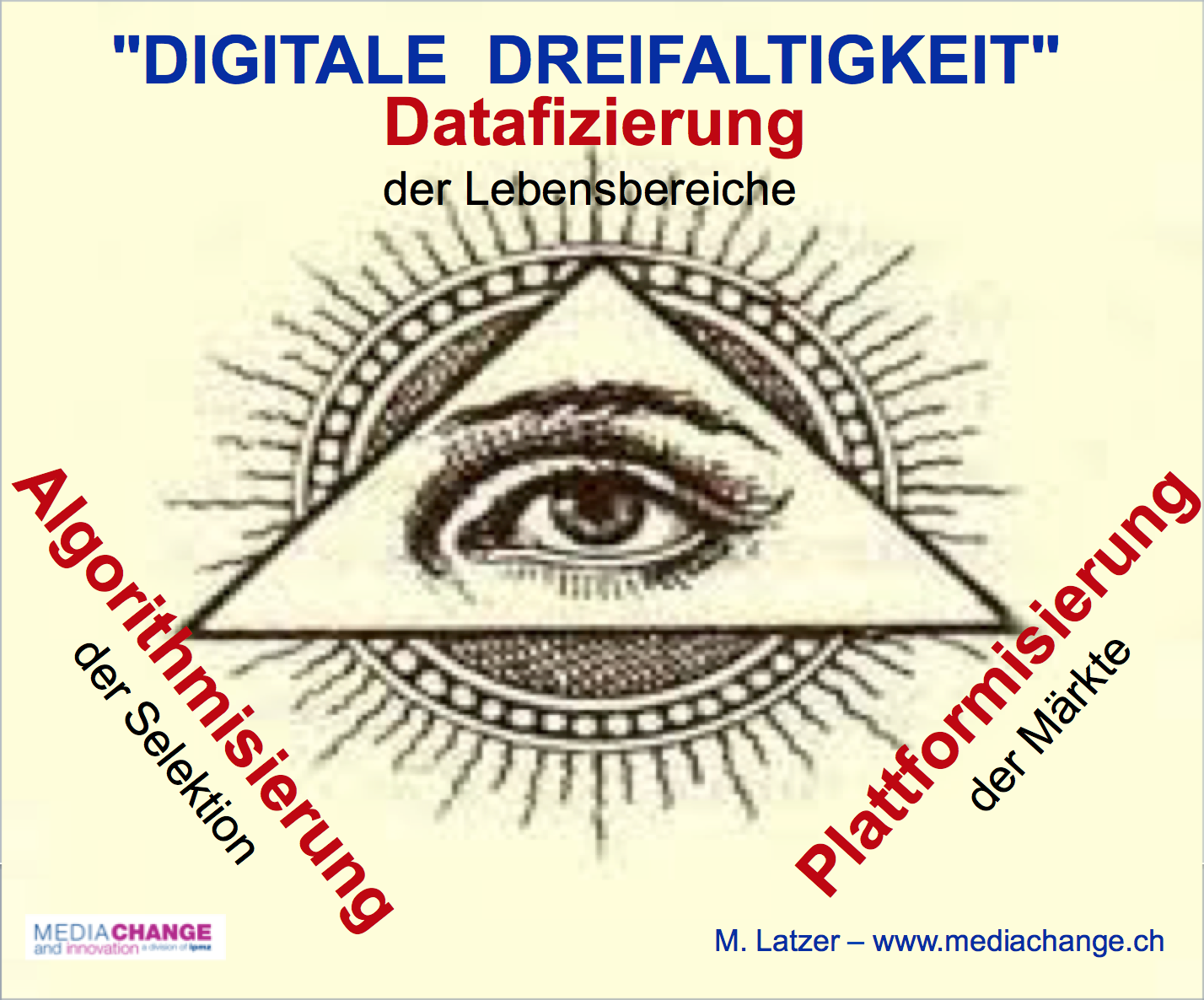
Mit den zunehmend verfügbaren Datenmengen, den sogenannten Big Data, wachsen auch der Glaube an und die Hoffnung auf deren heilsbringenden gesellschaftlichen Nutzen an. Automatisierte Datenverarbeitungssysteme und Plattformmärkte boomen, schaffen aber auch erhebliche soziale Risiken und Steuerungsbedarf.
-
World Internet Project – Switzerland 2017: Fact-Checking Increases as Trust in Online Content Drops
8th November 17Nine out of every ten people in Switzerland use the Internet. Usage time has doubled since 2011 and accessing the Internet from mobile devices has become common place for most demographics. The Internet is now not only the most important media source for information but also serves as the primary source of entertainment.
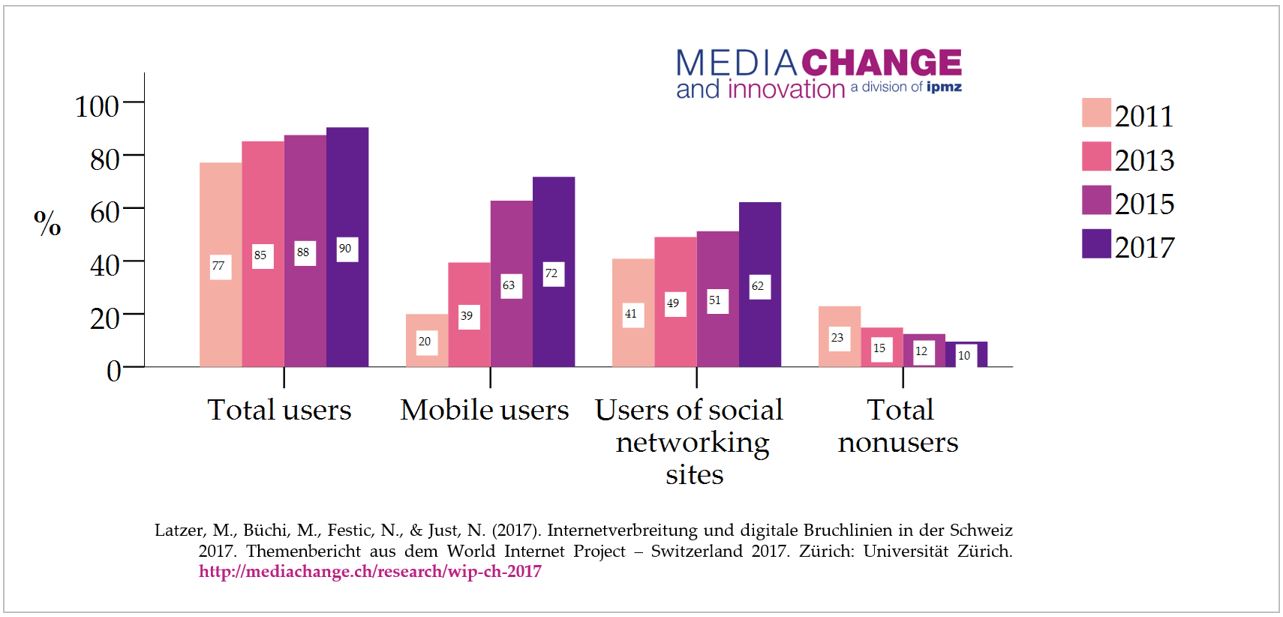
Searching for news and checking facts online has seen a considerable increase since 2011. During this period, overall trust in online content has significantly decreased. Half of all Internet users express concern regarding privacy violations online, while 44% feel they are able to control their privacy on the Internet.
Digital well-being is strong in Switzerland: Digital overconsumption and the feeling of missing out on more important things are more common among young people and people with lower levels of education, but mostly not seen as a problem. 83% state that they can distinguish between important and unimportant online activities. 75% of users believe they are able to target specifically which people and information sources they follow online, while 73% believe they can adjust the settings of Internet services and devices so that these will not disturb them.
For detailed information we refer to the four reports (in German) of the World Internet Project – Switzerland 2017 as well as to the WIP-CH 2017 Press Release in German and English.
Reports 2017 (Themenberichte)
The World Internet Project – Switzerland 2017
For the fourth time since 2011, a representative survey within the World Internet Project – Switzerland (WIP-CH 2017) was carried out by the Media Change & Innovation Division at the Institute of Mass Communication and Media Research (IPMZ), University of Zurich under the leadership of Prof. Michael Latzer.The World Internet Project (WIP) is a comparative longitudinal study that records the penetration and use of the Internet in more than 25 countries in an international comparison and analyzes social, political and economic implications of the development of the Internet.
The WIP-CH 2017 was supported by the Dean’s Office of the Faculty of Arts at the University of Zurich.
World Internet Project – Switzerland 2017: Verstärkte Faktenüberprüfung und weniger Vertrauen in Online-Inhalte
Neun von zehn nutzen in der Schweiz das Internet. Die Nutzungszeit hat sich seit 2011 verdoppelt und auch der Zugang von unterwegs ist in praktisch allen soziodemographischen Gruppen stark verbreitet. Das Internet ist nicht nur die bedeutendste mediale Informationsquelle, es liegt im intermedialen Vergleich erstmals auch für Unterhaltungszwecke auf dem ersten Platz.
Die Nachrichtensuche und das Überprüfen von Fakten im Netz sind seit 2011 wesentlich angestiegen. Parallel dazu ist insgesamt das Vertrauen in Online-Inhalte erheblich gesunken. Die Hälfte aller Internetnutzer äussert Bedenken bezüglich Privatsphäre-Verletzungen im Internet, während 44% glauben, ihre Privatsphäre online kontrollieren zu können.
Das digitale Wohlbefinden in der Schweiz ist hoch: Digitaler Überkonsum und das Gefühl, durch die Internetnutzung Zeit für Wichtigeres zu verlieren, sind häufiger unter jüngeren Nutzern und Niedriggebildeten, werden insgesamt jedoch als relativ unproblematisch beurteilt. 83% geben an, zwischen wichtigen und unwichtigen Internetaktivitäten unterscheiden zu können. 75% der Nutzer denken, dass sie gezielt auswählen können, von welchen Quellen sie online Informationen erhalten, während 73% glauben, dass sie Internetdienste so einrichten können, dass sie sie nicht stören.
Für detaillierte Informationen verweisen wir auf die vier Themenberichte des World Internet Project – Switzerland 2017 sowie auf die Pressemitteilung.
World Internet Project – Switzerland 2017
Zum vierten Mal seit 2011 hat die Abteilung Medienwandel & Innovation des Instituts für Publizistikwissenschaft und Medienforschung (IPMZ) der Universität Zürich unter der Leitung von Prof. Michael Latzer eine repräsentative Befragung im Rahmen des World Internet Project – Switzerland (WIP-CH 2017) durchgeführt.
Das World Internet Project (WIP) ist eine vergleichende Langzeitstudie und erfasst in mehr als 25 Ländern die Verbreitung und Nutzung des Internet im internationalen Vergleich und analysiert soziale, politische und ökonomische Implikationen der Netzentwicklung.
Das WIP-CH 2017 wurde vom Dekanat der Philosophischen Fakultät der Universität Zürich unterstützt.
-
Open positions @ MC&I
11th October 17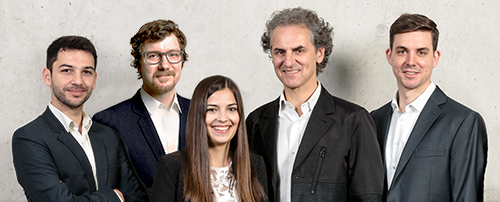
The Media Change & Innovation Division (Prof. Dr. Michael Latzer) at the IPMZ – Institute of Mass Communication and Media Research, University of Zurich is hiring:
and
1 Doctoral researcher / PhD student (60%)
in Internet & Society / Algorithm Studies
Please send your application with the usual documents and a letter of motivation (one pdf file) to Dr. Moritz Büchi: m.buechi@ipmz.uzh.ch.
The University of Zurich strives for the equality of men and women in academic positions and therefore particularly invites applications of qualified female researchers.
-
 Michael Latzer wird am Montag, 2. Oktober am Expert/innen-Workshop mit anschliessender öffentlicher Podiumsdiskussion zum Thema "Verantwortungsvolle Automatisierung. Wie können wir Algorithmen, Roboter und künstliche Intelligenz kontrollieren?" in Wien teilnehmen.
 Die Veranstaltung wird organisiert vom Institut für vergleichende Medien- und Kommunikationsforschung (CMC) der Österreichischen Akademie der Wissenschaften (ÖAW) und der Alpen-Adria Universität Klagenfurt. Auf dem Expert/innen-Workshop diskutieren führende Expert/innen über Kontrolle und Governance von Algorithmen aus technischer, ethischer, politischer, rechtlicher und soziologischer Sicht diskutiert. Zu den Fragen gehören unter anderem:
- Lassen sich Verantwortlichkeitskonzepte auf Maschinen übertragen und welche Rolle können Technologien selbst in Verantwortungszusammenhängen spielen?
- Welche Ansätze und Formen von Governance und welche Governance-Prinzipien bieten sich für komplexe sozio-technische Systeme mit hohen Freiheits- und Automatisierungsgraden an?
- Wo besteht rechtlicher Innovationsbedarf, weil Probleme mit dem vorhandenen rechtlichen Instrumentarium nicht gelöst werden können?
-
Konstantin Dörr earns PhD
23rd August 17
Konstantin Dörr, Research and Teaching Associate in the Media Change & Innovation Division, has successfully completed his doctorate with the dissertation entitled “Algorithmic Journalism – Analyzing automated text generation in journalism at a social, organizational and professional level”.
He will leave the division and IPMZ by the end of August to start his new job at Deloitte Consulting. Congratulations and all the best in your future career!
-
New Team Member - Noemi Festic
8th August 17
Noemi Festic, M.A., joined the Media Change & Innovation Division at the Institute of Mass Communication and Media Research (IPMZ) as Research and Teaching Associate in August 2017. Welcome, Noemi!
-
Michael Latzer wird auf dem Leopoldina-Symposium "Die Digitalisierung und ihre Auswirkungen auf Mensch und Gesellschaft" in Berlin über den Zusammenhang von Digitalisierung und Demokratie vortragen.
Auf dem Symposium vom 10. bis 11. Juli 2017 diskutieren führende Experten über Chancen und Risiken der Digitalisierung aus historischer, technischer, ökonomischer, politischer und gesellschaftlicher Perspektive.
Unter anderem zu folgenden Themen:
- Technische Revolutionen – gesellschaftliche Umbrüche
- Algorithmen: Unsichtbare Alleskönner?
- Virtuelles Ich oder reales Ich: Wer trifft Entscheidungen?
- Wie prägt Digitalisierung Lernen und Kognition?
- Schafft Digitalisierung eine eigene Dynamik in der Meinungsbildung?
- Die Zukunft sozialer Kontakte
- Digitalisierung und Demokratie
- Braucht eine digitalisierte Welt eine eigene Ethik?
Das Symposium richtet sich insbesondere an Entscheider und Meinungsführer in Gesellschaft, Industrie, Politik, Journalisten, interessierte Bürger und Wissenschaftler.
-
Michael Latzer @ Techniksoziologie TU Dortmund
26th June 17
Michael Latzer wird im Rahmen der "Aktuellen Debatten der Soziologie" einen Vortrag über "Algorithmische Selektion im Internet: Auswirkungen auf Ökonomie, Politik und den Alltag" halten.
Das Kolloquium findet am Montag, 26.06.17, an der Technischen Universität Dortmund statt, und beschäftigt sich mit Techniksoziologie und der Macht von Algorithmen. Wie beeinflussen Algorithmen Gesellschaften, die durch Datafizierung und Plattformisierung geprägt sind? Wo liegen die Unterschiede zwischen einer algorithmischen und einer massenmedialen Wirklichkeitskonstruktion? Welche demokratischen und sozialen Risiken ergeben sich und wie können diese gesteuert werden?
Neben dem Vortrag wird es auch die Möglichkeit einer anaschließenden Diskussion zur Beantwortung von Fragen und zum Austausch mit dem Vortragenden geben.
-
Michael Latzer @ Trimediale 2017
20th June 17
Michael Latzer wird in einer Keynote zum Thema «Internet-Plattformen und soziale Medien: politisch-ökonomische Bedeutung und Governance-Ansätze» referieren.
Am Mittwoch, 21.06.17, findet im Kursaal Bern die Trimediale 2017 statt, in der Medien-Expertinnen und -Experten aus Deutschland, Österreich und der Schweiz zum Motto "Plattform sucht Zielgruppe – Ringen um die Gunst des Publikums" diskutieren.
Die Trimediale 2017 wird federführend vom Bundesamt für Kommunikation (BAKOM) in Zusammenarbeit mit den deutschen Landesmedienanstalten (DLM) und der österreichischen Rundfunk- und Telekom Regulierungsbehörde-GmbH (RTR-GmbH) organisiert.
Das ausführliche Tagungsprogramm finden Sie hier.
-
William J. Drake project for the WEF on data localization and barriers to cross-border data flows
8th June 17
William J. Drake of the Media Change & Innovation Division is conducting a project for the World Economic Forum (WEF) on Data Localization and Barriers to Cross-Border Data Flows: Toward a Multistakeholder Approach. WEF community meetings on the topic have been organized in Geneva and San Francisco, and public outreach events are being held at the European Dialogue on Internet Governance in Tallinn, Estonia on 5-7 June and at the International Telecommunication Union's WSIS Forum in Geneva on 12-16 June. A White Paper by Drake will be released in parallel with the World Trade Organization’s Public Forum in Geneva on 26-28 September.
-
Algorithmen beeinflussen wie wir die Welt wahrnehmen und folglich unser Handeln. Prof. Dr. Michael Latzer erläutert im Interview die Auswirkungen der algorithmischen Selektion im UZH-Jahresbericht 2016.
Direkter Link zum Artikel.
Neun Anwendungsgebiete der algorithmischen Selektion, neun daraus resultierende Risiken und dafür adäquate Steuerungs- und Regulierungsarrangements werden in folgender jüngst erschienen Publikation dargelegt:
Saurwein, Florian, Natascha Just und Michael Latzer (2017): Algorithmische Selektion im Internet: Risiken und Governance automatisierter Auswahlprozesse. In: Jan-Hinrik Schmidt, Katharina Kinder-Kurlanda, Christian Stegbauer und Nils Zurawski (Hrsg.): Algorithmen, Kommunikation und Gesellschaft. Sonderausgabe von kommunikation@gesellschaft, Jg. 18.
Direkter Link zum Artikel.
-

Michael Latzer (Abteilung Medienwandel und Innovation) diskutiert mit Prof. Abraham Bernstein (Institut für Informatik und Digital Society Initiative der Universität Zürich) zum Thema «Fake News, Social Bots und Filter Bubble. Wie beeinflussen Social Media die politische Meinungsbildung?» im Rahmen der 19. Digital Lecture des Europa Instituts.
Wann: Donnerstag, 11. Mai 2017, 18.30 – 19.45 Uhr
Wo: Universität Zürich-Zentrum, Rämistrasse 71, Hörsaal KOL-F-101
-
Moritz Büchi Earns PhD and Young Academics Award
27th April 17
Moritz Büchi, Senior Research and Teaching Associate in the Media Change & Innovation Division, has successfully completed his doctorate with a dissertation entitled Digital Inequalities: Differentiated Internet Use and Social Implications. The dissertation project was supported by the Annual Young Academics Award of the Swiss Association of Communication and Media Research (SGKM/SACM).
-

Prof. Michael Latzer, Head of the Media Change & Innovation Division of the IPMZ, has been invited to join the Université Paris II Panthéon-Assas as Visiting Professor for this spring semester.
In Paris, Michael Latzer teaches in the communications and journalism degree programs on the risks and opportunities of digital societies and the Internet economy, for example, on the power of algorithms in daily life, and on the economics and business models of multisided platform-markets.
-
The Media Change and Innovation Division and the Personalised Communication project (University of Amsterdam) hosted a joint workshop in Zurich on January 24, 2017.

Natali Helberger (IVir), Judith Möller (ASCoR), Balázs Bodó (IVir), and the Media Change and Innovation team discussed current media change from the perspective of personalized communication and algorithmic selection on the Internet.
-
New Team Member - Benjamin Gerwoll-Ronca
13th December 16
Benjamin Gerwoll-Ronca, M.A., joined the Media Change & Innovation Division at the Institute of Mass Communication and Media Research (IPMZ) as Research and Teaching Associate in December 2016. Welcome, Benjamin!
-
"Die traditionellen Medien haben Trump gross gemacht"
30th November 16
-
Natascha Just wird Professorin an renommiertem Institut in den USA
16th November 16Natascha Just folgt einem Ruf an die Michigan State University (MSU) und wird ab Januar 2017 Associate Professor am Department of Media and Information.
Die MSU zählt gemäss QS World University Ranking zu den weltbesten Lehr- und Forschungseinrichtungen der Kommunikationswissenschaft. Mit Natascha Just wird erstmals jemand vom IPMZ an eine US-amerikanische Universität berufen.
Die Abteilung Medienwandel und Innovation des IPMZ freut sich sehr darüber und gratuliert ihr herzlich zu diesem bemerkenswerten Karriereschritt.
Natascha Just ist seit September 2008 am IPMZ als Oberassistentin in der von Prof. Michael Latzer geleiteten Abteilung Medienwandel und Innovation tätig. Weitere Stationen ihrer wissenschaftlichen Karriere waren u.a. die Stanford Law School, die University of Southern California, Los Angeles, die Universität Wien und die Österreichische Akademie der Wissenschaften.
Wir bedanken uns bei Natascha Just für ihr ausserordentliches Engagement für das IPMZ und die Abteilung Medienwandel und Innovation, wünschen ihr alles Gute für die berufliche Zukunft und hoffen sehr, dass sie mit dem Institut durch Kooperationen verbunden bleibt.
-
Media Change & Innovation @ ECREA 16
8th November 16
The Media Change & Innovation is presenting two papers at the 6. European Communication Conference of the ECREA (http://www.ecrea2016prague.eu/) in Prague:
"Public Attention Framing During the #ParisAttacks. Issue Attention Changes in German Speaking News Media and Twitter in a Crisis Event"
"How the Public Values Public Service Broadcasting"
Just, N., Büchi, M., & Latzer, M.
Natascha Just will also be chairing a session on “New Intermediares and Platforms: Challenges for Communication Policy and Research”.
Check the full program here: http://www.ecrea2016prague.eu/preliminary-programme-online
-
Inwieweit handeln Algorithmen autonom, selbstbestimmt und intentional? Sind sie kontrollier- und ihre Ergebnisse vorhersehbar? Können Algorithmen moralisch handeln?
Die Abteilung Medienwandel und Innovation, IPMZ, UZH lädt zusammen mit dem Center for Information Technology, Society, and Law – ITSL, UZH und dem Institut für Pervasive Computing, Dep. Informatik, ETH Zürich am 22. November zu einer spannenden Diskussionsrunde zur Macht der Algorithmen ein.
Die Macht der Algorithmen: Werkzeuge oder Akteure?
Zürich, 22. November 2016, 18.15-19.45 Uhr
Universität Zürich, RAI
Nach einer thematischen Einführung durch Prof. Dr. Michael Latzer (IPMZ – Abt. Medienwandel & Innovation, UZH) folgen Inputreferate zur Einschätzung der Macht der Algorithmen aus technischer und ethischer Perspektive durch Prof. Dr. Thomas Hofmann (Data Analytics Lab, Departement Informatik, ETH Zürich) und Prof. Dr. Oliver Bendel (Institut für Wirtschaftsinformatik, Hochschule für Wirtschaft, FHNW) mit anschliessender Diskussion.
-
Internet Rules! Media Change & Innovation @ AoIR 2016
3rd October 16
The Media Change & Innovation Division will be at "AoIR 2016: Internet Rules!" in Berlin.
The day before the conference, Michael Latzer will be a panelist at the event "The Rule of Algorithms: Formen, Einfluss und Regulierung algorithmischer Entscheidungen" hosted by the Hans-Bredow-Institute.
Conference presentations & panels:
Moritz Büchi, Natascha Just, and Michael Latzer will present the paper "Enhancing online privacy at the user level: the role of Internet skills and policy implications".
Florian Saurwein, Natascha Just, and Michael Latzer will present the paper "Governing algorithms on the Internet: approaches, options, gaps".
Natascha Just will be a panelist on the topic of "Big Nudging: a dream of social cybernetics come true?".
For more Information on AoIR 2016 click here.
-
New Publications on Comparative Research, Science Communication, Media Economics, and Privacy
24th August 16The Media Change & Innovation Division has published several new articles:
- Büchi, Moritz (2016): Measurement invariance in comparative Internet use research. In: Studies in Communication Sciences [more] [pdf]
- Bauer, Johannes M. / Latzer, Michael (2016): The economics of the Internet: an overview. In: Bauer, J. and Latzer, M. (Eds), Handbook on the Economics of the Internet. Cheltenham, Northampton: Edward Elgar, 3-20. [free download]
- Büchi, Moritz (2016): Microblogging as an extension of science reporting. In: Public Understanding of Science [more] [pdf]
- Just, Natascha / Latzer, Michael (2016): Institutionalistische Theorieansätze für die Medienökonomie. In: Krone, Jan/Pellegrini, Tassilo (Hrsg.): Handbuch Medienökonomie. Wiesbaden: Springer, 1-20. [more]
- Büchi, Moritz / Just, Natascha / Latzer, Michael (2016): Caring is not enough: The importance of Internet skills for online privacy protection. In: Information, Communication & Society [more] [pdf]
-
Top Faculty Paper Award of ICA-CLAP to MC&I
8th June 16
For their paper „Governance by Algorithms: Reality Construction by Algorithmic Selection on the Internet“ Natascha Just and Michael Latzer will receive a Top Faculty Paper Award of the Communication, Law and Policy Division (CLAP) of the ICA – International Communication Association.
The price will be awarded at this year’s ICA conference, which is taking place from June 9-13, 2016 in Fukuoka, Japan.
The ICA is the biggest international communications association with more than 4’500 members in 80 countries.
-
As the single most important general purpose technology of recent times, the Internet is transforming theorganization, competitive structure and business models of the private, the public and non-profit sectors. Intwenty six original chapters, leading authors discuss theoretical frameworks for the study of the economics of theInternet and its unique economics as a global information and communications infrastructure. They also examinethe effects of the Internet on economic transactions (including social production, advertising, innovation, andintellectual property rights), the economics and management of Internet-based industries (including search, news,entertainment, culture, and virtual worlds), and the effects of the Internet on the economy at large.
 The "Handbook on the Economics of the Internet" edited by Prof. Johannes M. Bauer of Michigan State University and Prof. Michael Latzer, is now available at Edward Elgar Publishing.
As the single most important general purpose technology of recent times, the Internet is transforming the organization, competitive structure and business models of the private, the public and non-profit sectors. In this book project, leading authors discuss theoretical frameworks for the study of the economics of the Internet and its unique economics as a global information and communications infrastructure.
They also examine the effects of the Internet on economic transactions (including social production, advertising, innovation, and intellectual property rights), the economics and management of Internet-based industries (including search, news, entertainment, culture, and virtual worlds), and the effects of the Internet on the economy at large.
Click here to read the first chapter of the book for free
Contributors
S. Aggarwal, C. Antonelli, H. Asghari, J.M. Bauer, S. Bauer, Y. Benkler, S.M. Besen, I. Brown, E. Castronova, D.D. Clark, C. Corrado, C. Feijóo, D.L. Garcia, J.-L. Gómez-Barroso, C. Handke, J. Haucap, K. Hollnbuchner, N. Just, G. Knieps, I. Knowles, J.J. Kranz, L. Küng, M. Latzer, W.H. Lehr, Y.-L. Liu, W. Ma, P. Mazepa, V. Mosco, N. Newman, E.M. Noam, P.P. Patrucco, R. Picard, A. Picot, G. Sadowsky, F. Saurwein, V. Schneider, S.J. Schultze, R. Sherman, P. Stepan,T. Stühmeier, R. Towse, B. Van Ark, M. Van Eeten, B. Van Schewick, H.R. Varian, D. Waterman, R.S. Whitt, S.S. Wildman, S. Wunsch-Vincent
Critical Acclaim
‘Internet development dynamics are tackled in this Handbook by leading scholars representing mainstream, institutional, evolutionary economics and political economy perspectives. They show how complex markets for digital technologies and services are evolving. Crucially, they demonstrate why conventional analytical tool kits need to be extended by bridging disciplinary boundaries. This volume offers significant advances in the analysis of technological and institutional change and demonstrates how important it is to acknowledge conflict resolution and tradeoffs as essential aspects of the internet’s history and its future.’
Robin Mansell, London School of Economics and Political Science, UK
'The Internet has transformed many fundamental economic facts of life and business, but it is challenging to catalogue them all. This topic deserves a comprehensive handbook, and the editors have delivered. The chapters are engaging and lucid, and cover a wide range of topics. The editors were not shy about spanning boundaries between technical detail, economic analysis, and policy relevance. This is a great resource for any modern scholar of the Internet.'
Shane Greenstein, Harvard Business School, US
-
Two workshops organized by MCI at the World Summit on the Information Society Forum 2016, Geneva
20th May 16
The Media Change & Innovation Division, represented by William J. Drake, has organised two workshops at the World Summit on the Information Society Forum in Geneva, May 2016:
Moderated by William J. Drake, the first workshop titled "Internet Fragmentation" built inter alia on an initial mapping report, "Internet Fragmentation: An Overview" that was written by William J. Drake, Vinton Cerf and Wolfgang Kleinwächter and released at the World Economic Forum’s Annual Meeting in Davos in January 2016.
As there is no general consensus about the nature, scope and potential impact of Internet fragmentation, much less how the issues could best be addressed, this workshop brought together a multistakeholder group of analysts to advance the conversation and help build a shared understanding of the topic.
Topics included the nature of Internet fragmentation; technical, commercial and governmental forms of fragmentation; and options for advancing global awareness and distributed responses to problematic cases.
The second workshop titled "Enhanced Cooperation and Internet Governance" was co-organised with the Centre for Communication Governance at the National Law University, Delhi and Global Partners Digital. The 2005 Tunis Agenda for the Information Society called for enhanced cooperation to enable governments, on an equal footing, to carry out their roles and responsibilities in international public policy issues pertaining to the Internet, but not in the day-to-day technical and operational matters that do not impact on international public policy issues. In the decade since, the international community has struggled to reach consensus as to the precise meaning and implementation of this enhanced cooperation. This workshop brought together a multistakeholder group of analysts and participants in the debate to provide initial inputs for the reconvened discussions to come and help build a shared understanding of the topic.
WSIS is a UN summit that was initiated in order to create an evolving multi-stakeholder platform aimed at addressing the issues raised by ICTs through a structured and inclusive approach at the national, regional and international levels. The WSIS Forum 2016 represents the world's largest annual gathering of the ‘ICT for development’ community.
-
Emerald Literati Award for Excellence
10th May 16
The paper “Governance of Algorithms: Options and Limitations” by Florian Saurwein, Natascha Just and Michael Latzer, published in Info 2015 Vol. 17 No. 6, has been selected by the journal’s editorial team as the Outstanding Paper in the 2016 Emerald Literati Network Awards for Excellence.
The Emerald Literati Awards are now in their 23rd year and were established to celebrate and reward outstanding contributions of authors and reviewers to scholarly research.
-
Assistentin/Assistent gesucht (60%)
3rd May 16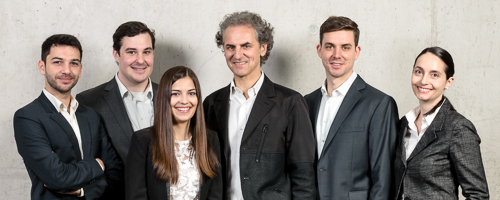
Die Abteilung Medienwandel & Innovation (Prof. Dr. Michael Latzer – http://www.mediachange.ch) des IPMZ – Institut für Publizistikwissenschaft und Medienforschung der Universität Zürich sucht zur Verstärkung ihres Teams eine/n
Assistentin/Assistenten (60%)
Eintrittszeitpunkt: nach Vereinbarung
Anforderungsprofil
- Abgeschlossenes Universitätsstudium der Publizistik- und Kommunikationswissenschaft oder einer benachbarten sozialwissenschaftlichen Disziplin (Master, Diplom)
- Interesse an wissenschaftlicher Weiterqualifikation (Dissertation) / wissenschaftlicher Karriere
- Vorkenntnisse bzw. hohes Interesse an zumindest einem der folgenden Bereiche:
Internet-Governance, Internetökonomie/-management (z.B. Geschäftsmodelle),
Internet & Gesellschaft, Automatisierung durch algorithmische Selektion im Internet, Innovationsforschung und sozialwissenschaftliche Technikforschung - Sehr gute Kenntnisse quantitativer und/oder qualitativer Forschungsmethoden sowie ihrer Anwendungen; Erfahrung und versierter Umgang mit Statistik- und Analysesoftware
- Forschungserfahrung von Vorteil
- Sehr gute Deutsch- und Englischkenntnisse in Wort und Schrift, weitere Fremdsprachen (v.a. Schweizer Landessprachen) von Vorteil
- Hohes Engagement und Detailorientiertheit
- Selbstständige, sorgfältige und verlässliche Arbeitsweise
- Teamfähigkeit
Arbeitsschwerpunkte
- Mitarbeit an Forschungsprojekten
- Wissenschaftliche Weiterqualifikation (Doktorat), die sich inhaltlich an den Lehr- und Forschungsschwerpunkten der Abteilung orientiert
- Konferenzteilnahmen und Publikationen
- Mitwirkung in der Lehre
- Betreuungs- und Administrationsarbeiten
Am IPMZ bieten wir Ihnen optimale Rahmenbedingungen für Ihre weitere wissenschaftliche Karriere und freuen uns auf Ihre Bewerbung.
Ein Anstellungsverhältnis als Assistent/in an der UZH hat eine maximale Laufzeit von sechs Jahren. Eine Aufstockung der Stellenprozente über Drittmittelprojekte wird angestrebt.
Die üblichen Bewerbungsunterlagen inklusive Motivationsschreiben, Prüfungs-/Notenausweis und den Namen einer Referenzperson senden Sie bitte als PDF (eine Datei) an Dr. Natascha Just: n.just@ipmz.uzh.ch. Der Auswahlprozess und die Interviews beginnen mit Eingang der Bewerbungen, spätestens ab Juni 2016. Die Ausschreibung bleibt offen, bis eine geeignete Kandidatin oder ein geeigneter Kandidat gefunden wurde.
Die Universität Zürich ist an der Gleichstellung von Männern und Frauen in wissenschaftlichen Positionen interessiert und fordert daher einschlägig qualifizierte Frauen ausdrücklich zur Bewerbung auf.
-
 William Drake, International Fellow and Lecturer in the Media Change and Innovation Division has edited a new volume entitled, The Working Group on Internet Governance:10th Anniversary Reflections http://amzn.to/22hWZxC.
 Convened by the UN Secretary General in 2004, the Working Group on Internet Governance (WGIG) was an important turning point in the UN’s three year World Summit on the Information Society negotiations.
The WGIG advance global understanding of the nature of Internet governance and the issues and institutions involved, and it produced a report with recommendations that included the creation of the UN’s Internet Governance Forum. This book brings together former WGIG members and other leading voices in the WSIS to reflect on the WGIG’s procedural and substantive contributions to the evolving global Internet governance ecosystem.
The volume is a follow-up to a previous book — William J. Drake, ed., Reforming Internet Governance: Perspectives from the UN Working Group on Internet Governance (2005).
-
New Handbook on Internet Economics
5th April 16As the single most important general purpose technology of recent times, the Internet is transforming theorganization, competitive structure and business models of the private, the public and non-profit sectors. Intwenty six original chapters, leading authors discuss theoretical frameworks for the study of the economics of theInternet and its unique economics as a global information and communications infrastructure. They also examinethe effects of the Internet on economic transactions (including social production, advertising, innovation, andintellectual property rights), the economics and management of Internet-based industries (including search, news,entertainment, culture, and virtual worlds), and the effects of the Internet on the economy at large. The "Handbook on the Economics of the Internet" edited by Prof. Johannes M. Bauer of Michigan State University and Prof. Michael Latzer, will be published in May 2016.
As the single most important general purpose technology of recent times, the Internet is transforming the organization, competitive structure and business models of the private, the public and non-profit sectors. In this book project, leading authors discuss theoretical frameworks for the study of the economics of the Internet and its unique economics as a global information and communications infrastructure.
Click here for a larger image of the brochure and contributing authors (pdf)
They also examine the effects of the Internet on economic transactions (including social production, advertising, innovation, and intellectual property rights), the economics and management of Internet-based industries (including search, news, entertainment, culture, and virtual worlds), and the effects of the Internet on the economy at large.
Critical Acclaim
‘Internet development dynamics are tackled in this Handbook by leading scholars representing mainstream, institutional, evolutionary economics and political economy perspectives. They show how complex markets for digital technologies and services are evolving. Crucially, they demonstrate why conventional analytical tool kits need to be extended by bridging disciplinary boundaries. This volume offers significant advances in the analysis of technological and institutional change and demonstrates how important it is to acknowledge conflict resolution and tradeoffs as essential aspects of the internet’s history and its future.’
Robin Mansell, London School of Economics and Political Science, UK
'The Internet has transformed many fundamental economic facts of life and business, but it is challenging to catalogue them all. This topic deserves a comprehensive handbook, and the editors have delivered. The chapters are engaging and lucid, and cover a wide range of topics. The editors were not shy about spanning boundaries between technical detail, economic analysis, and policy relevance. This is a great resource for any modern scholar of the Internet.'
Shane Greenstein, Harvard Business School, US
-
New Publications on Algorithmic Selection
18th March 16The Media Change & Innovation Division has published two new articles:
"Governance by Algorithms: Reality Construction by Algorithmic Selection on the Internet" by Natascha Just and Michael Latzer, forthcoming in Media, Culture & Society, and
"Ethical Challenges of Algorithmic Journalism" by Konstantin Dörr and Katharina Hollnbuchner, forthcoming in Digital Journalism.
Both articles are now available for download as pre-print/accepted manuscript:
-

William Drake, an International Fellow and Lecturer in the Media Change and Innovation Division of the Institute of Mass Communication and Media Research at the University of Zurich has been invited by the World Economic Forum as the leading expert to produce a white paper about the risk of Internet fragmentation.
The finished report addresses the growing concern that the global public Internet is in danger of splintering into a series of bordered cyberspace segments and provides the first systematic overview of the growth of Internet fragmentation
It maps the landscape of Internet fragmentation and cites 28 examples arising from technical, governmental and commercial trends and concludes that meeting the challenge of Internet fragmentation will require vigilance, analysis and international cooperation involving all relevant stakeholders.
The report can be found on weforum.org.
For a good overview, a video of a session with the president of Estonia, Toomas Hendrik Ilves and Harvard Professor Jonathan Zittrain can be found here

The World Economic Forum, committed to improving the state of the world, is the International Organization for Public-Private Cooperation. Over 2,500 leaders from business, government, international organizations, civil society, academia, media and the arts have participated in the 46th World Economic Forum Annual Meeting in Davos-Klosters, Switzerland, on 20-23 January 2016.
For more information about the Annual Meeting 2016, please visit www.weforum.org.
-
World Internet Project Switzerland 2015: Internet is the primary source of information
15th December 1588 out of every 100 people in Switzerland use the internet. Usage time is increasing and accessing the internet from mobile devices is considerably more frequent than before. The internet is now the most important source of information, and lots of applications are a daily routine, but concerns about privacy on the internet are increasing. In addition, users’ confidence in their internet skills has decreased, especially amongst women. These are findings of a survey by the Institute of Mass Communication and Media Research (IPMZ) at the University of Zurich.
For detailed information we refer to the 4 special reports (german) of the World Internet Project - Switzerland 2015 as well as to the WIP-CH 2015 Press Release (in German) and the WIP-CH 2015 Press Release (in English).
Special Reports 2015 (Themenberichte)
- Vertrauen und Sorgen bei der Internet-Nutzung in der Schweiz
- Internet-Anwendungen und deren Nutzung in der Schweiz
- Internetverbreitung und digitale Bruchlinien in der Schweiz
- Internet und Politik in der Schweiz
The World Internet Project Switzerland 2015
For the second time after 2011 the WIP project for Switzerland is being carried out by the Department for Media Change & Innovation in the Institute of Mass Communication and Media Research (IPMZ) at the University of Zurich under the leadership of Prof. Michael Latzer.
The World Internet Project (WIP) is a comparative longitudinal study that records the penetration and use of the internet in 30 countries in an international comparison and analyzes social, political and economic implications of the development of the internet.
The WIP project for Switzerland is supported by the Swiss Federal Office of Communication (Bakom) and by the Dean’s Office of the Faculty of Arts at the University of Zurich.
Schweizer informieren sich hauptsächlich über das Internet
88 von 100 Schweizerinnen und Schweizern nutzen 2015 das Internet – immer länger und bedeutend häufiger auch unterwegs. Das Internet ist nun die wichtigste Informationsquelle und viele Anwendungen sind tägliche Routine, doch steigende Sorgen um die Privatsphäre trüben das Online-Leben. Darüber hinaus haben sich laut Selbsteinschätzung die Internetfähigkeiten, speziell von Frauen, verschlechtert. Dies zeigt eine Erhebung des Instituts für Publizistikwissenschaft und Medienforschung (IPMZ) der Universität Zürich.
Für detaillierte Informationen verweisen wir auf die 4 Themenberichte des World Internet Project - Schweiz 2015 sowie auf die Pressemitteilung.
Zum World Internet Project Switzerland 2015
Das World Internet Project (WIP) ist eine vergleichende Langzeitstudie und erfasst in 30 Ländern die Verbreitung und Nutzung des Internets im internationalen Vergleich und analysiert soziale, politische und ökonomische Implikationen der Netzentwicklung.
Zum dritten Mal nach 2011 und 2013 wird das WIP-CH-Projekt wird von der Abteilung Medienwandel & Innovation des Instituts für Publizistikwissenschaft und Medienforschung (IPMZ) der Universität Zürich unter der Leitung von Prof. Michael Latzer durchgeführt. Das WIP-CH-Projekt wird vom Bundesamt für Kommunikation (Bakom) und vom Dekanat der Philosophischen Fakultät der Universität Zürich unterstützt.
-
New Publications on Digital Divide and the Governance of Algorithms
16th September 15The Media Change & Innovation Division has published two new articles:

Now available online is a new article by Moritz Büchi, Michael Latzer and Natascha Just in New Media & Society titled "Modeling the second-level digital divide: A five-country study of social differences in Internet use"

Also available online is a new article by Florian Saurwein, Natascha Just and Michael Latzer published in "info" titled "Governance of Algorithms: options and limitations".
-
Bundesrat verstärkt Jugendmedienschutz
15th May 15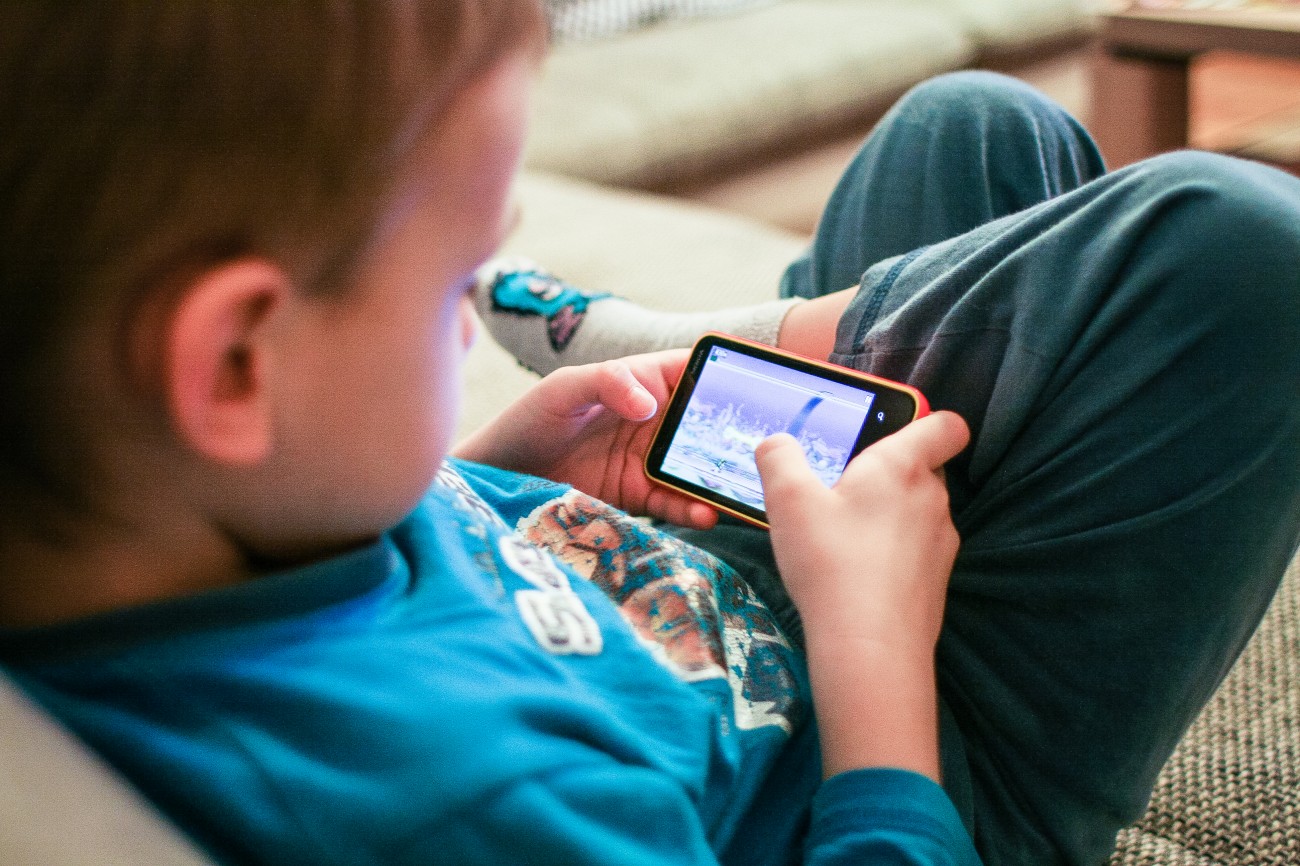 Am 13. Mai 2015 hat die Schweizerische Regierung den Bundesratsbericht „Jugend und Medien“ veröffentlicht und über zukünftige Massnahmen für einen besseren Jugendmedienschutz entschieden.
Die Abteilung Medienwandel & Innovation des IPMZ hat als Teil der Projektgruppe die Selbstregulierung der Branchen Film, Computerspiele, Telekommunikation und Internet untersucht und damit u.a. die Grundlage für die Entscheidungen des Bundesrats geschaffen.
Die Evaluierung zeigt u.a., dass in rund 50% der Fälle Minderjährige ungeeignete Filme und Spiele erwerben konnten, dass Jugendschutzfilter im Internet keinen verlässlichen Schutz vor ungeeigneten Inhalten bieten und dass Telekommunikationsunternehmen Selbstverpflichtungen zur Jugendschutzberatung beim Kauf von Mobiltelefonen nur unzureichend umsetzen. Der Bericht empfiehlt die Selbstregulierung in Branchenverbänden stärker zu verankern, Beratungsleistungen zu verbessern und die Selbstregulierungsmassnahmen periodisch zu überprüfen.
Die Ergebnisse dieser Überprüfung bilden dabei eine wichtige Grundlage für den Entscheid über zukünftige Regulierungsmassnahmen auf Bundesebene, z.B. um die Branchen stärker in die Pflicht zu nehmen und hinsichtlich der gesetzlichen Abstützung von Regulierungsmassnahmen im Sinne der Ko-Regulierung. Als Konsequenz wird der Bund die Koordination und Regulierung im Jugendmedienschutz verstärken.
Mit dem Medienwandel gehen die Debatten über Risiken für Kinder und Jugendliche sowie adäquaten Jugendmedienschutz einher. In der Schweiz hat sich der Bundesrat bereits 2010 zum Ziel gesetzt bis 2015 zu einer Gesamteinschätzung zu kommen, welcher Regulierungsbedarf besteht und wie der Jugendmedienschutz in der Schweiz gestaltet werden soll. Im Vorfeld der Entscheidung des Bundesrates wurden im Auftrag des Bundesamtes für Sozialversicherungen (BSV) mehrere Untersuchungen durchgeführt, um Risiken für Kinder und Jugendliche zu analysieren und das bestehende Regulierungssystem zu überprüfen.
Links
-
SACM Best Paper Award
16th March 15
For their comparative study of the digital divide, Moritz Büchi, Natascha Just, and Michael Latzer received the Best Paper Award of the Swiss Association of Communication and Media Research (SACM) at the 2015 Annual Conference.
The conference, hosted by the University of Bern, March 13 – 14, 2015, focused on “Contexts and Consequences: Approaches and Results of Comparative Communication and Media Studies”.
The paper titled “Comparing Internet use: Sociodemographic differences in five countries” contributes to the methodological and substantive understanding of the digital divide. Based on representative survey data from the World Internet Project, Internet usage differences are modeled for countries with very high access rates. The paper shows that measurement invariance testing is a crucial factor for unbiased comparative research. A generational and educational gap in types of Internet use is evident, whereas gender differences have narrowed. The results are further discussed in the light of digital inequality and the link between Internet access and usage.
-
 The Multi-Disciplinary Forum for Promoting Human Well-Being through Digital Media will be launched under the auspices of UNESCO and its Information fo All Programme (IFAP).
Michael Latzer represents the Media Change & Innovation Division as a member of the Forums's steering committee and will give two presentations on the occasion of the upcoming IFAP International Conference on Well Being in Digital Media, taking place 17 - 19th February, hosted by the Ben-Gurion University of the Negev and the Interdisciplinary Center Herzliya, Israel.
-
Einladung zum Gastvortrag: Google and the Information Society
22nd October 14 Elad Segev (Tel Aviv University) wird im Rahmen der Vorlesung «Medienwandel durch Innovation» einen Gastvortrag zu «Google and the Information Society» halten. Die öffentliche Vorlesung findet am Dienstag, den 28. Oktober 2014 um 16:15 Uhr in BIN-0-K.02, Binzmühlestrasse 14, 8050 Zürich statt.
In this meeting we look at the central role of search engines in the information age. We examine their importance as information agents, but also as producers of information biases that can intensify the digital divide. On the one hand, search engines enhance their control over the information “market” by customising content to the particular demands of each individual user. On the other, they expand their control to collect and index information, prioritising popular, commercial, American and English websites. Several implications of these information biases are discussed such as intellectual property, freedom of information (production and consumption), national security, and privacy.
Dr. Elad Segev ist Leiter des Master-Programms am Department of Communication der Tel Aviv Universität in Israel. Er ist Autor des Buches „Google and the Digital Divide“ und hält Kurse und Seminare in den Schwerpunkten Information und Macht, Suchmaschinen, Neue Medien, Digitale Kultur und Netzwerkanalysen.
-
New Team Member – Noemi Festic
16th October 14
Noemi Festic, B.A. joins the Media Change & Innovation Division at the Institute of Mass Communication and Media Research (IPMZ) as Student Assistant in October 2014.
-
William Drake, an International Fellow and Lecturer in the Media Change and Innovation Division of the Institute of Mass Communication and Media Research at the University of Zurich has just released his new eBook “Beyond NETmundial: The Roadmap for Institutional Improvements to the Global Internet Governance Ecosystem”.
It explores options for the implementation of a key section of the “NETmundial Multistakeholder Statement” that was adopted at the Global Meeting on the Future of Internet Governance (NETmundial) held on April 23rd and 24th 2014 in São Paulo, Brazil. The Roadmap section of the statement concisely sets out a series of proposed enhancements to existing mechanisms for global internet governance, as well as suggestions of possible new initiatives that the global community may wish to consider.
The book was produced as a part of the Internet Policy Observatory, a program at the Center for Global Communication Studies, the Annenberg School for Communication at the University of Pennsylvania. It was edited by William J. Drake of the University of Zurich and Monroe Price of the Annenberg School for Communication. They were assisted by Laura Schwartz-Henderson, Briar Smith, and Alexandra Esenler.
For more information, please visit globalnetpolicy.org

-
The Media Change & Innovation Division is part of the Global Network of Internet and Society Research Centers.
The global Network of Internet & Society Centers (NoC) is a collaborative initiative among academic institutions with a focus on interdisciplinary research on the development, social impact, policy implications, and legal issues concerning the Internet.
For more information, please visit networkofcenters.net

-
[Video] Medienwandel in der Schweiz 2014
17th June 14"Wann war dein letzter Tag ohne Internet?"
Privatsphäre, Google & Gangnam Style. Das Internet verändert die Art und Weise, wie wir öffentlich und privat kommunizieren. Digitalisierung und Konvergenz von Medien und Telekommunikation treiben diese Entwicklung weiter voran. Der Film zeigt ausgewählte Befunde und Statistiken zum Medienwandel und geht der der Frage nach: Wie zeigt sich der Medienwandel in der Schweiz im Jahr 2014?
Weitere Infos zum Film
Dieser Film entstand unter der Leitung von Prof. Michael Latzer, lic.phil Julian Wallace und M.A. Konstantin Dörr in der Abteilung Medienwandel & Innovation des Instituts für Publizistikwissenschaft und Medienforschung (IPMZ) der Universität Zürich.
Credits- Recherche & Konzept: Julian Wallace, Konstantin Dörr & Tobias Gilgen
- Umsetzung & Musik: Tobias Gilgen (monotrone@gmail.com)
- Projektleitung: Prof. Dr. Michael Latzer
Weiterführende Links
-
DGPuK Award for Journal Article on Media Change
6th June 14
The article „Medienwandel durch Innovation, Ko-Evolution und Komplexität. Ein Aufriss“ written by Michael Latzer was honored by the German Communication Association (DGPuK) with an award for the best journal articles of the year 2013.
-
New Team Member - Moritz Büchi
3rd March 14Moritz Büchi, cand. M.A., joined the Media Change & Innovation Division at the Institute of Mass Communication and Media Research (IPMZ) as Research and Teaching Associate in March 2014.
-
World Internet Project - Schweiz 2013
10th December 13Zum zweiten Mal nach 2011 wird das WIP-CH-Projekt wird von der Abteilung Medienwandel & Innovation des Instituts für Publizistikwissenschaft und Medienforschung (IPMZ) der Universität Zürich unter der Leitung von Prof. Michael Latzer durchgeführt.
Das World Internet Project (WIP) ist eine vergleichende Langzeitstudie und erfasst in 30 Ländern die Verbreitung und Nutzung des Internets im internationalen Vergleich und analysiert soziale, politische und ökonomische Implikationen der Netzentwicklung
Das WIP-CH-Projekt wird vom Bundesamt für Kommunikation (Bakom) und vom Dekanat der Philosophischen Fakultät der Universität Zürich unterstützt.
Für detaillierte Informationen verweisen wir auf die 4 Themenberichte des World Internet Project - Schweiz 2013 sowie auf die Pressemitteilung.
English
For the second time after 2011 the WIP project for Switzerland is being carried out by the Department for Media Change & Innovation in the Institute of Mass Communication and Media Research (IPMZ) at the University of Zurich under the leadership of Prof. Michael Latzer.
The World Internet Project (WIP) is a comparative longitudinal study that records the penetration and use of the internet in 30 countries in an international comparison and analyzes social, political and economic implications of the development of the internet.
The WIP project for Switzerland is supported by the Swiss Federal Office of Communication (Bakom) and by the Dean’s Office of the Faculty of Arts at the University of Zurich.
For more detailed information we refer to the press release WIP-CH 2013.
Special Reports 2013 (Themenberichte)
- Vertrauen und Sorgen bei der Internet-Nutzung in der Schweiz
- Internet-Anwendungen und deren Nutzung in der Schweiz
- Internetverbreitung und digitale Bruchlinien in der Schweiz
- Internet und Politik in der Schweiz
News
-
Recent Publications of the Media Change & Innovation Division
12th November 13 Mediachange
Please find attached a list of recent publications of the Media Change & Innovation Division in 2013. Most of them are available online via VPN Client as well as on www.mediachange.ch.
2013
- Just, Natascha (2013): Competition Law. In: Mansell, R./Ang, P.H. (Eds.): Encyclopedia of Digital Communication and Society. Wiley-Blackwell [Forthcoming].
- Just, Natascha / Latzer, Michael / Metreveli, Sulkhan / Saurwein, Florian (2013): Switzerland on the Internet: An overview of diffusion, usage, concerns and democratic implications. In: Studies in Communication Sciences [Forthcoming].
- Latzer, Michael (2013): Towards an Innovation-Co-evolution-Complexity Perspective on Communications Policy. In: Löblich, Maria / Pfaff, Senta (Eds.): Communication and Media Policy in the Era of Digitization and the Internet. Baden-Baden: Nomos [Forthcoming]. [pdf]
- Latzer, Michael (2013): Convergence, co-evolution and complexity in European communications policy. In: Donders, Karen / Pauwels, Caroline / Loisen, Jan (Eds.): Handbook on European Media Policy. Houndmills: Palgrave Macmillan [Forthcoming]. [pdf]
- Latzer, Michael (2013): Media Convergence. In: Towse, Ruth / Handke, Christian (Eds.): Handbook of the Digital Creative Economy. Cheltenham: Edward Elgar [Forthcoming]. [pdf]
- Latzer, Michael (2013): Medienwandel durch Innovation, Ko-Evolution und Komplexität. Ein Aufriss. In: Medien und Kommunikationswissenschaft, Heft Nr. 2/2013, 235-252. [pdf]
- Latzer, Michael / Just, Natascha / Saurwein, Florian (2013): Self- and co-regulation: evidence, legitimacy and governance choice. In: Price, Monroe E. / Verhulst, Stefaan G. / Morgan, Libby (Eds.): Routledge Handbook of Media Law. Routledge: Abingdon / New York, 373-397. [more] [pdf]
- Dörr, Konstantin (2013): Zwischen Nachrichtenbürokratie und Boulevard. Eine Untersuchung der Nachrichtenstruktur der Hauptnachrichten des deutschen Fernsehens. Münster, Wien, Zürich: LIT Verlag Dr. W. Hopf.
- Latzer, Michael / Just, Natascha / Metreveli, Sulkhan / Saurwein, Florian / Wallace, Julian (2013): SRG Online Beobachtung 2012. Konzessionskonformität von Webseiten und elektronischen Verbindungen. Forschungsbericht im Auftrag des BAKOM. [pdf]
-
The Media Change & Innovation Division has started a research project which evaluates self-regulation by the industry in the domain of the protection of minors from harmful content. Industry self-regulation is considered an important element of the governance architecture for the protection of minors. But which initiatives are adopted by the industry in order to protect minors and how effective are these measures?
The new project will assess the structures of self-regulatory organizations and the implemented measures for the protection of minors. The evaluation is carried out on behalf of the Federal Social Insurance Office (FSIO) within the wider framework of the Swiss National Program Youth and Media.
For more details visit the project website. Jugend-und-Medien
-
Research Report: Country profiles of media usage - Comparing traditional and new media (2012) online
3rd April 13The Media Change & Innovation Division has completed the research project „Country profiles of media usage: comparing traditional and new media“ (2012). The project is carried out on behalf of the Swiss Federal Department of Foreign Affairs (FDFA).
The project analyses the media structures for political communication in selected countries with strong relevance for Swiss foreign affairs. The analyses center on the question of the efficiency of old and new communication channels for collective actors’ communication purposes. To this end, the analysis compiles basic data regarding the outreach, usage and attributed credibility of selected media channels and outlets.
For more details check the project's webpage.
Donwload the research report here.
-
New Team Member - Konstantin Dörr
13th March 13 Konstantin Doerr
Konstantin Dörr, M.A., joined the Media Change & Innovation Division at the Institute of Mass Communication and Media Research (IPMZ) as Research and Teaching Associate in March 2013.
-
Michael Latzer on sabbatical at USC - Los Angeles
11th February 13
From January to July 2013, Prof. Michael Latzer is a Visiting Fellow at the USC Annenberg School Center for the Digital Future, University of Southern California (USC), Los Angeles. His Media Change & Innovation Division has been cooperating with the Center, chaired by Prof. Jeff Cole, in the international comparative «World Internet Project» since 2011.
-
Lehrveranstaltungen im Frühjahrsemester 2013
22nd January 13Liebe Studierende
im kommenden Semester werden folgende Lehrveranstaltungen von der Abteilung Media Change & Innovation angeboten:
Lektürekurs Gruppe 2 „Grundlagen der Publizistik- und Kommunikationswissenschaft III“
Mi 10:00 – 12:00 (Natascha Just)
Vorlesung „The Changing NetWorld Order“
Mo 14:00 – 18:00 (William Drake)
SP 1 Kurs: „Theorien und Befunde des aktuellen Medienwandels“
Mo 10:15 – 12:00 (Lena Korinth, Julian Wallace)
Di 08:00 – 09:45 (Lena Korinth, Julian Wallace)
Do 14:00 – 14:45 (Florian Saurwein)
Di 12:00 – 13:45 (Katharina Hollnbuchner, Joscha Gewinner)
-
New Team Member - Julian Wallace
11th January 13 Julian Wallace
Julian Wallace, lic. Phil. joined the Media Change & Innovation Division at the Institute of Mass Communication and Media Research (IPMZ) as Research and Teaching Associate in January 2013
-
Einladung zum Gastvortrag Datenschutz bei Facebook
4th December 12
Max Schrems ist Sprecher der Initiative europe-v-facebook.org, die sich für die Verbesserung des Datenschutzes bei Facebook einsetzt.
Er wird am 6.12.2012 im Rahmen der Vorlesung «Medien, Öffentlichkeit, Gesellschaft» einen Gastvortrag zum Thema «Facebook und Datenschutz» halten.
Bekannt wurde die Initiative europe-v-facebook, da sie im Jahr 2011 über 20 Anzeigen gegen Facebook bei der irischen Datenschutzbehörde einbrachte. Max Schrems und seine Freunde lösten damit das grösste Datenschutzverfahren in der Geschichte von Facebook aus. "Der Mann, der Facebook nervt", nannte ihn deshalb die Süddeutsche Zeitung.
Max Schrems wird in seinem Gastvortrag die Datenschutzprobleme bei Facebook erklären und über seine Ambitionen, seine Vorgangsweise und den Stand der Dinge im aktuellen Verfahren gegen Facebook berichten.
Die öffentliche Vorlesung findet am Donnerstag, 6. Dezember 2012 um 14.00 Uhr an der Universität Zürich, Irchel, Raum Y24-G-45 statt. Adresse: Winterthurerstrasse 190, 8057 Zürich.
-
 Prof. Dr. Johannes Bauer (Michigan State University) wird im Rahmen der Vorlesung «Medienwandel durch Innovation» einen Gastvortrag zu «Netzneutralität – Der Kampf um ein offenes Internet» halten. Die öffentliche Vorlesung findet am Dienstag, den 4. Dezember 2012 um 16:15 Uhr in BIN-0-K.02, Binzmühlestrasse 14, 8050 Zürich statt.
Die Netzneutralitätsdebatte ist zentral für die Zukunft des Internet mit potenziell gravierenden Auswirkungen für seine weitere Entwicklung. Die Offenheit und Transparenz des Internet trägt massgeblich zur Innovationsdynamik der digitalen Ökonomie bei. Sie ist auch ein Grundstein des Beitrags des Internet und neuer Medien zu Demokratie und Redefreiheit. Diese Offenheit ist technologisch in der Architektur des Internet verwurzelt, die aus pragmatischen Designkonventionen entstand. Mit der zunehmenden Diversifizierung von Anwendungen, Nutzern und Geschäftsmodellen ist diese historische Lösung jedoch zusehends unbefriedigend, weil sie sinnvolle Formen des Netzmanagements erschwert und Innovationen im Netzbereich möglicherweise behindert. Der Kern der Netzneutralitätsdebatte ist, wie die erwünschten Ziele der Innovationsdynamik bei Anwendungen und Diensten sowie der Redefreiheit und des demokratischen Potenzials des Internet in einer Welt rapide zunehmender Datenflüsse abgesichert werden können. Der informelle Zugang der Vergangenheit, aufbauend auf freiwilligen Vereinbarungen, wird zusehends als zu schwach angesehen, um dies sicherzustellen. Die USA, Holland und einige weitere Länder haben spezifische, aber umstrittene Massnahmen ergriffen, um ein offenes Netz abzusichern. Ein nächster Meilenstein wird die World Conference on International Telecommunications (WCIT) Ende 2012 in Dubai sein, wo eine Gruppe von Internetanbietern stärkere Freiheit fordern, Zugangsentgelte von Inhaltsanbietern zu verlangen und Länder wie China, Indien und Russland stärkere Autorität suchen, das Netz zu regulieren. Der Vortrag wird die Grundlagen dieser wichtigen Internetdebatten, laufende Kontroversen und mögliche Lösungen diskutieren.
Johannes M. Bauer ist Professor für Telekommunikation, Informationsstudien und Medien an der Michigan State University, East Lansing, USA. Zudem ist er Direktor für besondere Forschungsprojekte am «Quello Center for Telecommunication Management and Law» an der gleichnamigen Universität. Im Frühjahrssemester 2012 war er Gastprofessor am IPMZ.
-
Muzammil M. Hussain will guest lecture on “State Power and the Management of Information Infrastructure” in the Media Change and Innovation Division’s class on “Medienwandel durch Innovation” on Tuesday, November 27, 2012 at 16:15 pm. Visitors are welcome to attend this lecture in BIN-0-K.02, Binzmühlestrasse 14, 8050 Zürich.
Ben Ali ruled Tunisia for 20 years, Mubarak reigned in Egypt for 30 years, and Gaddafi held Libya in a tight grip for over 40 years. Yet their bravest challengers were 20- and 30-year-olds without ideological baggage, violent intentions or clear leaders. The groups that initiated and sustained protests have few meaningful experiences with public deliberation or voting, and little experience with successful protesting. However, these young activists are politically disciplined, pragmatic and collaborative. Where do young people who grow up in entrenched authoritarian regimes learn about public life and get political aspirations? Internet, mobile phones, and social networking applications have transformed politics across North Africa and the Middle East. In this lecture on digital media and the organization of social change in the Arab Spring, we examine various dimensions of emerging information infrastructure in North Africa and the Middle East and the global struggle to govern and manage their political impacts.
Muzammil M. Hussain, University of Washington, is a visiting researcher at the Media Change and Innovation Division of the IPMZ, University of Zurich until December 2012.
-
Stellenausschreibung - Assistentin/Assistenten (50%)
10th October 12Die Abteilung Medienwandel & Innovation (Prof. Dr. Michael Latzer – http://www.mediachange.ch) des IPMZ – Institut für Publizistikwissenschaft und Medienforschung der Universität Zürich sucht zur Verstärkung ihres Teams eine/n
Assistentin/Assistenten (50%)
Eintrittszeitpunkt: ehestmöglich. Das Auswahlverfahren beginnt mit Einlangen der Bewerbungen. Die Ausschreibung bleibt aber offen, bis eine geeignete Kandidatin oder ein geeigneter Kandidat gefunden wurde. Die Stelle ist vorerst auf 1 Jahr befristet. Eine Verlängerung um bis zu 5 weitere Jahre sowie eine Aufstockung der Stellenprozente über Drittmittelprojekte wird angestrebt.
Anforderungsprofil
- Abgeschlossenes Universitätsstudium der Publizistik- und Kommunikationswissenschaft oder einer benachbarten sozialwissenschaftlichen Disziplin (Lizentiat, Diplom, Master, Magister)
- Interesse an wissenschaftlicher Weiterqualifikation, Forschungserfahrung von Vorteil
- Vorkenntnisse, bzw. hohes Interesse an einem oder mehreren Bereichen der Internetforschung: Internetpolitik und/oder Internetökonomie, Medientechnik, Internet & Gesellschaft, Analyse von Big Data
- Umfassende Kenntnisse quantitativer Forschungsmethoden sowie ihrer Anwendungen; Erfahrung mit Statistik- und Analysesoftware
- Sehr gute Deutsch- und Englischkenntnisse in Wort und Schrift, weitere Fremdsprachen (v.a. Schweizer Landessprachen) erwünscht
- Routinierte Anwendung der üblichen Computerprogramme
- Hohes Engagement und Teamfähigkeit
- Sorgfältige und verlässliche Arbeitsweise
Arbeitsschwerpunkte
- Mitarbeit an Forschungsprojekten
- Wissenschaftliche Weiterqualifikation (Doktorat), die sich inhaltlich an den Lehr- und Forschungsschwerpunkten der Abteilung orientiert
- Konferenzteilnahmen und Publikationen
- Mitwirkung in der Lehre
- Betreuungs- und Administrationsarbeiten
Die üblichen Bewerbungsunterlagen inklusive Motivationsschreiben senden Sie bitte bis zum 15. November 2012 als pdf (ein File) an Dr. Natascha Just: n.just@ipmz.uzh.ch.
Die Universität Zürich ist an der Gleichstellung von Männern und Frauen in wissenschaftlichen Positionen interessiert und fordert daher einschlägig qualifizierte Frauen ausdrücklich zur Bewerbung auf.
-
 Muzammil M. Hussain is a doctoral candidate at the University of Washington's Department of Communication. His interests cover comparative international research on information infrastructure and social organization, and digital media and political participation.
He also teaches courses on multimedia journalism and information networks. Since 2008, he has investigated changes taking place in advanced digital media systems (e.g., here and here) and new media in emerging markets (e.g., here and here). Before 2008, he was at the University of Wisconsin's School of Journalism and Mass Communication, and worked on media and politics (e.g., here, here, here, and here). Most recently, he was keynote speaker at MediaOn 2011 (Sao Paulo), Brazil's largest annual international convention on online journalism in emerging markets, and a delegate to the Swedish Ministry of Foreign Affair's Stockholm Internet Forum 2012. Hussain has held visiting positions in North America and Europe, and conducted research fieldwork in the Middle East, North Africa, South Asia, and Southeast Asia.
Currently, Muzammil M. Hussain is a visiting researcher at the Media Change and Innovation Division of IPMZ – University of Zurich until December 2012.
-
New Research Project: Country profiles of media usage: comparing traditional and new media
8th June 12 The Media Change & Innovation Division has started the research project „Country profiles of media usage: comparing traditional and new media“. The project is carried out on behalf of the Swiss Federal Department of Foreign Affairs (FDFA).
The transition to the information society brings about new challenges for collective actors and their communication strategies. How can target groups be addressed adequately under the conditions of media change, convergence, crosslinking, channel multiplication and audience fragmentation? Which channels are suitable for reaching a mass audience and how can the comparatively narrow segment of social multiplicators and decision-makers be reached?
The project analyses the media structures for political communication in selected countries with strong relevance for Swiss foreign affairs. The analyses center on the question of the efficiency of old and new communication channels for collective actors’ communication purposes. To this end, the analysis compiles basic data regarding the outreach, usage and attributed credibility of selected media channels and outlets.
For more details check the project's webpage
-
Die Schweiz im Internet – Neuer Themenbericht zu Vertrauen und Sorgen bei der Internet-Nutzung
22nd May 12WIP-CH veröffentlicht erneut Daten zur Internet-Nutzung in der Schweiz: Die Ergebnisse des Themenberichts „Vertrauen und Sorgen bei der Internet-Nutzung in der Schweiz“ zeigen ein geringes Vertrauen der Internet-Nutzer in nutzergenerierte Inhalte, Sorgen vor der Kontrolle durch Unternehmen und einen erheblichen Anteil an Leuten, die sich manchmal aufgrund von Medienkonsum im Haushalt unbeachtet fühlen.Themenbericht Vertrauen und Sorgen bei der Internet-Nutzung in der Schweiz
Weitere verfügbare Themenberichte:
- Themenbericht Internetverbreitung und digitale Bruchlinien in der Schweiz
- Themenbericht Internet und Politik in der Schweiz
- Themenbericht Internet-Anwendungen und deren Nutzung in der Schweiz
-
Neue Daten zur Internet-Nutzung in der Schweiz veröffentlicht: Der Themenbericht „Internet-Anwendungen und deren Nutzung in der Schweiz“ liefert detaillierte Nutzungsdaten zu über 40 Internet-Anwendungen, von E-Mail über Online-Shopping bis hin zu Social Media.
Themenbericht Internet-Anwendungen und deren Nutzung in der Schweiz
Weitere verfügbare Themenberichte:
- Themenbericht Internetverbreitung und digitale Bruchlinien in der Schweiz
- Themenbericht Internet und Politik in der Schweiz
-

Viviane Aubert, lic. phil., and Lena Korinth, cand. M.A, joined the Media Change & Innovation Division at the Institute of Mass Communication and Media Research (IPMZ) as Research and Teaching Associates in May 2012, and Joscha Gewinner, Dipl.-Oek. as Research Assistant in the SNF project Algorithmic Selection in the Internet.
-
Media Change and Innovation in Costa Rica and Colombia
23rd April 12The Internet Corporation for Assigned Names and Numbers (ICANN) is a global multistakeholder organization that is responsible for key elements of Internet governance, such as the coordination of the Domain Name System, Internet Protocol addresses, space allocation, protocol identifier assignment, generic (gTLD) and country code (ccTLD) Top-Level Domain name system management, and root server system management functions. From 11-16 March 2012, ICANN held its 43rd public meeting in San Jose, Costa Rica. The meeting was attended by an estimated 1,500 people, and was opened with a speech by Costa Rican President Laura Chinchilla. The Division was represented at the meeting by Dr. William J. Drake, International Fellow, who holds two elected positions in ICANN: He is a member, representing the Noncommercial Stakeholders Group, of the Council of the Generic Names Supporting Organization, the body responsible for coordinating global policy for gTLDs; and a member of the Board of Directors of the European At Large Organization, which speaks for European users in various ICANN processes. In addition to participating in policy deliberations and negotiations throughout the week, Drake also gave a presentation on the history of the International Telecommunication Regulations in the workshop, "ICANN and the Internet Governance Landscape."
Dr. Drake also participated in the annual meeting of South School on Internet Governance, which was held in Bogota, Colombia from 19-23 March. The South School is linked to the European Summer School on Internet Governance that is held every July in Meissen, Germany; both provide intensive capacity building training for students selected from academic, government, business and civil society organizations around the world. Drake, who has served as a core faculty member of both programs since the initiative began in 2007, gave a lecture on "Internet Governance for Development."
-
Die Schweiz hat 2011 erstmals am World Internet Project teilgenommen und die Schweizer Bevölkerung zu ihrer Internet-Nutzung und ihren Einstellungen zum Internet befragt.
Nun sind erste Themenberichte verfügbar. Diese widmen sich der Internetverbreitung, der digitalen Kluft und digitalen Demokratisierung sowie Fragen zu Meinungsfreiheit und Internetpolitik.
- Themenbericht Internetverbreitung und digitale Bruchlinien in der Schweiz
- Themenbericht Internet und Politik in der Schweiz
-
New Book: Trends in Communication Policy Research
8th March 12 The newest addition to the ECREA Book Series «Trends in Communication Policy Research» has been released.
This book, edited by Natascha Just and Manuel Puppis (IPMZ), University of Zurich, brings together international experts in communication policy research to tackle ongoing changes and challenges. It gives insights into new theories, methods and subjects and thereby provides important contributions to pressing communication policy issues. «Trends in Communication Policy Research» is an ideal source of information for scholars, professionals, students and anyone interested in communication policy and regulation.
Praise for «Trends in Communication Policy Research»:
«Communication policy research is a notoriously under-theorized field. This book puts that right. The contributors draw on older and newer theoretical approaches to institutions, interests and ideas showing very convincingly why policy in this area is so crucial in shaping the mediated world we inhabit and why innovative methods are needed in the analysis of constant pressures brought by changing markets, technologies and practices.» // Prof. Robin Mansell, London School of Economics and Political Science
«The authors gather a chorus of provocative voices to explore and explain new tendencies in communications research and their implications for communications policy. A real service to the field and a pioneering way to organize innovative thought.» // Prof. Monroe E. Price, Annenberg School for Communication at the University of Pennsylvania
«As a result of on-going transformations in law-state-society relations, communication policy is neither what it was, nor what is depicted through the relatively limited range of habitual research methods, theories, and conceptualizations of the research subject. This literate, sophisticated, and stimulating collection valuably opens the conversation about where European communication policy research might go in the 21st century.» // Prof. Sandra Braman, University of Wisconsin-Milwaukee
Just, Natascha/Puppis, Manuel (eds) (2012): Trends in Communication Policy Research. New Theories, Methods & Subjects. (ECREA Book Series, Vol. 7). Bristol/Chicago: Intellect. ISBN: 978-1-84150-4674
-
New Team Member – Katharina Hollnbuchner
7th March 12
Katharina Hollnbuchner joined the Media Change & Innovation Division of the IPMZ as Research and Teaching Associate in February 2012. As of May she will hold a doctoral position in the SNF project „Algorithmic Selection in the Internet“. Her research centers on the relationship between media and politics, with a special emphasis on media governance, and regulatory aspects of algorithmic selections on the Internet.
-
Stellenausschreibung: 2 Assistierende und 2 Projektassistierende
11th January 12Zürich, 11. Januar 2012
Die Abteilung Medienwandel & Innovation (Prof. Dr. Michael Latzer – http://www.mediachange.ch) des IPMZ – Institut für Publizistikwissenschaft und Medienforschung der Universität Zürich sucht zur Verstärkung ihres Teams
2 Assistentinnen / Assistenten (50%)
2 Projektassistentinnen / Projektassistenten SNF (50%)
Eintrittszeitpunkt: ehestmöglich.
Die üblichen Bewerbungsunterlagen inklusive Motivationsschreiben senden Sie bitte als pdf (ein File) an Dr. Natascha Just: n.just@ipmz.uzh.ch. Der Auswahlprozess beginnt am 1. Februar 2012. Die Ausschreibung bleibt jedoch offen, bis geeignete Kandidatinnen und Kandidaten gefunden wurden.
Die Universität Zürich ist an der Gleichstellung von Männern und Frauen in wissenschaftlichen Positionen interessiert und fordert daher einschlägig qualifizierte Frauen ausdrücklich zur Bewerbung auf.
Stellenbeschreibung: 2 Assistentinnen / Assistenten (50%)
Die Stellen sind vorerst auf 1 Jahr befristet und können um bis zu 5 weitere Jahre verlängert werden. Eine Aufstockung der Stellenprozente über Drittmittelprojekte wird angestrebt.
Anforderungsprofil
- Abgeschlossenes Universitätsstudium der Publizistik- und Kommunikationswissenschaft oder einer benachbarten sozialwissenschaftlichen Disziplin (Lizentiat, Diplom, Master, Magister)
- Interesse an wissenschaftlicher Weiterqualifikation, Forschungserfahrung von Vorteil
- Vorkenntnisse, bzw. hohes Interesse an den Bereichen Neue Medien/Internet/Mobilkommunikation, Medienpolitik und/oder Medienökonomie, Medientechnik, Internet & Gesellschaft
- Sehr gute Kenntnisse quantitativer und/oder qualitativer Forschungsmethoden sowie ihrer Anwendungen; Erfahrung mit Statistik- und Analysesoftware
- Sehr gute Deutsch- und Englischkenntnisse in Wort und Schrift, weitere Fremdsprachen (v.a. Schweizer Landessprachen) von Vorteil
- Hohes Engagement und Teamfähigkeit
- Sorgfältige und verlässliche Arbeitsweise
Arbeitsschwerpunkte
- Mitarbeit an Forschungsprojekten
- Wissenschaftliche Weiterqualifikation (Doktorat), die sich inhaltlich an den Lehr- und Forschungsschwerpunkten der Abteilung orientiert
- Konferenzteilnahmen und Publikationen
- Mitwirkung in der Lehre
- Betreuungs- und Administrationsarbeiten
Stellenbeschreibung: 2 Projektassistentinnen / Projektassistenten SNF (50%)
Die Stellen sind auf 2 Jahre befristet und an ein Forschungsprojekt gebunden, das sich mit automatisierten Auswahlprozessen im Internet beschäftigt (Algorithmische Selektion im Internet. Funktionsweise, Bedeutung und Auswirkungen von automatisierten Auswahlprozessen in der Informationsgesellschaft). Das Projekt wird vom Schweizerischen Nationalfonds zur Förderung der wissenschaftlichen Forschung (SNF) finanziert (siehe http://mediachange.ch/research/algorithmic-selection-internet).
Anforderungsprofil
- Abgeschlossenes Universitätsstudium der Publizistik- und Kommunikationswissenschaft oder einer benachbarten sozialwissenschaftlichen Disziplin (Lizentiat, Diplom, Master, Magister)
- Interesse an wissenschaftlicher Weiterqualifikation, Forschungserfahrung von Vorteil
- Vorkenntnisse in den Bereichen Neue Medien/Internet, Medienökonomie/-management, Innovationsforschung oder sozialwissenschaftliche Technikforschung
- Erfahrung bzw. Interesse an der Erforschung von automatisierten Auswahlprozessen im Internet (z. B. Suchmaschinen, Nachrichten-Aggregatoren, Empfehlungs-Systeme)
- Sehr gute Deutsch- und Englischkenntnisse in Wort und Schrift, weitere Fremdsprachen (v.a. Schweizer Landessprachen) von Vorteil
- Hohes Engagement und Teamfähigkeit
- Eigenständige, sorgfältige und verlässliche Arbeitsweise
Arbeitsschwerpunkte
- Mitarbeit am SNF-Forschungsprojekt Algorithmische Selektion im Internet. Funktionsweise, Bedeutung und Auswirkungen von automatisierten Auswahlprozessen in der Informationsgesellschaft
- Theoretische Analysen algorithmischer Selektionsprozesse und -dienste und ihre kommunikationswissenschaftliche Einordnung
- Fallstudien von Geschäftsmodellen und Funktionsweisen von ausgewählten Anwendungen der algorithmischen Selektion im Internet
- Gesellschaftliche Auswirkungen und Governance der algorithmischen Selektion im Internet
- Konferenzteilnahmen und Publikationen
- Mitwirkung in der Lehre
- Administrationsarbeiten
Stellenausschreibung als PDF herunterladen
-
Wer herrscht im Internet?
10th January 12
Das Internet ist für viele Regimes eine Quelle der Subversion. Wie steht es um das demokratische Potenzial des Web? Und wer hat dort die Macht? Mit Hans Geser und Michael Latzer sprachen Roger Nickl und Thomas Gull.
-
Medienmitteilung: Die Schweiz im Internet 2011
29th November 11Bitte finden Sie hier die Medienmitteilung zur Projektpräsentation "Die Schweiz im Internet 2011"
-
Die Schweiz im Internet 2011
16th November 11Einladung zur Projektpräsentation: Die Schweiz im Internet 2011Wie wird das Internet in der Schweiz genutzt und wer nutzt es nicht? An welchen Bruchlinien verläuft die Digitale Spaltung? Wie steht es um das Vertrauen in das Internet und um das Verhältnis Internet und Politik? Gefährdet das Web traditionelle Medien wie das Fernsehen?
Diese und viele weitere Themen werden im World Internet Project (WIP) behandelt, einer vergleichenden Langzeitstudie, die in mittlerweile 30 Ländern die Verbreitung und Nutzung des Internet im internationalen Vergleich erfasst und soziale, politische und ökonomische Implikationen der Netzentwicklung analysiert.
Die Abteilung Medienwandel & Innovation des IPMZ – Institut für Publizistikwissenschaft und Medienforschung der Universität Zürich ist seit kurzem der Schweizer Länderpartner des WIP und hat soeben die erste WIP-Erhebung in der Schweiz durchgeführt.
Aus diesem Anlass werden der Leiter und Gründer des World Internet Project, Prof. Jeff Cole, Direktor USC Annenberg School Center for the Digital Future, Los Angeles, und der Leiter des WIP Schweiz, Prof. Michael Latzer, WIP-Ergebnisse zur Diskussion stellen.
Jeff Cole, einer der weltweit führenden Internetforscher, spricht an dieser Veranstaltung über Trends, Fads & Transformation: The Impact of the Internet.
Drawing on ten years of data and insights from a worldwide study in 30 countries, Jeffrey Cole will separate myth from reality as he describes how the Internet and mobile technology are changing the fabric of daily life.
Michael Latzer präsentiert anschliessend Die Schweiz im Internet 2011, Ergebnisse zur Verbreitung, Nutzung und Einschätzung des Internet aus der erstmals durchgeführten Schweizer WIP-Befragung.
Zeit: Dienstag, 29. November 2011, 18:30–20:00 Uhr
Ort: Universität Zürich, Rämistrasse 71, 8006 Zürich, Raum KOL-G-217
Wir laden Sie herzlich zu dieser Veranstaltung ein und freuen uns, wenn Sie bei Vorträgen, Diskussion und anschliessendem Apéro riche dabei sind! Ein Flyer liegt bei.
Für Rückfragen steht Ihnen Dr. Natascha Just, n.just@ipmz.uzh.ch, gerne zur Verfügung.
Das World Internet Project Switzerland wird vom Bundesamt für Kommunikation (BAKOM) und vom Dekanat der Philosophischen Fakultät der Universität Zürich unterstützt.
-
Media Change & Innovation in Nairobi & Berlin
2nd November 11Media Change & Innovation @ the Internet Governance Forum
The Sixth Annual Internet Governance Forum (IGF) Meeting was held at the United Nations Office at Nairobi, Kenya on 27-30 September 2011. The theme of the meeting was, “Internet as a catalyst for change: access, development, freedoms and innovation.” Over 2000 participants from around the world participated in the multistakeholder discussions that took place in ten plenary main sessions and 122 workshops, dynamic coalition meetings and open fora.
The Media Change & Innovation Division sponsored a workshop on Institutional Choice in Global Internet Governance. Organized and moderated by International Fellow William Drake, the event featured leading voices from academia, civil society, the technical community, and the governments of Argentina, Kenya, and the United States. Included among the eight institutional co-sponsors were the Federal Office of Communication of the Government of Switzerland, the governments of Argentina and Kenya, and the Council of Europe. The workshop description is available here and the transcript is available here.
Dr. Drake also co-organized and co-moderated the main session on Critical Internet Resources, which featured a news-making debate on a controversial proposal to establish a new UN body responsible for global Internet governance. He also co-organized and spoke in the main session on Internet Governance for Development, and spoke in the workshops on, “Teaching Internet Governance” and “Enhanced Intra-Stakeholder Diversity and Intra-stakeholder Balance in Multi-Stakeholder Internet Governance,” as well as at the release event for the Multistakeholder Internet Dialog, Co:llaboratory Discussion Paper Series No. 2, “Internet Policymaking.” Finally, Drake co-organized and co-moderated a “Roundtable on the state of Internet Rights” at the Sixth Annual Symposium of the Global Internet Governance Academic Network, which was held on the eve of the IGF meeting.
Videos from the meeting are forthcoming on the IGF website.
Media Change and Innovation in Berlin

Prof. Michael Latzer and International Fellow William Drake participated in the 1st Berlin Symposium on Internet and Society on 26-27 October 2011. The symposium was organized by the new Institute on Internet and Society at Humboldt University, which was launched with financial support from Google. At the symposium, Dr. Drake spoke in a workshop on Future Internet Architecture.
New Publication
William J. Drake, “Multistakeholderism: Internal Limitations and External Limits.” In, MIND: Multistakeholder Internet Dialog, Co:llaboratory Discussion Paper Series No. 2, Internet Policymaking. Berlin: Co:llaboratory, 2011, pp. 68-72.
-
Einladung zur öffentlichen Vortragsreihe zum Medienwandel
30th October 11Renommierte Gastredner werden aus jeweils unterschiedlichen Perspektiven zum Medienwandel referieren. Diskutieren Sie mit Experten aus Politik, Wirtschaft, Bildung und Journalismus, die den Medienwandel in ihrem täglichen Umfeld mitgestalten.
Die öffentliche Vortragsreihe wird von der Abteilung Medienwandel & Innovation des IPMZ veranstaltet und ist in die Vorlesung „Medienwandel durch Innovation“ von Prof. Michael Latzer, Dr. Natascha Just und Florian Saurwein integriert.

8.11.2011
Roland Wittmann, Leiter Unternehmensentwicklung & Projekte bei Tamedia, spricht zu:
„Medienhäuser im digitalen Zeitalter: Herausforderungen und Strategien am Beispiel Tamedia“

15.11.2011
Thomas Schneider, Koordinator internationale Informationsgesellschaft beim BAKOM - Bundesamt für Kommunikation, spricht zu: „Anforderungen an eine transnationale Internet-Ordnung: Wie viel Staat braucht das Internet?“

22.11.2011
Hansi Voigt, Chefredaktor von 20 Minuten Online, spricht über:
„Wie Medienwandel den Journalismus verändert“

29.11.2011
Marion R. Gruber, E-Learning-Koordinatorin an der UZH, spricht über:
„Digitalisierung des kulturellen Erbes“
6.12.2011
Thomas Hanan, Gründer und Geschäftsführer von Webrepublic, spricht über:
„Google und der Wandel der Mediennutzung“
Veranstaltungsort: BIN-O-K.02, Binzmühlestrasse 14, 8050 Zürich
Termin: jeweils Dienstags, 16.15-17.45 Uhr
-
New Research Project: Algorithmic selection in the Internet
18th October 11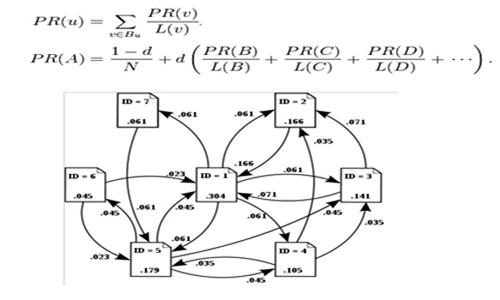
The Media Change & Innovation Division will start a new research project on “Algorithmic selection in the Internet”. The project has a duration of two years and is funded by the Swiss National Science Foundation.
This project grasps and assesses an Internet phenomenon that is developing into one of the central innovations of current media change: algorithmic selection, a distinctive feature of various societal communications processes.
Algorithmic selection of information constitutes the common technological and functional core of various Internet services and is growing rapidly in importance. It is the underlying technological function of diverse applications such as news aggregators (Google News, Techmeme), search engines (Google, Bing, Yahoo), recommender systems (Amazon book recommendations, LastFM), computational advertising (Google AdSense) and reputation systems (eBay feedback). These applications automatically assess the relevance of web documents, choose the most important news articles, recommend books, songs or movies, display personalised advertising and determine the reputation of companies and scholars.
For more details check the research project’s webpage.
-
Twitter, Facebook & Co. in der politischen Meinungsbildung. Einladung zum Talk Demokratie@HOME
4th October 11 Von «Twitter-Revolutionen» im arabischen Raum bis zur «Facebook-Kampagne» im Quartier: Neue Medien und soziale Netzwerke haben den öffentlichen Meinungsmarkt umgekrempelt und sind aus dem politischen Alltag nicht mehr wegzudenken.
Welche Rolle spielen Twitter, Facebook & Co. in der politischen Meinungsbildung? Welche Chancen bietet das Internet für die Demokratie? Welche Rollen spielen Blogs und soziale Netzwerke im politischen Meinungsbildungsprozess? Hat das Internet tatsächlich die Machtverhältnisse auf den Kopf gestellt, oder taugt es bloss als Ventil für Wutbürger?
Welche Herausforderungen stellen sich den politischen Parteien und dem politischen System der Schweiz im digitalen Zeitalter?
Antworten dazu im Talk Demokratie@HOME am 10. Oktober in Lenzburg.
Im Gespräch sind Michael Latzer (Medienwissenschafter, IPMZ, Universität Zürich), Erich Gysling (Autor, Publizist) und Cédric Wermuth
Diese Veranstaltung wird in Zusammenarbeit mit 20 Minuten Online live gestreamt unter www.demokratie.20min.ch
-
Stellenausschreibung: Assistentin / Assistent (50%)
22nd August 11Zur Verstärkung unseres Teams suchen wir eine/n Assistentin / Assistenten.
Die Stelle ist vorerst auf 1 Jahr befristet. Eine Verlängerung um bis zu 5 weitere Jahre sowie eine Aufstockung der Stellenprozente über Drittmittelprojekte wird angestrebt.
Eintrittszeitpunkt: 1. Januar 2012
Anforderungsprofil
- Abgeschlossenes Universitätsstudium der Publizistik- und Kommunikationswissenschaft oder einer benachbarten sozialwissenschaftlichen Disziplin (Lizentiat, Diplom, Master, Magister)
- Interesse an wissenschaftlicher Weiterqualifikation, Forschungserfahrung von Vorteil
- Exzellente Kenntnisse quantitativer Forschungsmethoden sowie ihrer Anwendungen; Erfahrung mit Statistik- und Analysesoftware
- Vorkenntnisse, bzw. hohes Interesse an den Bereichen Neue Medien/Internet, Medienpolitik und/oder Medienökonomie, Medientechnik, Internet & Gesellschaft
- Sehr gute Deutsch- und Englischkenntnisse in Wort und Schrift, weitere Fremdsprachen (v.a.Schweizer Landessprachen) erwünscht
- Routinierte Anwendung der üblichen Computerprogramme
- Hohes Engagement und Teamfähigkeit
- Sorgfältige und verlässliche Arbeitsweise
Arbeitsschwerpunkte
- Mitarbeit an Forschungsprojekten
- Wissenschaftliche Weiterqualifikation (z.B. Doktorat), die sich inhaltlich an den Lehr- und Forschungsschwerpunkten der Abteilung orientiert
- Konferenzteilnahmen und Publikationen
- Mitwirkung in der Lehre
- Betreuungs- und Administrationsarbeiten
Die üblichen Bewerbungsunterlagen inklusive Motivationsschreiben senden Sie bitte bis zum 30. September 2011 als pdf (ein File) an Dr. Natascha Just: n.just@ipmz.uzh.ch.
Die Ausschreibung bleibt offen, bis eine geeignete Kandidatin oder ein geeigneter Kandidat gefunden wurde.
Die Universität Zürich ist an der Gleichstellung von Männern und Frauen in wissenschaftlichen Positionen interessiert und fordert daher einschlägig qualifizierte Frauen ausdrücklich zur Bewerbung auf.
-

Central findings from the project Digital Dividend in Austria were recently published in the International Journal of Digital Television:
Börnsen, Arne / Braulke, Tim / Kruse, Jörn / Latzer, Michael (2011): The Allocation of the Digital Dividend in Austria, in: International Journal of Digital Television, 2 (2), 161-179Abstract: The digital dividend is the amount of spectrum that is freed up by the switchover from analogue TV to digital terrestrial TV in the ultra high frequency band. Drawing from a research project (Braulke et al. 2010) commissioned by the Austrian regulator Rundfunk und Telekommunikations Regulierungs GmbH, this article prioritizes, analyses and evaluates the options of use of the 790–862 MHz frequency band – the so-called ‘upper digital dividend’ in Austria. The underlying economic considerations are based on an analysis of the incremental value. The two main options are the use of the spectrum for digital television and the use for mobile broadband (MBB). The economic analysis clearly shows that the use of the upper digital dividend for MBB would generate the highest economic value. The Austrian government has, based on this analysis, decided to assign the upper digital dividend for MBB use from 2012 onwards. An auction of the spectrum will take place in 2011.
-
The Media Change & Innovation Division has recently joined the World Internet Project (WIP) as Swiss country partner. The international consortium is chaired by Prof. Jeff Cole, USC Annenberg School Center for the Digital Future, and consists of 26 national teams which regularly conduct surveys on Internet usage and its multifaceted impact. This long-term longitudinal study provides national and international comparative results on Internet developments. The findings of the first Swiss WIP survey, which is supported by the Information Society Coordination Office of the Swiss Federal Office of Communication (Bakom) and the Dean’s Office, Faculty of Arts of the University of Zurich, will be presented in late fall of 2011.
-
Media Change and Innovation @ the United Nations
26th May 11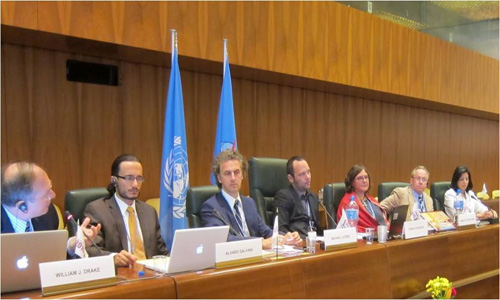
On 17 May 2011, the Media Change and Innovation Division hosted a workshop at the International Labor Organization, a United Nations body located in Geneva. Entitled, «Institutional Choice in Global Communications Governance,» it was held in the context of the WSIS Forum, an annual four-day conference convened to take stock of progress made in implementing the agreements reached during the 2002-2005 World Summit on the Information Society negotiations.
The workshop was organized and moderated by the division’s International Fellow, Dr. William J. Drake, and featured a panel of expert speakers that included the division’s Chair, Prof. Michael Latzer. Other speakers included representatives of global civil society, the Internet technical community, and the governments of Switzerland, Brazil, and Egypt. About sixty people attended the event in person, while others from around the world participated remotely via the Internet.
The purpose of the workshop was to promote dialogue between policy analysts and practitioners about the design and selection of global governance arrangements for information and communication technology (ICT). The contemporary global communi-cations order has been marked by a significant increase in the number and variety of these arrangements, which vary greatly in terms of the collective action problems they address and the institutional attributes they possess. This proliferation raises a number of challenging problems like, how do we evaluate the relative political feasibility and functional effectiveness of alternatives approaches in relation to specific global policy challenges? What are their respective strengths and weaknesses? How well do such mechanisms cohere into an effective global governance architecture? The workshop explored these and related questions in relation to current policy challenges concerning the global Internet in particular.
Find documentation on the workshop bellow:
MCI@UN-WSIS-Forum -

We are pleased to announce that William J. Drake has joined the Media Change and Innovation Division of the Institute of Mass Communication and Media Research at the University of Zurich as its first International Fellow. Bill also has been teaching in the division since the Autumn 2010 term. Previously he has worked in academia, a foreign policy think tank, a civil society organization, and as a consultant. His work focuses on various aspects of global communications and information policy and the impact of the information revolution on world politics. His biography and publications can be accessed under People on this website.
-
SRG Online Beobachtung 2010: Bericht veröffentlicht
1st March 11
Die von der IPMZ-Abteilung Medienwandel & Innovation durchgeführte Studie "SRG Online Beobachtung 2010" wurde heute vom Auftraggeber Bakom veröffentlicht. Wie schon im Jahr 2009 wurde die Konzessionskonformität von Webseiten und elektronischen Verbindungen der Webauftritte von SF, DRS, TSR, RSR und RSI überprüft.
Die Internet-Auftritte der SRG sind weitgehend konzessionskonform gestaltet. Der Anteil unproblematischer Seiten umfasst über 90 Prozent. Für knapp jede zwölfte Webseite im SRG-Online Angebot konnte die Konzessionskonformität jedoch nicht abschliessend belegt werden. Der Umfang der Grauzone beträgt im SRG-Schnitt 8.4 Prozent und hat sich im Jahresvergleich unternehmensübergreifend nicht signifikant verändert.
Latzer, Michael / Braendle, Andreas / Just, Natascha / Saurwein, Florian (2010): SRG Online Beobachtung 2010. Konzessionskonformität von Webseiten und elektronischen Verbindungen. Forschungsprojekt im Auftrag des BAKOM – Bundesamt für Kommunikation. Zürich: IPMZ.
Mehr
-
Stellenausschreibung: Univ.-Assistentin / Univ.-Assistent (50%)
27th January 11Abteilung Medienwandel & Innovation (Prof. Dr. Michael Latzer) des IPMZ – Institut für Publizistikwissenschaft und Medienforschung der Universität Zürich
Die Stelle ist vorerst auf 1 Jahr befristet – eine Verlängerung um bis zu 5 weitere Jahre sowie eine Aufstockung der Stellenprozente über Drittmittelprojekte wird angestrebt.
Eintrittszeitpunkt: ehestmöglich, nach Vereinbarung
Anforderungsprofil- Abgeschlossenes Universitätsstudium der Publizistik- und Kommunikationswissenschaft oder einer benachbarten sozialwissenschaftlichen Disziplin (Lizentiat, Diplom, Master, Magister, Doktorat)
- Forschungserfahrung und Interesse an wissenschaftlicher Weiterqualifikation
- Exzellente Kenntnisse quantitativer Forschungsmethoden sowie ihrer Anwendungen; Erfahrung mit Statistik- und Analysesoftware
- Grundlegende Kenntnisse über technische Struktur und Funktionsweisen sowie Gestaltung von Webseiten; Erfahrungen mit Webcrawling sind von Vorteil
- Technik-Affinität und grundlegende Informatik-Kenntnisse sind von Vorteil
- Starke Teamorientierung
- Sorgfältige und verlässliche Arbeitsweise
Arbeitsschwerpunkte- Mitarbeit an einer international vergleichenden Interneterhebung in der Schweiz (methodische Weiterentwicklung, Datenanalyse und Interpretation)
- Mitarbeit bei Forschungsprojekten zu Online-Inhalts- und Linkanalysen
- Eine inhaltlich an den Lehr- und Forschungsschwerpunkten der Abteilung orientierte wissenschaftliche Weiterqualifikation
- Konferenzteilnahmen und Publikationen
- Mitwirkung in der Lehre
- Betreuungs- und Administrationsarbeiten
Die üblichen Bewerbungsunterlagen inklusive Motivationsschreiben senden Sie bitte bis zum 15. Februar 2011 als pdf (ein File) an Dr. Natascha Just: n.just@ipmz.uzh.ch
Die Ausschreibung bleibt offen, bis eine geeignete Kandidatin oder ein Kandidat gefunden wurde.Die Universität Zürich ist an der Gleichstellung von Männern und Frauen in wissenschaftlichen Positionen interessiert und fordert daher einschlägig qualifizierte Frauen ausdrücklich zur Bewerbung auf.
-
SRG Online Beobachtung als Buch erschienen
6th December 10Die Studie «SRG Online Beobachtung» von Michael Latzer, Andreas Braendle, Natascha Just und Florian Saurwein ist als Buch im Rüegger Verlag erschienen.
Die im Auftrag des Bundesamts für Kommunikation (BAKOM) durchgeführte Studie untersucht die Konzessionskonformität des SRG-Online-Angebots, bietet einen Überblick über die Angebots- und Vernetzungsstruktur der SRG-Online-Auftritte und wurde für die Buchpublikation um regulatorische Perspektiven ergänzt. In der Studie stehen drei Fragen im Zentrum der Analyse:
- Können die einzelnen Teile des Online-Angebots einer der in Art. 13 Abs. 1 der Konzession SRG umschriebenen Kategorien zugeordnet werden?
- Welche Bereiche des Online-Angebots sind als kritisch im Sinne einer Grauzone zu betrachten? Gibt es Angebote, die weder direkt noch indirekt (thematische Verwandtschaft) mit den Programmen in Verbindung gebracht werden können?
- Enthält das Online-Angebot Links, die nicht nach publizistischen Kriterien zu begründen, sondern rein kommerziell zu beurteilen sind?
Die Studie untersucht entsprechend der Vorgaben des Auftraggebers die Online-Auftritte von Schweizer Fernsehen (SF) und Schweizer Radio DRS (DRS) aus der deutschsprachigen Schweiz, jene von Télévision Suisse Romande (TSR) und Radio Suisse Romande (RSR) aus der französischsprachi-gen Schweiz sowie den Auftritt von Radiotelevisione svizzera di lingua italiana (RSI) aus der italienischsprachigen Schweiz.- Mehr Infos auf der Projektseite
- SRG Online Beobachtung beim Rüegger Verlag
- Literaturverweis: Latzer, Michael / Braendle, Andreas / Just, Natascha / Saurwein, Florian (2010): SRG Online Beobachtung. Konzessionskonformität von Webseiten und elektronischen Verbindungen. Zürich/Chur: Rüegger Verlag.
For an english summary of this study see: Latzer, Michael / Braendle, Andreas / Just, Natascha / Saurwein, Florian (2010): Public-Service Broadcasting Online: Assessing Compliance with Regulatory Requirements. In: International Telecommunications Policy Review, 17(2), 1-25
-

Two new publications by members of the Division on Media Change & Innovation were made available over the last few weeks:
- Article: Saurwein, Florian / Latzer, Michael (2010): Regulatory Choice in Communications: The Case of Content-Rating Schemes in the Audiovisual Industry. In: Journal of Broadcasting & Electronic Media, 54(3), 463-484.
- Book: Aichholzer, Georg / Bora, Alfons / Bröchler, Stephan / Decker, Michael / Latzer, Michael (Hg.) (2010): Technology Governance. Der Beitrag der Technikfolgenabschätzung. Berlin: Edition Sigma.
Find more information in the publications section: -
Einführungen in die ökonomischen Theorien der Medien und Medien- und Telekommunikationspolitik
29th November 10
In den letzten Wochen sind die beiden Einführungstexte zu Medien- und Telekommunikationspolitik sowie zu Ökonomische Theorien der Medien aktualisiert worden.
- Just, Natascha / Latzer, Michael (2010): Ökonomische Theorien der Medien. In: Weber, Stefan (Hg.): Theorien der Medien. 2. vollst. aktualisierte Ausgabe, Konstanz: UVK-Verlag, 78-103.
- Puppis, Manuel / Latzer, Michael / Jarren, Otfried (2010): Medien- und Telekommunikationspolitik. In: Bonfadelli, Heinz / Jarren, Otfried / Siegert, Gabriele (Hg.): Einführung in die Publizistikwissenschaft. 3. vollst. aktualisierte Ausgabe, Bern/Stuttgart/Wien: Haupt Verlag, 271-306.
Weitere Informationen finden sich im Seitenbereich Publikationen
-

Rohan Samarajiva is founding Chair and CEO of LIRNEasia, an ICT policy and regulation think tank active across 12 emerging Asian economies. He was telecommunications regulator in Sri Lanka, Visiting Professor of Economics and Infrastructure at the Delft University of Technology in the Netherlands, and Associate Professor of Communication and Public Policy at the Ohio State University in the US. On October 14, Samarajiva will talk on:
«Not one path to the Internet economy »
University of Zurich
Rämistrasse 71
Room: KO2-F-18010/14/2010
17:15 – 18 :00 -
[Film] Medienwandel in der Schweiz
24th August 10Medieninnovationen verändern die Art und Weise, wie wir öffentlich und privat kommunizieren. Während diese Veränderungen in anderen Ländern, wie etwa den USA, bereits gut dokumentiert sind, ist die Datenlage in der Schweiz noch recht mangelhaft.
Wie sieht also der Medienwandel in der Schweiz aus? Treffen die häufig kolportierten Befunde über die Krise der traditionellen Print- und Rundfunkunternehmen und den Boom bei Internetfirmen auch für die Schweiz zu? Welche Schlussfolgerungen sind daraus zu ziehen?
Studierende unseres Forschungsseminars haben die verfügbaren Statistiken über Veränderungen bei Massenmedien, Internet und Telekommunikation in der Schweiz zusammengetragen, damit gängige Thesen über die Auswirkungen des aktuellen Medienwandels überprüft und einige verblüffende Erkenntnisse zu einem Youtube-Video verarbeitet.
Wir hoffen, dass der Film die Diskussion des Medienwandels in der Schweiz belebt.
Weitere Infos zum Film
Dieser Film entstand im Forschungsseminar „Medienwandel -- Gesellschaftswandel" von Prof. Michael Latzer und lic. phil. Andreas Braendle an der Abteilung Medienwandel & Innovation des Instituts für Publizistikwissenschaft und Medienforschung (IPMZ) der Universität Zürich
Credits- Recherche & Konzept: Eddie Brand, Patrizia Burger, René Köhne, Susann König, Kris Lüdi, Christian Stark, Silvio Wernli
- Umsetzung: Kris Lüdi
- Projektleitung: Michael Latzer & Andreas Braendle
-
New Course by Bill Drake! The Changing Global Communications Order: Governing Electronic Networks
23rd August 10
The Division on Media Change & Innovation is excited to offer this new and cutting edge course in the Autumn term. Since the 1850s, governments, business, and civil society have established "rules of the game" governing international communication markets and cross-border information flows. Collectively, these frameworks define the global communications order. In recent years that order has been transformed by privatization, liberalization, and the Internet. This course will survey the evolution, political-economic power dynamics, and social impact of the global governance arrangements for telecommunications regulation, technical standardization, radio frequency spectrum, satellites, trade in goods and communication services, electronic commerce, intellectual property, mass media, Internet content, Internet domain names and numbers, cybercrime and security, privacy protection, and development, as well as the broader debates in the United Nations’ World Summit on the Information Society and Internet Governance Forum.
The course will be taught by Dr. William Drake, who is a Senior Associate of the Centre for International Governance at the Graduate Institute of International and Development Studies in Geneva and a co-editor of the MIT Press book series, The Information Revolution and Global Politics. Drake is a leading international scholar of global communications policy, and has a diverse background. He has taught at Georgetown University and the University of California, San Diego in the USA; was a Senior Associate and Director of the Project on the Information Revolution and World Politics at the Carnegie Endowment for International Peace, an influential foreign policy think tank in Washington DC; and has served as the elected president of a global civil liberties organization, Computer Professionals for Social Responsibility.
Drake is heavily involved as a public interest activist in a number of key global governance processes examined inthis course, such as the ICANN (Internet Corporation for Assigned Names and Numbers), and the UN’s Internet Governance Forum. As such, in this course he will be presenting an “insider’s perspective” on the current geopolitics of governance, particularly with respect to the Internet. He has also been involved in a number of related global networks and initiatives, such as the Global Internet Governance Academic Network and the International Summer Schools on Internet Governance. You can read more about him at http://www.linkedin.com/in/williamjdrake and watch his brief remarks at the UN’s 2009 Internet Governance Forum in Sharm el Sheikh http://tinyurl.com/Drake-IGF09.
This course will be held biweekly on Mondays from 2 to 6pm. Course dates are:- September 20
- October 4
- October 18
- November 1
- November 15
- November 29
- December 13
Course language is English.
More
- Vorlesungsverzeichnis
- Bill Drake on LinkedIn
- Bill Drake’s Remarks at the UN’s 2009 Internet Governance Forum in Sharm el Sheikh
-
Further findings from the assessment of the Swiss public-service broadcaster’s (SRG) Internet offer have been published in the International Telecommunications Policy Review and in Medialex. Find more information in the publications section:
- Latzer, Michael / Braendle, Andreas / Just, Natascha / Saurwein, Florian (2010): Public-Service Broadcasting Online: Assessing Compliance with Regulatory Requirements. In: International Telecommunications Policy Review, 17(2), 1-25 [more]
- Latzer, Michael / Braendle, Andreas / Just, Natascha / Saurwein, Florian (2010): SRG Online Beobachtung: Konzessionskonformität von Webseiten und elektronischen Verbindungen. In: medialex, 15(2), 77-83 [more]
Further findings from the assessment of the Swiss public-service broadcaster’s (SRG) Internet offer have been published in the International Telecommunications Policy Review and in Medialex. Find more information in the publications section:
Latzer, Michael / Braendle, Andreas / Just, Natascha / Saurwein, Florian (2010): Public-Service Broadcasting Online: Assessing Compliance with Regulatory Requirements. In: International Telecommunications Policy Review, 17(2), 1-25 [more]
Latzer, Michael / Braendle, Andreas / Just, Natascha / Saurwein, Florian (2010): SRG Online Beobachtung: Konzessionskonformität von Webseiten und elektronischen Verbindungen. In: medialex, 15(2), 77-83 [more]
-

Results of ongoing research of the IPMZ’s Division on Media Change & Innovation will be presented at international conferences during the next two weeks.
- On June 22, Michael Latzer and Florian Saurwein will contribute to the 19th Annual Conference of the Asian Media Information and Communication Centre (AMIC) in Singapore with a paper on ‘Regulatory Choice in Communications: The Case of Content-Rating Schemes in the Audiovisual Industry’.
- Results of the monitoring and assessment of the Swiss public broadcaster’s (SRG) Internet offer will be presented to the participants of the 60th Annual Conference of the International Communication Association (ICA) in Singapore, June 22-26. The conference is entitled ‘Matters of Communication: Political, Cultural, Technological Challenges’. Michael Latzer, Natascha Just, Florian Saurwein and Andreas Braendle will contribute to a Communication Law & Policy panel with the paper ‘Public Service Broadcasting Online: Assessing Compliance with Regulatory Requirements’.
- From June 27-30 Media Change & Innovation will also take part in the 18th Biennial Conference of the International Telecommunications Society (ITS) in Tokyo at Waseda University and presents results from its study SRG Online Observation. The conference titled “Culture, Communication and the Cutting Edge of Technology” will be held in Association with the 27th Annual Conference of the Japan Society of Information and Communication Research (JSICR).
-
The Division on Media Change & Innovation of the IPMZ continues the monitoring and assessment of the SRG Internet offer in 2010. The project SRG Online Assessment 2010 is commissioned by the Swiss regulator BAKOM as part of its Media Research 2010 special focus on the continuous program analysis of television, radio and online offers of the SRG. The study’s focus is–in replication of its 2009 analysis–on the extent of compliance of the SRG online services with the regulatory requirements of the charter (e.g., relation of online offers to broadcasts, no commercial links). It builds on a methodological approach, which has been developed and applied for the SRG Online Assessment 2009 and conducts a content analysis to give insights into the structure and functioning of the websites of five SRG enterprise units, and a link analysis to capture the intensity of electronic linking and the pattern of interconnection with other websites. The replication of the analysis will show first trends of development and change.
For more information see the project website. Results will be available by the end of 2010.
-

The research report on the utilization of the Digital Dividend in Austria, conducted by Michael Latzer together with Arne Boernsen (AB Consulting), Tim Braulke (Infront Consulting & Management) and Joern Kruse (Helmut-Schmidt University, Hamburg), has been published by the Austrian regulator RTR. The responsible Austrian minister has already announced that she will follow the study’s recommendations and award the available spectrum for broadband mobile communication.
The Digital Dividend, a product of digitalisation and convergence in the communications sector, denotes those frequencies that are freed up as a result of the switchover from analogue TV to more spectrally efficient digital TV. The digital dividend spectrum is suitable for a wide range of potential uses. The political decision how this valuable freed up spectrum is used for mobile communication (e.g. broadband internet) and/or for broadcasting (e.g. HDTV) is heavily debated worldwide.More:
-
The Division on Media Change & Innovation participates as country expert in a study that analyzes the independence and efficiency of European regulatory authorities for audiovisual media. The study was contracted by the European Commission to an international research consortium under the direction of the Hans-Bredow-Institut für Medienforschung. Further consortium partners are: Katholieke Universiteit Leuven, Central European University, Cullen International, and Perspective Associates.
A network of country experts cooperates with the consortium and provides the data from 43 countries covered by the study (EU member states, candidate and potential candidate countries to the EU, EFTA countries as well as selected other countries).
The overall aim of the study is the development of indicators that allow the measurement of independence of regulatory bodies in the field of audiovisual media as well as the assessment of these bodies’ functioning to ensure an effective application of the AVMS Directive.
The Division on Media Change & Innovation of the IPMZ contributes to the study with the analyses of independent regulatory authorities in Switzerland and Austria.Find more information on the Project Page
-
Programm der öffentlichen Vortragsreihe steht fest
22nd January 10In diesem Frühlingssemester gibt es für Studierende am IPMZ – im Rahmen der Vorlesung „Digitale Destabilisierung: Medienwandel durch Konvergenz“ – die einmalige Gelegenheit, eine Reihe renommierter Gastredner aus den USA, Grossbritannien, Deutschland und der Schweiz zu treffen. Diskutieren Sie mit jenen Experten aus Wirtschaft und Politik, die die Veränderungen im Kommunikationssektor wesentlich mitprägen sowie mit Wissenschaftern, die diese analysieren.
Die öffentliche Vortragsreihe des IPMZ wird von der Abteilung Medienwandel & Innovation veranstaltet und ist in die wöchentlich stattfindende Vorlesung von Prof. Michael Latzer, Dr. Natascha Just und lic. phil. Andreas Braendle integriert. Sie ist für Bachelor und Lizstudierende als Wahlpflichtvorlesung und als Wahlvorlesung anrechenbar, steht aber auch anderen Studierenden und Interessierten offen.
Folgende Gastredner besuchen das IPMZ:

Christoph Neuberger ist Professor am Institut für Kommunikationswissenschaft der Universität Münster und ein renommierter deutscher Journalismus- und Internetforscher. Seine Präsentation trägt den Titel: "Niedergang oder Neustart des Journalismus? Das Internet und seine Folgen" (23. März).

Martin Radelfinger leitet das Business Development bei Goldbach Media, dem grössten Vermarkter für elektronische und Online-Medien in der Schweiz. Er skizziert seine Sicht der Destabilisierung des Werbemarktes durch Medienkonvergenz und das Internet (13. April). 
Felix Graf ist COO bei Teleclub AG und war als Leiter Entertainment & Multimedia bei Swisscom massgeblich für den Aufbau von Bluewin TV (IPTV) zuständig. Er trägt zum Thema Destabilisierung der Telekommunikation und Medienindustrie vor (20. April). 
Hans-Jürg Fehr, Schweizer Nationalrat, Medienpolitiker und vormaliger Präsident der SP Schweiz, spricht über den politischen Handlungsbedarf (4. Mai). 
William H. Dutton ist Professor an der Oxford University (GB) und Leiter des Oxford Internet Institutes. Er präsentiert seine Forschung zum Internet und der Entstehung einer fünften Gewalt (11. Mai).

Johannes M. Bauer ist Professor am Institute of Telecommunications, Information Studies and Media der Michigan State University (USA). Er vergleicht Netzneutralität und Internetentwicklung in den USA und Europa (18. Mai).
Veranstaltungsort: Uni Hauptgebäude, Rämistr. 71, KOL-F-117
Termin: jeweils Dienstags um 18:15 Uhr. (Link Vorlesungsverzeichnis UZH)
Mehr
-
International Telecom Expert to lecture at IPMZ
21st January 10
Johannes M. Bauer, Prof. in the Department of Telecommunication, Information Studies, and Media at Michigan State University, confirmed his participation as guest speaker of the Public Lecture Series that is part of the course «Digitale Destabilisierung: Medienwandel durch Konvergenz».
On May 18, 2010 he is going to lecture at the IPMZ about net neutrality and Internet development in Europe and the USA.
-

Hans-Jürg Fehr, member of the Swiss National Council and former president of the Social Democratic Party of Switzerland, is going to guest lecture on May 4, 2010 on the occasion of the Public Lecture Series that is part of the course Digitale Destabilisierung: Medienwandel durch Konvergenz. His presentation is entitled "Welchen politischen Handlungsbedarf erzeugt das Internet?"
Other confirmed speakers for the Public Lecture Series include:
- Prof. Dr. William H. Dutton, Director Oxford Internet Institute, University of Oxford
- Prof. Dr. Christoph Neuberger, Geschäftsführender Direktor, Institut für Kommunikationswissenschaft, Westfälische Wilhelms-Universität Münster
- Martin Radelfinger, Chief of Business Development, Goldbach Media Gruppe
- Felix R. Graf, COO Teleclub AG
Details will follow
-
Michael Latzer is part of an international research group that investigates the options for using the Digital Dividend in Austria. Other members are Arne Boernsen (AB Consulting), Tim Braulke (Infront Consulting & Management) and Joern Kruse (Helmut-Schmidt University, Hamburg). The study is commissioned by the Austrian regulator RTR and will assess different usage scenarios and develop policy recommendations for this highly contended issue.
The Digital Dividend, a product of digitalisation and convergence in the communications sector, denotes those frequencies that are freed up as a result of the switchover from analogue TV to more spectrally efficient digital TV. The digital dividend spectrum is suitable for a wide range of potential uses. The political decision of if and how this valuable freed up spectrum is used for mobile communication (e.g. broadband internet) and/or for broadcasting (e.g. HDTV) is heavily debated worldwide.
More
-
Spring Courses Online
16th December 09
The handbook for courses for next semester has been published. IPMZ's division on Mediachange & Innovation will be offering the following courses:
- Vorlesung: Digitale Destabilisierung: Medienwandel durch Konvergenz (Latzer, Just, Brändle & Gäste)
- SP 1 Forschungsseminar: Medienwandel - Gesellschaftswandel: Merkmale, Thesen und empirische Evidenz (Latzer, Brändle)
- SP 1 Seminar: Medienwandel und Demokratie im Kommunikationsraum Europa (Saurwein)
- Seminar MA NF/Liz: Medieninnovationen (Latzer)
- Einführung in die Publizistikwissenschaft III: (Lektürekurs Gruppe 3) (Just, Saurwein)
- Einführung in die Publizistikwissenschaft III: (Lektürekurs Gruppe 4) (Just, Saurwein)
- Lizentianden-Kolloquium Abteilung Prof. Michael Latzer (Latzer)
- Doktoranden-Kolloquium Abteilung Prof. Michael Latzer (Latzer)
-
Convergence Revisited - New Paper by Michael Latzer in Convergence
28th November 09Convergence - The International Journal of Research into New Media Technologies - features a new article by Michael Latzer. It revisits the nature and governance implications of the convergence phenomenon more than a decade after it gained major prominence.
 Latzer, Michael (2009): Convergence Revisited: Toward a Modified Pattern of Communications Governance, In: Convergence – The International Journal of Research into New Media Technologies, 15 (4), 411-426
Abstract: This paper revisits the nature and governance implications of the convergence phenomenon more than a decade after it gained major prominence in politics and research. It analyses the reforms undertaken in reaction to convergence, outlines their common features, and argues that a worldwide trend towards a modified common governance pattern for convergent communications markets is emerging. The major constituent components include integrated strategies, control structures and legal frameworks for the convergent communications sector; a technology-neutral functional taxonomy; a subdivision into transmission and content regulation; and a growing reliance on alternative modes of regulation such as self- and coregulation.More
-
Guest Lecture at the Universität Tübingen
5th November 09Michael Latzer is going to give a guest lecture on Neue Governancemodelle: Konvergenz und Regulierung (New Governance Models: Convergence and Regulation) in the lecture series on "Medienkonvergenz und Neue Medien", December 3, 2009 at Medienwissenschaften, Universität Tübingen
-
Presentation at the Conference „Public Value in the Digital and Internet Economy“ in Hamburg
26th October 09
Natascha Just and Michael Latzer are going to present a paper on „Media policy via competition policy in the EU: pressure on public service broadcasters and the meaning of public value“ at the upcoming conference „Public Value in the Digital and Internet Economy“ of the Division on Media Economics of the German Society for Communication (DGPuK), November 13-14, 2009, in Hamburg.
-
ECREA "Communication Law and Policy" Workshop 2009
30th September 09 ECREA Logo
The Division on Media Change & Innovation hosts the 2009 workshop of the European Communication Research and Education Association's (ECREA) "Communication Law and Policy" section. It takes place in Zurich, Switzerland, on November 6-7, 2009. The workshop is jointly organized with the division "Media & Politics” of the University of Zurich's Institute of Mass Communication and Media Research (IPMZ).
The theme of the workshop is "New Directions for Communication Policy Research". The state of the art of communication policy research is well documented, but where do we go from here? How do we theoretically and methodologically approach new policy issues? What policy challenges are emerging and what insights can we gain from the application of theories and methods of cognate areas? The workshop focuses on new theories, new methods, new subjects as well as new regulatory structures and instruments. It is our aim to stimulate reflection and discussion. Thus, the sessions will leave room for discussion and exchange.
Please visit the official Website of ECREA-CLP Workshop 2009
-
SRG Online Assessment for BAKOM
15th September 09Online services of public service broadcasters in Europe are disputed because they are in direct competition with online activities of private broadcaster and publishers. While the discussions are similar across European countries, the regulatory responses by national governments differ. In Switzerland a charter lays down the conditions for the online activities of the Swiss public broadcaster (SRG) and clarifies what kind of content is permissible. The Division on Media Change & Innovation conducted a research project commissioned by the Swiss regulator BAKOM to assess the SRG’s compliance with these regulatory requirements. For this endeavor we have (1) developed an analytical approach for the external assessment, and conducted (2) a content analysis to give insights into the structure and functioning of the websites of five SRG enterprise units, and (3) a link analysis to capture the intensity of electronic linking and the pattern of interconnection with other websites (link structure). The paper shows the potential of the developed analytical tools and the extent to which the SRG websites comply with regulatory requirements.
Get the full research report here

-
Measuring Media Concentration and Diversity: New Approaches and Instruments in Europe and the US
15th August 09Media, Culture & Society published an article by Natascha Just. The article describes and discusses new methods and instruments for measuring media concentration.
 Abstract: Debates on media concentration and the appropriate way to handle it are not coming to an end. This article stresses the dual character of media goods, the underlying ideological ideals, and the attendant institutional setting as sources of value conflict in communications policy making. It discusses this value conflict and gives examples of where it surfaces and how it is confronted. It is particularly evident in cases of media concentration. Newly introduced communications laws and policies within Europe and the US aim to reduce (ownership) regulation, promote competition and cope with the challenges posed by convergence. This quest is coupled in part with protections of media pluralism through custom-developed indices for measuring concentration in media markets and tests for assessing media plurality in merger cases. The article describes and discusses these new methods and instruments as novel but imperfect attempts by policy makers to respond to the various challenges in communications such as value conflict, convergence, the need for empirical proof and claims for non-economic ways of assessing media diversity. It concludes by stressing the need to re-emphasize normative claims as essential guiding elements of communications policy making. Keywords: communications policy, Europe, measurement, media concentration, value conflict, US
 -
Fall courses online
17th July 09The handbook for courses for next semester has been published. IPMZ's division on Mediachange & Innovation will be offering the following two courses:
-
Are ICT innovations radical and disruptive? This is question is brought forward by Michael Latzer’s newest article in News Media & Society’s June edition.
 Information and communication technology innovations (ICT) are considered to be of central importance to social and economic developments. Various innovation theories offer classifications to predict and assess their impact. This article reviews the usefulness of selected approaches and their application in the convergent communications sector. It focuses on the notion of disruption, the comparatively new distinction between disruptive and sustaining innovations, and examines how it is related to other innovation-theoretical typologies. According to the literature, there is a high frequency of disruptive changes in the field of internet protocol-based innovations in combination with wireless technology. A closer analysis reveals that these classifications and assessments not only differ in detail but are even contradictory. The article explains these differences by highlighting delicate choices that have to be taken by analysts applying the disruption concept. It argues that its applicability is comparatively low in the convergent communications sector and generalizations of single-firm assessments are hardly valid.
More
New Media & Society – Official Website
New Media & Society - Information and communication technology innovations: radical and disruptive?
More information in our publication’s section -
Ben Ali ruled Tunisia for 20 years, Mubarak reigned in Egypt for 30 years, and Gaddafi held Libya in a tight grip for over 40 years. Yet their bravest challengers were 20- and 30-year-olds without ideological baggage, violent intentions or clear leaders. The groups that initiated and sustained protests have few meaningful experiences with public deliberation or voting, and little experience with successful protesting. However, these young activists are politically disciplined, pragmatic and collaborative. Where do young people who grow up in entrenched authoritarian regimes learn about public life and get political aspirations? Internet, mobile phones, and social networking applications have transformed politics across North Africa and the Middle East. In this lecture on digital media and the organization of social change in the Arab Spring, we examine various dimensions of emerging information infrastructure in North Africa and the Middle East and the global struggle to govern and manage their political impacts.
-
Michael Latzer wird im Rahmen der "Aktuellen Debatten der Soziologie" einen Vortrag über "Algorithmische Selektion im Internet: Auswirkungen auf Ökonomie, Politik und den Alltag" halten.
Das Kolloquium findet am Montag, 26.06.17, an der Technischen Universität Dortmund statt, und beschäftigt sich mit Techniksoziologie und der Macht von Algorithmen. Wie beeinflussen Algorithmen Gesellschaften, die durch Datafizierung und Plattformisierung geprägt sind? Wo liegen die Unterschiede zwischen einer algorithmischen und einer massenmedialen Wirklichkeitskonstruktion? Welche demokratischen und sozialen Risiken ergeben sich und wie können diese gesteuert werden?
Neben dem Vortrag wird es auch die Möglichkeit einer anaschließenden Diskussion zur Beantwortung von Fragen und zum Austausch mit dem Vortragenden geben.
-
The Media Change and Innovation Division (Prof. Michael Latzer), Department of Communication and Media Research (IKMZ), University of Zurich is seeking applications for a postdoctoral position and short-term visiting researchers in socio-technical transformations through digitalization and AI.
The successful applicants will work on dedicated topics that align with the division’s research program including the chilling effects of dataveillance, the religion-like digitalization of societies, or content creators’ belief systems within the social media ecosystem (see division’s recent publications).
Postdoctoral position
→ Read the full job description and apply.
Short-Term Visiting Researchers
→ Read the full job description and apply.
Contacts for further information:
Dr. Noemi Festic (n.festic@ikmz.uzh.ch)
Dr. Daniela Jaramillo-Dent (d.jaramillo@ikmz.uzh.ch)