

News
-
New Publications on Digital Divide and the Governance of Algorithms
16th September 15The Media Change & Innovation Division has published two new articles:

Now available online is a new article by Moritz Büchi, Michael Latzer and Natascha Just in New Media & Society titled "Modeling the second-level digital divide: A five-country study of social differences in Internet use"

Also available online is a new article by Florian Saurwein, Natascha Just and Michael Latzer published in "info" titled "Governance of Algorithms: options and limitations".
-
Die Schweiz im Internet – Neuer Themenbericht zu Vertrauen und Sorgen bei der Internet-Nutzung
22nd May 12 WIP-CH veröffentlicht erneut Daten zur Internet-Nutzung in der Schweiz: Die Ergebnisse des Themenberichts „Vertrauen und Sorgen bei der Internet-Nutzung in der Schweiz“ zeigen ein geringes Vertrauen der Internet-Nutzer in nutzergenerierte Inhalte, Sorgen vor der Kontrolle durch Unternehmen und einen erheblichen Anteil an Leuten, die sich manchmal aufgrund von Medienkonsum im Haushalt unbeachtet fühlen.
Themenbericht Vertrauen und Sorgen bei der Internet-Nutzung in der Schweiz
Weitere verfügbare Themenberichte:
- Themenbericht Internetverbreitung und digitale Bruchlinien in der Schweiz
- Themenbericht Internet und Politik in der Schweiz
- Themenbericht Internet-Anwendungen und deren Nutzung in der Schweiz
-
Die Schweiz hat 2011 erstmals am World Internet Project teilgenommen und die Schweizer Bevölkerung zu ihrer Internet-Nutzung und ihren Einstellungen zum Internet befragt.
Nun sind erste Themenberichte verfügbar. Diese widmen sich der Internetverbreitung, der digitalen Kluft und digitalen Demokratisierung sowie Fragen zu Meinungsfreiheit und Internetpolitik.
- Themenbericht Internetverbreitung und digitale Bruchlinien in der Schweiz
- Themenbericht Internet und Politik in der Schweiz
-
New Book: Trends in Communication Policy Research
8th March 12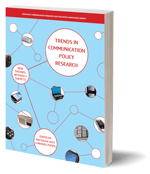 The newest addition to the ECREA Book Series «Trends in Communication Policy Research» has been released.
This book, edited by Natascha Just and Manuel Puppis (IPMZ), University of Zurich, brings together international experts in communication policy research to tackle ongoing changes and challenges. It gives insights into new theories, methods and subjects and thereby provides important contributions to pressing communication policy issues. «Trends in Communication Policy Research» is an ideal source of information for scholars, professionals, students and anyone interested in communication policy and regulation.
Praise for «Trends in Communication Policy Research»:
«Communication policy research is a notoriously under-theorized field. This book puts that right. The contributors draw on older and newer theoretical approaches to institutions, interests and ideas showing very convincingly why policy in this area is so crucial in shaping the mediated world we inhabit and why innovative methods are needed in the analysis of constant pressures brought by changing markets, technologies and practices.» // Prof. Robin Mansell, London School of Economics and Political Science
«The authors gather a chorus of provocative voices to explore and explain new tendencies in communications research and their implications for communications policy. A real service to the field and a pioneering way to organize innovative thought.» // Prof. Monroe E. Price, Annenberg School for Communication at the University of Pennsylvania
«As a result of on-going transformations in law-state-society relations, communication policy is neither what it was, nor what is depicted through the relatively limited range of habitual research methods, theories, and conceptualizations of the research subject. This literate, sophisticated, and stimulating collection valuably opens the conversation about where European communication policy research might go in the 21st century.» // Prof. Sandra Braman, University of Wisconsin-Milwaukee
Just, Natascha/Puppis, Manuel (eds) (2012): Trends in Communication Policy Research. New Theories, Methods & Subjects. (ECREA Book Series, Vol. 7). Bristol/Chicago: Intellect. ISBN: 978-1-84150-4674
-
Neue Publikation: Medienpolitik durch europäische Wettbewerbspolitik
24th February 11
Im Halem Verlag ist der Band Public Value in der Digital- und Internetökonomie erschienen. Er stellt in zahlreichen Beiträgen Forschungsperspektiven und Thesen zum Kern von Public Value vor. Im Band enthalten ist folgender Beitrag von Natascha Just und Michael Latzer:
Just, Natascha / Latzer, Michael (2011): Medienpolitik durch Europäische Wettbewerbspolitik: Druck auf öffentlichen Rundfunk durch Beihilfenpolitik - Public-Value-Konzepte als Lösungsansatz. In: Gundlach, Hardy (Hg.): Public Value in der Digital- und Internetökonomie. Köln: Halem, 79-100Mehr:
-
SRG Online Beobachtung als Buch erschienen
6th December 10Die Studie «SRG Online Beobachtung» von Michael Latzer, Andreas Braendle, Natascha Just und Florian Saurwein ist als Buch im Rüegger Verlag erschienen.
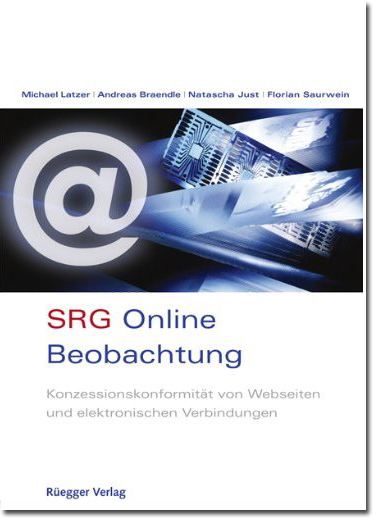
Die im Auftrag des Bundesamts für Kommunikation (BAKOM) durchgeführte Studie untersucht die Konzessionskonformität des SRG-Online-Angebots, bietet einen Überblick über die Angebots- und Vernetzungsstruktur der SRG-Online-Auftritte und wurde für die Buchpublikation um regulatorische Perspektiven ergänzt. In der Studie stehen drei Fragen im Zentrum der Analyse:
- Können die einzelnen Teile des Online-Angebots einer der in Art. 13 Abs. 1 der Konzession SRG umschriebenen Kategorien zugeordnet werden?
- Welche Bereiche des Online-Angebots sind als kritisch im Sinne einer Grauzone zu betrachten? Gibt es Angebote, die weder direkt noch indirekt (thematische Verwandtschaft) mit den Programmen in Verbindung gebracht werden können?
- Enthält das Online-Angebot Links, die nicht nach publizistischen Kriterien zu begründen, sondern rein kommerziell zu beurteilen sind?
Die Studie untersucht entsprechend der Vorgaben des Auftraggebers die Online-Auftritte von Schweizer Fernsehen (SF) und Schweizer Radio DRS (DRS) aus der deutschsprachigen Schweiz, jene von Télévision Suisse Romande (TSR) und Radio Suisse Romande (RSR) aus der französischsprachi-gen Schweiz sowie den Auftritt von Radiotelevisione svizzera di lingua italiana (RSI) aus der italienischsprachigen Schweiz.- Mehr Infos auf der Projektseite
- SRG Online Beobachtung beim Rüegger Verlag
- Literaturverweis: Latzer, Michael / Braendle, Andreas / Just, Natascha / Saurwein, Florian (2010): SRG Online Beobachtung. Konzessionskonformität von Webseiten und elektronischen Verbindungen. Zürich/Chur: Rüegger Verlag.
For an english summary of this study see: Latzer, Michael / Braendle, Andreas / Just, Natascha / Saurwein, Florian (2010): Public-Service Broadcasting Online: Assessing Compliance with Regulatory Requirements. In: International Telecommunications Policy Review, 17(2), 1-25
-
Einführungen in die ökonomischen Theorien der Medien und Medien- und Telekommunikationspolitik
29th November 10
In den letzten Wochen sind die beiden Einführungstexte zu Medien- und Telekommunikationspolitik sowie zu Ökonomische Theorien der Medien aktualisiert worden.
- Just, Natascha / Latzer, Michael (2010): Ökonomische Theorien der Medien. In: Weber, Stefan (Hg.): Theorien der Medien. 2. vollst. aktualisierte Ausgabe, Konstanz: UVK-Verlag, 78-103.
- Puppis, Manuel / Latzer, Michael / Jarren, Otfried (2010): Medien- und Telekommunikationspolitik. In: Bonfadelli, Heinz / Jarren, Otfried / Siegert, Gabriele (Hg.): Einführung in die Publizistikwissenschaft. 3. vollst. aktualisierte Ausgabe, Bern/Stuttgart/Wien: Haupt Verlag, 271-306.
Weitere Informationen finden sich im Seitenbereich Publikationen
-
Measuring Media Concentration and Diversity: New Approaches and Instruments in Europe and the US
15th August 09Media, Culture & Society published an article by Natascha Just. The article describes and discusses new methods and instruments for measuring media concentration.
 Abstract: Debates on media concentration and the appropriate way to handle it are not coming to an end. This article stresses the dual character of media goods, the underlying ideological ideals, and the attendant institutional setting as sources of value conflict in communications policy making. It discusses this value conflict and gives examples of where it surfaces and how it is confronted. It is particularly evident in cases of media concentration. Newly introduced communications laws and policies within Europe and the US aim to reduce (ownership) regulation, promote competition and cope with the challenges posed by convergence. This quest is coupled in part with protections of media pluralism through custom-developed indices for measuring concentration in media markets and tests for assessing media plurality in merger cases. The article describes and discusses these new methods and instruments as novel but imperfect attempts by policy makers to respond to the various challenges in communications such as value conflict, convergence, the need for empirical proof and claims for non-economic ways of assessing media diversity. It concludes by stressing the need to re-emphasize normative claims as essential guiding elements of communications policy making. Keywords: communications policy, Europe, measurement, media concentration, value conflict, US
 -
Are ICT innovations radical and disruptive? This is question is brought forward by Michael Latzer’s newest article in News Media & Society’s June edition.
 Information and communication technology innovations (ICT) are considered to be of central importance to social and economic developments. Various innovation theories offer classifications to predict and assess their impact. This article reviews the usefulness of selected approaches and their application in the convergent communications sector. It focuses on the notion of disruption, the comparatively new distinction between disruptive and sustaining innovations, and examines how it is related to other innovation-theoretical typologies. According to the literature, there is a high frequency of disruptive changes in the field of internet protocol-based innovations in combination with wireless technology. A closer analysis reveals that these classifications and assessments not only differ in detail but are even contradictory. The article explains these differences by highlighting delicate choices that have to be taken by analysts applying the disruption concept. It argues that its applicability is comparatively low in the convergent communications sector and generalizations of single-firm assessments are hardly valid.
More
New Media & Society – Official Website
New Media & Society - Information and communication technology innovations: radical and disruptive?
More information in our publication’s section