

News
-

William Drake, an International Fellow and Lecturer in the Media Change and Innovation Division of the Institute of Mass Communication and Media Research at the University of Zurich has just released his new eBook “Beyond NETmundial: The Roadmap for Institutional Improvements to the Global Internet Governance Ecosystem”.
It explores options for the implementation of a key section of the “NETmundial Multistakeholder Statement” that was adopted at the Global Meeting on the Future of Internet Governance (NETmundial) held on April 23rd and 24th 2014 in São Paulo, Brazil. The Roadmap section of the statement concisely sets out a series of proposed enhancements to existing mechanisms for global internet governance, as well as suggestions of possible new initiatives that the global community may wish to consider.
The book was produced as a part of the Internet Policy Observatory, a program at the Center for Global Communication Studies, the Annenberg School for Communication at the University of Pennsylvania. It was edited by William J. Drake of the University of Zurich and Monroe Price of the Annenberg School for Communication. They were assisted by Laura Schwartz-Henderson, Briar Smith, and Alexandra Esenler.
For more information, please visit globalnetpolicy.org

-
New Book: Trends in Communication Policy Research
8th March 12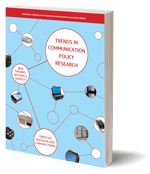 The newest addition to the ECREA Book Series «Trends in Communication Policy Research» has been released.
This book, edited by Natascha Just and Manuel Puppis (IPMZ), University of Zurich, brings together international experts in communication policy research to tackle ongoing changes and challenges. It gives insights into new theories, methods and subjects and thereby provides important contributions to pressing communication policy issues. «Trends in Communication Policy Research» is an ideal source of information for scholars, professionals, students and anyone interested in communication policy and regulation.
Praise for «Trends in Communication Policy Research»:
«Communication policy research is a notoriously under-theorized field. This book puts that right. The contributors draw on older and newer theoretical approaches to institutions, interests and ideas showing very convincingly why policy in this area is so crucial in shaping the mediated world we inhabit and why innovative methods are needed in the analysis of constant pressures brought by changing markets, technologies and practices.» // Prof. Robin Mansell, London School of Economics and Political Science
«The authors gather a chorus of provocative voices to explore and explain new tendencies in communications research and their implications for communications policy. A real service to the field and a pioneering way to organize innovative thought.» // Prof. Monroe E. Price, Annenberg School for Communication at the University of Pennsylvania
«As a result of on-going transformations in law-state-society relations, communication policy is neither what it was, nor what is depicted through the relatively limited range of habitual research methods, theories, and conceptualizations of the research subject. This literate, sophisticated, and stimulating collection valuably opens the conversation about where European communication policy research might go in the 21st century.» // Prof. Sandra Braman, University of Wisconsin-Milwaukee
Just, Natascha/Puppis, Manuel (eds) (2012): Trends in Communication Policy Research. New Theories, Methods & Subjects. (ECREA Book Series, Vol. 7). Bristol/Chicago: Intellect. ISBN: 978-1-84150-4674
-
SRG Online Beobachtung 2010: Bericht veröffentlicht
1st March 11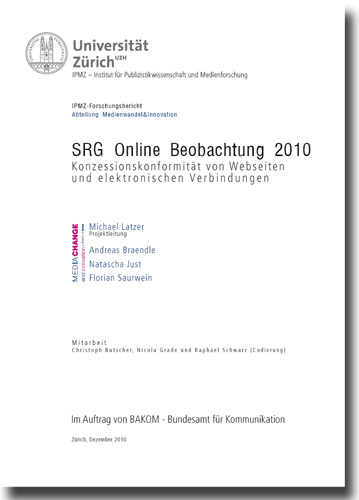
Die von der IPMZ-Abteilung Medienwandel & Innovation durchgeführte Studie "SRG Online Beobachtung 2010" wurde heute vom Auftraggeber Bakom veröffentlicht. Wie schon im Jahr 2009 wurde die Konzessionskonformität von Webseiten und elektronischen Verbindungen der Webauftritte von SF, DRS, TSR, RSR und RSI überprüft.
Die Internet-Auftritte der SRG sind weitgehend konzessionskonform gestaltet. Der Anteil unproblematischer Seiten umfasst über 90 Prozent. Für knapp jede zwölfte Webseite im SRG-Online Angebot konnte die Konzessionskonformität jedoch nicht abschliessend belegt werden. Der Umfang der Grauzone beträgt im SRG-Schnitt 8.4 Prozent und hat sich im Jahresvergleich unternehmensübergreifend nicht signifikant verändert.
Latzer, Michael / Braendle, Andreas / Just, Natascha / Saurwein, Florian (2010): SRG Online Beobachtung 2010. Konzessionskonformität von Webseiten und elektronischen Verbindungen. Forschungsprojekt im Auftrag des BAKOM – Bundesamt für Kommunikation. Zürich: IPMZ.
Mehr
-
SRG Online Beobachtung als Buch erschienen
6th December 10Die Studie «SRG Online Beobachtung» von Michael Latzer, Andreas Braendle, Natascha Just und Florian Saurwein ist als Buch im Rüegger Verlag erschienen.
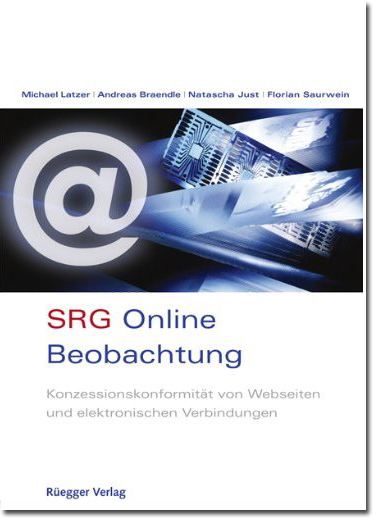
Die im Auftrag des Bundesamts für Kommunikation (BAKOM) durchgeführte Studie untersucht die Konzessionskonformität des SRG-Online-Angebots, bietet einen Überblick über die Angebots- und Vernetzungsstruktur der SRG-Online-Auftritte und wurde für die Buchpublikation um regulatorische Perspektiven ergänzt. In der Studie stehen drei Fragen im Zentrum der Analyse:
- Können die einzelnen Teile des Online-Angebots einer der in Art. 13 Abs. 1 der Konzession SRG umschriebenen Kategorien zugeordnet werden?
- Welche Bereiche des Online-Angebots sind als kritisch im Sinne einer Grauzone zu betrachten? Gibt es Angebote, die weder direkt noch indirekt (thematische Verwandtschaft) mit den Programmen in Verbindung gebracht werden können?
- Enthält das Online-Angebot Links, die nicht nach publizistischen Kriterien zu begründen, sondern rein kommerziell zu beurteilen sind?
Die Studie untersucht entsprechend der Vorgaben des Auftraggebers die Online-Auftritte von Schweizer Fernsehen (SF) und Schweizer Radio DRS (DRS) aus der deutschsprachigen Schweiz, jene von Télévision Suisse Romande (TSR) und Radio Suisse Romande (RSR) aus der französischsprachi-gen Schweiz sowie den Auftritt von Radiotelevisione svizzera di lingua italiana (RSI) aus der italienischsprachigen Schweiz.- Mehr Infos auf der Projektseite
- SRG Online Beobachtung beim Rüegger Verlag
- Literaturverweis: Latzer, Michael / Braendle, Andreas / Just, Natascha / Saurwein, Florian (2010): SRG Online Beobachtung. Konzessionskonformität von Webseiten und elektronischen Verbindungen. Zürich/Chur: Rüegger Verlag.
For an english summary of this study see: Latzer, Michael / Braendle, Andreas / Just, Natascha / Saurwein, Florian (2010): Public-Service Broadcasting Online: Assessing Compliance with Regulatory Requirements. In: International Telecommunications Policy Review, 17(2), 1-25
-
Einführungen in die ökonomischen Theorien der Medien und Medien- und Telekommunikationspolitik
29th November 10
In den letzten Wochen sind die beiden Einführungstexte zu Medien- und Telekommunikationspolitik sowie zu Ökonomische Theorien der Medien aktualisiert worden.
- Just, Natascha / Latzer, Michael (2010): Ökonomische Theorien der Medien. In: Weber, Stefan (Hg.): Theorien der Medien. 2. vollst. aktualisierte Ausgabe, Konstanz: UVK-Verlag, 78-103.
- Puppis, Manuel / Latzer, Michael / Jarren, Otfried (2010): Medien- und Telekommunikationspolitik. In: Bonfadelli, Heinz / Jarren, Otfried / Siegert, Gabriele (Hg.): Einführung in die Publizistikwissenschaft. 3. vollst. aktualisierte Ausgabe, Bern/Stuttgart/Wien: Haupt Verlag, 271-306.
Weitere Informationen finden sich im Seitenbereich Publikationen
-
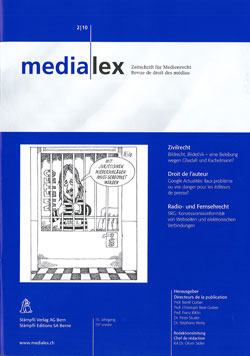
Further findings from the assessment of the Swiss public-service broadcaster’s (SRG) Internet offer have been published in the International Telecommunications Policy Review and in Medialex. Find more information in the publications section:
- Latzer, Michael / Braendle, Andreas / Just, Natascha / Saurwein, Florian (2010): Public-Service Broadcasting Online: Assessing Compliance with Regulatory Requirements. In: International Telecommunications Policy Review, 17(2), 1-25 [more]
- Latzer, Michael / Braendle, Andreas / Just, Natascha / Saurwein, Florian (2010): SRG Online Beobachtung: Konzessionskonformität von Webseiten und elektronischen Verbindungen. In: medialex, 15(2), 77-83 [more]
Further findings from the assessment of the Swiss public-service broadcaster’s (SRG) Internet offer have been published in the International Telecommunications Policy Review and in Medialex. Find more information in the publications section:
Latzer, Michael / Braendle, Andreas / Just, Natascha / Saurwein, Florian (2010): Public-Service Broadcasting Online: Assessing Compliance with Regulatory Requirements. In: International Telecommunications Policy Review, 17(2), 1-25 [more]
Latzer, Michael / Braendle, Andreas / Just, Natascha / Saurwein, Florian (2010): SRG Online Beobachtung: Konzessionskonformität von Webseiten und elektronischen Verbindungen. In: medialex, 15(2), 77-83 [more]
-

Hans-Jürg Fehr, member of the Swiss National Council and former president of the Social Democratic Party of Switzerland, is going to guest lecture on May 4, 2010 on the occasion of the Public Lecture Series that is part of the course Digitale Destabilisierung: Medienwandel durch Konvergenz. His presentation is entitled "Welchen politischen Handlungsbedarf erzeugt das Internet?"
Other confirmed speakers for the Public Lecture Series include:
- Prof. Dr. William H. Dutton, Director Oxford Internet Institute, University of Oxford
- Prof. Dr. Christoph Neuberger, Geschäftsführender Direktor, Institut für Kommunikationswissenschaft, Westfälische Wilhelms-Universität Münster
- Martin Radelfinger, Chief of Business Development, Goldbach Media Gruppe
- Felix R. Graf, COO Teleclub AG
Details will follow
-
ECREA "Communication Law and Policy" Workshop 2009
30th September 09 ECREA Logo
The Division on Media Change & Innovation hosts the 2009 workshop of the European Communication Research and Education Association's (ECREA) "Communication Law and Policy" section. It takes place in Zurich, Switzerland, on November 6-7, 2009. The workshop is jointly organized with the division "Media & Politics” of the University of Zurich's Institute of Mass Communication and Media Research (IPMZ).
The theme of the workshop is "New Directions for Communication Policy Research". The state of the art of communication policy research is well documented, but where do we go from here? How do we theoretically and methodologically approach new policy issues? What policy challenges are emerging and what insights can we gain from the application of theories and methods of cognate areas? The workshop focuses on new theories, new methods, new subjects as well as new regulatory structures and instruments. It is our aim to stimulate reflection and discussion. Thus, the sessions will leave room for discussion and exchange.
Please visit the official Website of ECREA-CLP Workshop 2009
-
Measuring Media Concentration and Diversity: New Approaches and Instruments in Europe and the US
15th August 09Media, Culture & Society published an article by Natascha Just. The article describes and discusses new methods and instruments for measuring media concentration.
 Abstract: Debates on media concentration and the appropriate way to handle it are not coming to an end. This article stresses the dual character of media goods, the underlying ideological ideals, and the attendant institutional setting as sources of value conflict in communications policy making. It discusses this value conflict and gives examples of where it surfaces and how it is confronted. It is particularly evident in cases of media concentration. Newly introduced communications laws and policies within Europe and the US aim to reduce (ownership) regulation, promote competition and cope with the challenges posed by convergence. This quest is coupled in part with protections of media pluralism through custom-developed indices for measuring concentration in media markets and tests for assessing media plurality in merger cases. The article describes and discusses these new methods and instruments as novel but imperfect attempts by policy makers to respond to the various challenges in communications such as value conflict, convergence, the need for empirical proof and claims for non-economic ways of assessing media diversity. It concludes by stressing the need to re-emphasize normative claims as essential guiding elements of communications policy making. Keywords: communications policy, Europe, measurement, media concentration, value conflict, US