

News
-
New Publications on Digital Divide and the Governance of Algorithms
16th September 15The Media Change & Innovation Division has published two new articles:

Now available online is a new article by Moritz Büchi, Michael Latzer and Natascha Just in New Media & Society titled "Modeling the second-level digital divide: A five-country study of social differences in Internet use"

Also available online is a new article by Florian Saurwein, Natascha Just and Michael Latzer published in "info" titled "Governance of Algorithms: options and limitations".
-
The Media Change & Innovation Division has started a research project which evaluates self-regulation by the industry in the domain of the protection of minors from harmful content. Industry self-regulation is considered an important element of the governance architecture for the protection of minors. But which initiatives are adopted by the industry in order to protect minors and how effective are these measures?
The new project will assess the structures of self-regulatory organizations and the implemented measures for the protection of minors. The evaluation is carried out on behalf of the Federal Social Insurance Office (FSIO) within the wider framework of the Swiss National Program Youth and Media.
For more details visit the project website. Jugend-und-Medien
-
Media Change and Innovation @ the United Nations
26th May 11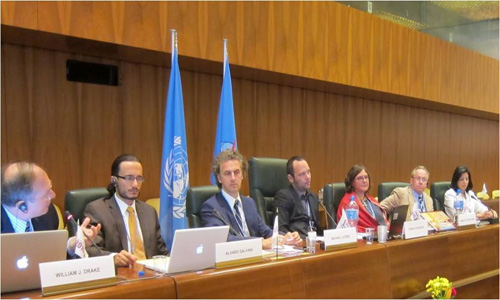
On 17 May 2011, the Media Change and Innovation Division hosted a workshop at the International Labor Organization, a United Nations body located in Geneva. Entitled, «Institutional Choice in Global Communications Governance,» it was held in the context of the WSIS Forum, an annual four-day conference convened to take stock of progress made in implementing the agreements reached during the 2002-2005 World Summit on the Information Society negotiations.
The workshop was organized and moderated by the division’s International Fellow, Dr. William J. Drake, and featured a panel of expert speakers that included the division’s Chair, Prof. Michael Latzer. Other speakers included representatives of global civil society, the Internet technical community, and the governments of Switzerland, Brazil, and Egypt. About sixty people attended the event in person, while others from around the world participated remotely via the Internet.
The purpose of the workshop was to promote dialogue between policy analysts and practitioners about the design and selection of global governance arrangements for information and communication technology (ICT). The contemporary global communi-cations order has been marked by a significant increase in the number and variety of these arrangements, which vary greatly in terms of the collective action problems they address and the institutional attributes they possess. This proliferation raises a number of challenging problems like, how do we evaluate the relative political feasibility and functional effectiveness of alternatives approaches in relation to specific global policy challenges? What are their respective strengths and weaknesses? How well do such mechanisms cohere into an effective global governance architecture? The workshop explored these and related questions in relation to current policy challenges concerning the global Internet in particular.
Find documentation on the workshop bellow:
MCI@UN-WSIS-Forum -
Am 12. und 13. Mai findet in Luzern erstmals das SwissMediaForum statt, das sich laut Ankündigung mit dem «fundamentalen Medienwandel» beschäftigt. Auf der Themenagenda des Forums steht auch die «gegenwärtig heisseste medienpolitische Streitsache» (Urs Meier im Medienheft), die Online-Strategie der SRG.
Die Verleger sehen in den SRG Online Auftritten einen «öffentlich alimentierten Verdrängungskampf gegen private Medien» und fordern u.a., dass der SRG die Werbung Online untersagt bleiben muss. Für die SRG plädiert Roger de Weck für eine «Partnerschaft mit privaten Medienhäusern», um sich wechselseitig auf dem Internet-Werbemarkt zu stärken und im internationalen Wettbewerb konkurrenzfähig zu bleiben.
In der aktuellen Debatte geht es jedoch um mehr als nur um die Frage ob und wie viel Online-Werbung der SRG in Zukunft erlaubt sein soll. Es geht auch um die Fragen inwieweit das aktuelle SRG Online-Angebot den bestehenden rechtlichen Vorgaben entspricht, welche Online-Angebote der SRG in Zukunft erlaubt sein sollen und ob Online überhaupt Teil des Service Public sein soll. «Online als Service Public? - SRG und Verleger im Clinch» lautet der Titel einer Session am SwissMediaForum in der Urs Saxer und Michael Latzer aktuelle Forschungsbefunde und Zukunftsszenarien diskutieren.
Literatur & Links zum Thema:
Saxer, Urs (2011): Möglichkeiten und Grenzen der Online-Angebote der SRG. Rechtsgutachten erstattet dem Verband Schweizer Medien. Zürich.
Just, Natascha / Latzer, Michael (2011): Medienpolitik durch Europäische Wettbewerbspolitik: Druck auf öffentlichen Rundfunk durch Beihilfenpolitik - Public-Value-Konzepte als Lösungsansatz. In: Gundlach, Hardy (Hg.): Public Value in der Digital- und Internetökonomie. Köln: Halem, 79-100. [pdf]
Latzer, Michael / Braendle, Andreas / Just, Natascha / Saurwein, Florian (2010): SRG-Online-Beobachtung 2010: Konzessionskonformität von Webseiten und elektronischen Verbindungen. Forschungsbericht im Auftrag des BAKOM – Bundesamt für Kommunikation. Zürich: IPMZ. [pdf]
Latzer, Michael / Braendle, Andreas / Just, Natascha / Saurwein, Florian (2010): SRG Online Beobachtung: Konzessionskonformität von Webseiten und elektronischen Verbindungen. In: medialex, 15(2), 77-83.
Latzer, Michael / Braendle, Andreas / Just, Natascha / Saurwein, Florian (2010): SRG Online Beobachtung: Konzessionskonformität von Webseiten und elektronischen Verbindungen. Zürich/Chur: Rüegger Verlag.
Latzer, Michael / Braendle, Andreas / Just, Natascha / Saurwein, Florian (2009): SRG Online Beobachtung: Konzessionskonformität von Webseiten und elektronischen Verbindungen. Forschungsbericht im Auftrag des BAKOM – Bundesamt für Kommunikation. Zürich: IPMZ.
-
SRG Online Beobachtung 2010: Bericht veröffentlicht
1st March 11
Die von der IPMZ-Abteilung Medienwandel & Innovation durchgeführte Studie "SRG Online Beobachtung 2010" wurde heute vom Auftraggeber Bakom veröffentlicht. Wie schon im Jahr 2009 wurde die Konzessionskonformität von Webseiten und elektronischen Verbindungen der Webauftritte von SF, DRS, TSR, RSR und RSI überprüft.
Die Internet-Auftritte der SRG sind weitgehend konzessionskonform gestaltet. Der Anteil unproblematischer Seiten umfasst über 90 Prozent. Für knapp jede zwölfte Webseite im SRG-Online Angebot konnte die Konzessionskonformität jedoch nicht abschliessend belegt werden. Der Umfang der Grauzone beträgt im SRG-Schnitt 8.4 Prozent und hat sich im Jahresvergleich unternehmensübergreifend nicht signifikant verändert.
Latzer, Michael / Braendle, Andreas / Just, Natascha / Saurwein, Florian (2010): SRG Online Beobachtung 2010. Konzessionskonformität von Webseiten und elektronischen Verbindungen. Forschungsprojekt im Auftrag des BAKOM – Bundesamt für Kommunikation. Zürich: IPMZ.
Mehr
-
SRG Online Beobachtung als Buch erschienen
6th December 10Die Studie «SRG Online Beobachtung» von Michael Latzer, Andreas Braendle, Natascha Just und Florian Saurwein ist als Buch im Rüegger Verlag erschienen.
Die im Auftrag des Bundesamts für Kommunikation (BAKOM) durchgeführte Studie untersucht die Konzessionskonformität des SRG-Online-Angebots, bietet einen Überblick über die Angebots- und Vernetzungsstruktur der SRG-Online-Auftritte und wurde für die Buchpublikation um regulatorische Perspektiven ergänzt. In der Studie stehen drei Fragen im Zentrum der Analyse:
- Können die einzelnen Teile des Online-Angebots einer der in Art. 13 Abs. 1 der Konzession SRG umschriebenen Kategorien zugeordnet werden?
- Welche Bereiche des Online-Angebots sind als kritisch im Sinne einer Grauzone zu betrachten? Gibt es Angebote, die weder direkt noch indirekt (thematische Verwandtschaft) mit den Programmen in Verbindung gebracht werden können?
- Enthält das Online-Angebot Links, die nicht nach publizistischen Kriterien zu begründen, sondern rein kommerziell zu beurteilen sind?
Die Studie untersucht entsprechend der Vorgaben des Auftraggebers die Online-Auftritte von Schweizer Fernsehen (SF) und Schweizer Radio DRS (DRS) aus der deutschsprachigen Schweiz, jene von Télévision Suisse Romande (TSR) und Radio Suisse Romande (RSR) aus der französischsprachi-gen Schweiz sowie den Auftritt von Radiotelevisione svizzera di lingua italiana (RSI) aus der italienischsprachigen Schweiz.- Mehr Infos auf der Projektseite
- SRG Online Beobachtung beim Rüegger Verlag
- Literaturverweis: Latzer, Michael / Braendle, Andreas / Just, Natascha / Saurwein, Florian (2010): SRG Online Beobachtung. Konzessionskonformität von Webseiten und elektronischen Verbindungen. Zürich/Chur: Rüegger Verlag.
For an english summary of this study see: Latzer, Michael / Braendle, Andreas / Just, Natascha / Saurwein, Florian (2010): Public-Service Broadcasting Online: Assessing Compliance with Regulatory Requirements. In: International Telecommunications Policy Review, 17(2), 1-25
-
New Course by Bill Drake! The Changing Global Communications Order: Governing Electronic Networks
23rd August 10
The Division on Media Change & Innovation is excited to offer this new and cutting edge course in the Autumn term. Since the 1850s, governments, business, and civil society have established "rules of the game" governing international communication markets and cross-border information flows. Collectively, these frameworks define the global communications order. In recent years that order has been transformed by privatization, liberalization, and the Internet. This course will survey the evolution, political-economic power dynamics, and social impact of the global governance arrangements for telecommunications regulation, technical standardization, radio frequency spectrum, satellites, trade in goods and communication services, electronic commerce, intellectual property, mass media, Internet content, Internet domain names and numbers, cybercrime and security, privacy protection, and development, as well as the broader debates in the United Nations’ World Summit on the Information Society and Internet Governance Forum.
The course will be taught by Dr. William Drake, who is a Senior Associate of the Centre for International Governance at the Graduate Institute of International and Development Studies in Geneva and a co-editor of the MIT Press book series, The Information Revolution and Global Politics. Drake is a leading international scholar of global communications policy, and has a diverse background. He has taught at Georgetown University and the University of California, San Diego in the USA; was a Senior Associate and Director of the Project on the Information Revolution and World Politics at the Carnegie Endowment for International Peace, an influential foreign policy think tank in Washington DC; and has served as the elected president of a global civil liberties organization, Computer Professionals for Social Responsibility.
Drake is heavily involved as a public interest activist in a number of key global governance processes examined inthis course, such as the ICANN (Internet Corporation for Assigned Names and Numbers), and the UN’s Internet Governance Forum. As such, in this course he will be presenting an “insider’s perspective” on the current geopolitics of governance, particularly with respect to the Internet. He has also been involved in a number of related global networks and initiatives, such as the Global Internet Governance Academic Network and the International Summer Schools on Internet Governance. You can read more about him at http://www.linkedin.com/in/williamjdrake and watch his brief remarks at the UN’s 2009 Internet Governance Forum in Sharm el Sheikh http://tinyurl.com/Drake-IGF09.
This course will be held biweekly on Mondays from 2 to 6pm. Course dates are:- September 20
- October 4
- October 18
- November 1
- November 15
- November 29
- December 13
Course language is English.
More
- Vorlesungsverzeichnis
- Bill Drake on LinkedIn
- Bill Drake’s Remarks at the UN’s 2009 Internet Governance Forum in Sharm el Sheikh
-
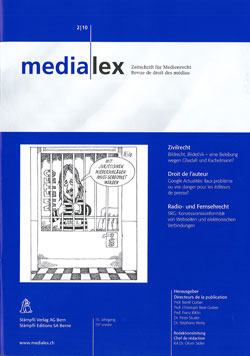
Further findings from the assessment of the Swiss public-service broadcaster’s (SRG) Internet offer have been published in the International Telecommunications Policy Review and in Medialex. Find more information in the publications section:
- Latzer, Michael / Braendle, Andreas / Just, Natascha / Saurwein, Florian (2010): Public-Service Broadcasting Online: Assessing Compliance with Regulatory Requirements. In: International Telecommunications Policy Review, 17(2), 1-25 [more]
- Latzer, Michael / Braendle, Andreas / Just, Natascha / Saurwein, Florian (2010): SRG Online Beobachtung: Konzessionskonformität von Webseiten und elektronischen Verbindungen. In: medialex, 15(2), 77-83 [more]
Further findings from the assessment of the Swiss public-service broadcaster’s (SRG) Internet offer have been published in the International Telecommunications Policy Review and in Medialex. Find more information in the publications section:
Latzer, Michael / Braendle, Andreas / Just, Natascha / Saurwein, Florian (2010): Public-Service Broadcasting Online: Assessing Compliance with Regulatory Requirements. In: International Telecommunications Policy Review, 17(2), 1-25 [more]
Latzer, Michael / Braendle, Andreas / Just, Natascha / Saurwein, Florian (2010): SRG Online Beobachtung: Konzessionskonformität von Webseiten und elektronischen Verbindungen. In: medialex, 15(2), 77-83 [more]
-
The Division on Media Change & Innovation of the IPMZ continues the monitoring and assessment of the SRG Internet offer in 2010. The project SRG Online Assessment 2010 is commissioned by the Swiss regulator BAKOM as part of its Media Research 2010 special focus on the continuous program analysis of television, radio and online offers of the SRG. The study’s focus is–in replication of its 2009 analysis–on the extent of compliance of the SRG online services with the regulatory requirements of the charter (e.g., relation of online offers to broadcasts, no commercial links). It builds on a methodological approach, which has been developed and applied for the SRG Online Assessment 2009 and conducts a content analysis to give insights into the structure and functioning of the websites of five SRG enterprise units, and a link analysis to capture the intensity of electronic linking and the pattern of interconnection with other websites. The replication of the analysis will show first trends of development and change.
For more information see the project website. Results will be available by the end of 2010.
-

The research report on the utilization of the Digital Dividend in Austria, conducted by Michael Latzer together with Arne Boernsen (AB Consulting), Tim Braulke (Infront Consulting & Management) and Joern Kruse (Helmut-Schmidt University, Hamburg), has been published by the Austrian regulator RTR. The responsible Austrian minister has already announced that she will follow the study’s recommendations and award the available spectrum for broadband mobile communication.
The Digital Dividend, a product of digitalisation and convergence in the communications sector, denotes those frequencies that are freed up as a result of the switchover from analogue TV to more spectrally efficient digital TV. The digital dividend spectrum is suitable for a wide range of potential uses. The political decision how this valuable freed up spectrum is used for mobile communication (e.g. broadband internet) and/or for broadcasting (e.g. HDTV) is heavily debated worldwide.More:
-
The Division on Media Change & Innovation participates as country expert in a study that analyzes the independence and efficiency of European regulatory authorities for audiovisual media. The study was contracted by the European Commission to an international research consortium under the direction of the Hans-Bredow-Institut für Medienforschung. Further consortium partners are: Katholieke Universiteit Leuven, Central European University, Cullen International, and Perspective Associates.
A network of country experts cooperates with the consortium and provides the data from 43 countries covered by the study (EU member states, candidate and potential candidate countries to the EU, EFTA countries as well as selected other countries).
The overall aim of the study is the development of indicators that allow the measurement of independence of regulatory bodies in the field of audiovisual media as well as the assessment of these bodies’ functioning to ensure an effective application of the AVMS Directive.
The Division on Media Change & Innovation of the IPMZ contributes to the study with the analyses of independent regulatory authorities in Switzerland and Austria.Find more information on the Project Page
-
Convergence Revisited - New Paper by Michael Latzer in Convergence
28th November 09Convergence - The International Journal of Research into New Media Technologies - features a new article by Michael Latzer. It revisits the nature and governance implications of the convergence phenomenon more than a decade after it gained major prominence.
 Latzer, Michael (2009): Convergence Revisited: Toward a Modified Pattern of Communications Governance, In: Convergence – The International Journal of Research into New Media Technologies, 15 (4), 411-426
Abstract: This paper revisits the nature and governance implications of the convergence phenomenon more than a decade after it gained major prominence in politics and research. It analyses the reforms undertaken in reaction to convergence, outlines their common features, and argues that a worldwide trend towards a modified common governance pattern for convergent communications markets is emerging. The major constituent components include integrated strategies, control structures and legal frameworks for the convergent communications sector; a technology-neutral functional taxonomy; a subdivision into transmission and content regulation; and a growing reliance on alternative modes of regulation such as self- and coregulation.More