

News
-
SRG Online Beobachtung als Buch erschienen
6th December 10Die Studie «SRG Online Beobachtung» von Michael Latzer, Andreas Braendle, Natascha Just und Florian Saurwein ist als Buch im Rüegger Verlag erschienen.
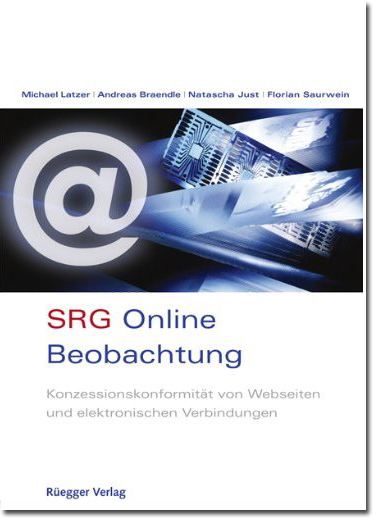
Die im Auftrag des Bundesamts für Kommunikation (BAKOM) durchgeführte Studie untersucht die Konzessionskonformität des SRG-Online-Angebots, bietet einen Überblick über die Angebots- und Vernetzungsstruktur der SRG-Online-Auftritte und wurde für die Buchpublikation um regulatorische Perspektiven ergänzt. In der Studie stehen drei Fragen im Zentrum der Analyse:
- Können die einzelnen Teile des Online-Angebots einer der in Art. 13 Abs. 1 der Konzession SRG umschriebenen Kategorien zugeordnet werden?
- Welche Bereiche des Online-Angebots sind als kritisch im Sinne einer Grauzone zu betrachten? Gibt es Angebote, die weder direkt noch indirekt (thematische Verwandtschaft) mit den Programmen in Verbindung gebracht werden können?
- Enthält das Online-Angebot Links, die nicht nach publizistischen Kriterien zu begründen, sondern rein kommerziell zu beurteilen sind?
Die Studie untersucht entsprechend der Vorgaben des Auftraggebers die Online-Auftritte von Schweizer Fernsehen (SF) und Schweizer Radio DRS (DRS) aus der deutschsprachigen Schweiz, jene von Télévision Suisse Romande (TSR) und Radio Suisse Romande (RSR) aus der französischsprachi-gen Schweiz sowie den Auftritt von Radiotelevisione svizzera di lingua italiana (RSI) aus der italienischsprachigen Schweiz.- Mehr Infos auf der Projektseite
- SRG Online Beobachtung beim Rüegger Verlag
- Literaturverweis: Latzer, Michael / Braendle, Andreas / Just, Natascha / Saurwein, Florian (2010): SRG Online Beobachtung. Konzessionskonformität von Webseiten und elektronischen Verbindungen. Zürich/Chur: Rüegger Verlag.
For an english summary of this study see: Latzer, Michael / Braendle, Andreas / Just, Natascha / Saurwein, Florian (2010): Public-Service Broadcasting Online: Assessing Compliance with Regulatory Requirements. In: International Telecommunications Policy Review, 17(2), 1-25
-

Results of ongoing research of the IPMZ’s Division on Media Change & Innovation will be presented at international conferences during the next two weeks.
- On June 22, Michael Latzer and Florian Saurwein will contribute to the 19th Annual Conference of the Asian Media Information and Communication Centre (AMIC) in Singapore with a paper on ‘Regulatory Choice in Communications: The Case of Content-Rating Schemes in the Audiovisual Industry’.
- Results of the monitoring and assessment of the Swiss public broadcaster’s (SRG) Internet offer will be presented to the participants of the 60th Annual Conference of the International Communication Association (ICA) in Singapore, June 22-26. The conference is entitled ‘Matters of Communication: Political, Cultural, Technological Challenges’. Michael Latzer, Natascha Just, Florian Saurwein and Andreas Braendle will contribute to a Communication Law & Policy panel with the paper ‘Public Service Broadcasting Online: Assessing Compliance with Regulatory Requirements’.
- From June 27-30 Media Change & Innovation will also take part in the 18th Biennial Conference of the International Telecommunications Society (ITS) in Tokyo at Waseda University and presents results from its study SRG Online Observation. The conference titled “Culture, Communication and the Cutting Edge of Technology” will be held in Association with the 27th Annual Conference of the Japan Society of Information and Communication Research (JSICR).
-

The research report on the utilization of the Digital Dividend in Austria, conducted by Michael Latzer together with Arne Boernsen (AB Consulting), Tim Braulke (Infront Consulting & Management) and Joern Kruse (Helmut-Schmidt University, Hamburg), has been published by the Austrian regulator RTR. The responsible Austrian minister has already announced that she will follow the study’s recommendations and award the available spectrum for broadband mobile communication.
The Digital Dividend, a product of digitalisation and convergence in the communications sector, denotes those frequencies that are freed up as a result of the switchover from analogue TV to more spectrally efficient digital TV. The digital dividend spectrum is suitable for a wide range of potential uses. The political decision how this valuable freed up spectrum is used for mobile communication (e.g. broadband internet) and/or for broadcasting (e.g. HDTV) is heavily debated worldwide.More:
-
Programm der öffentlichen Vortragsreihe steht fest
22nd January 10In diesem Frühlingssemester gibt es für Studierende am IPMZ – im Rahmen der Vorlesung „Digitale Destabilisierung: Medienwandel durch Konvergenz“ – die einmalige Gelegenheit, eine Reihe renommierter Gastredner aus den USA, Grossbritannien, Deutschland und der Schweiz zu treffen. Diskutieren Sie mit jenen Experten aus Wirtschaft und Politik, die die Veränderungen im Kommunikationssektor wesentlich mitprägen sowie mit Wissenschaftern, die diese analysieren.
Die öffentliche Vortragsreihe des IPMZ wird von der Abteilung Medienwandel & Innovation veranstaltet und ist in die wöchentlich stattfindende Vorlesung von Prof. Michael Latzer, Dr. Natascha Just und lic. phil. Andreas Braendle integriert. Sie ist für Bachelor und Lizstudierende als Wahlpflichtvorlesung und als Wahlvorlesung anrechenbar, steht aber auch anderen Studierenden und Interessierten offen.
Folgende Gastredner besuchen das IPMZ:

Christoph Neuberger ist Professor am Institut für Kommunikationswissenschaft der Universität Münster und ein renommierter deutscher Journalismus- und Internetforscher. Seine Präsentation trägt den Titel: "Niedergang oder Neustart des Journalismus? Das Internet und seine Folgen" (23. März).

Martin Radelfinger leitet das Business Development bei Goldbach Media, dem grössten Vermarkter für elektronische und Online-Medien in der Schweiz. Er skizziert seine Sicht der Destabilisierung des Werbemarktes durch Medienkonvergenz und das Internet (13. April). 
Felix Graf ist COO bei Teleclub AG und war als Leiter Entertainment & Multimedia bei Swisscom massgeblich für den Aufbau von Bluewin TV (IPTV) zuständig. Er trägt zum Thema Destabilisierung der Telekommunikation und Medienindustrie vor (20. April). 
Hans-Jürg Fehr, Schweizer Nationalrat, Medienpolitiker und vormaliger Präsident der SP Schweiz, spricht über den politischen Handlungsbedarf (4. Mai). 
William H. Dutton ist Professor an der Oxford University (GB) und Leiter des Oxford Internet Institutes. Er präsentiert seine Forschung zum Internet und der Entstehung einer fünften Gewalt (11. Mai).

Johannes M. Bauer ist Professor am Institute of Telecommunications, Information Studies and Media der Michigan State University (USA). Er vergleicht Netzneutralität und Internetentwicklung in den USA und Europa (18. Mai).
Veranstaltungsort: Uni Hauptgebäude, Rämistr. 71, KOL-F-117
Termin: jeweils Dienstags um 18:15 Uhr. (Link Vorlesungsverzeichnis UZH)
Mehr
-
Convergence Revisited - New Paper by Michael Latzer in Convergence
28th November 09Convergence - The International Journal of Research into New Media Technologies - features a new article by Michael Latzer. It revisits the nature and governance implications of the convergence phenomenon more than a decade after it gained major prominence.
 Latzer, Michael (2009): Convergence Revisited: Toward a Modified Pattern of Communications Governance, In: Convergence – The International Journal of Research into New Media Technologies, 15 (4), 411-426
Abstract: This paper revisits the nature and governance implications of the convergence phenomenon more than a decade after it gained major prominence in politics and research. It analyses the reforms undertaken in reaction to convergence, outlines their common features, and argues that a worldwide trend towards a modified common governance pattern for convergent communications markets is emerging. The major constituent components include integrated strategies, control structures and legal frameworks for the convergent communications sector; a technology-neutral functional taxonomy; a subdivision into transmission and content regulation; and a growing reliance on alternative modes of regulation such as self- and coregulation.More